Как появилась идея
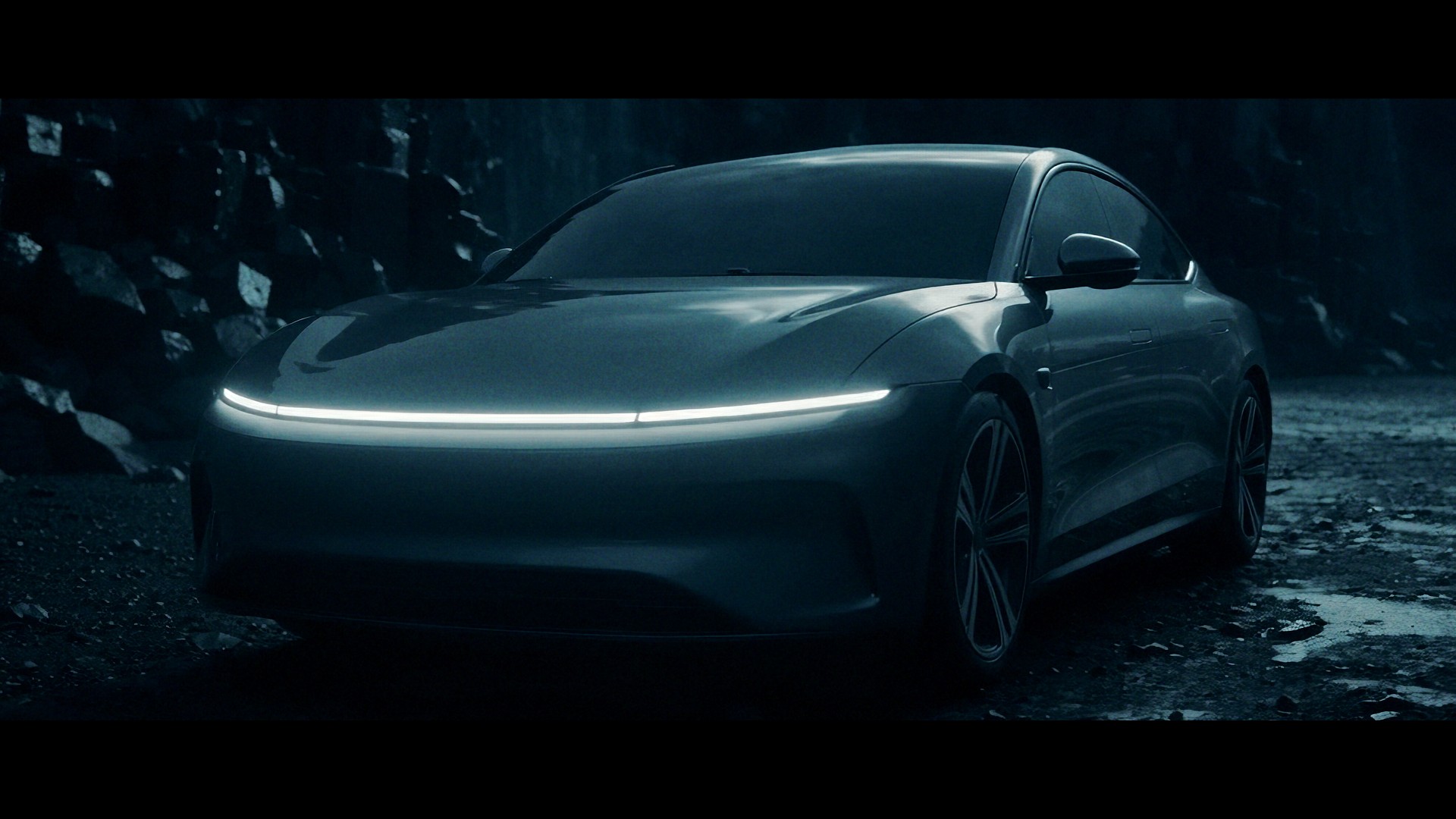
Отправной точкой для моего проекта стал CGI-ролик «Porsche Taycan — Electricity» от Bipolar Studio, в котором студия представила, как мог бы выглядеть Porsche Taycan, если бы он был рождён самой природой — точнее, ударом молнии.
Меня заинтересовала идея воссоздать подобную концепцию, но уже с помощью инструментов искусственного интеллекта. При этом я не стремился к точному повторению оригинала. Скорее, мне хотелось вдохновиться его визуальным подходом, переосмыслить отдельные решения и создать собственную интерпретацию.
В итоге получился ролик, который сохраняет связь с первоисточником, но отличается от него как визуально, так и по исполнению.
Porsche Taycan «Electricity»
Покадровый разбор референсов
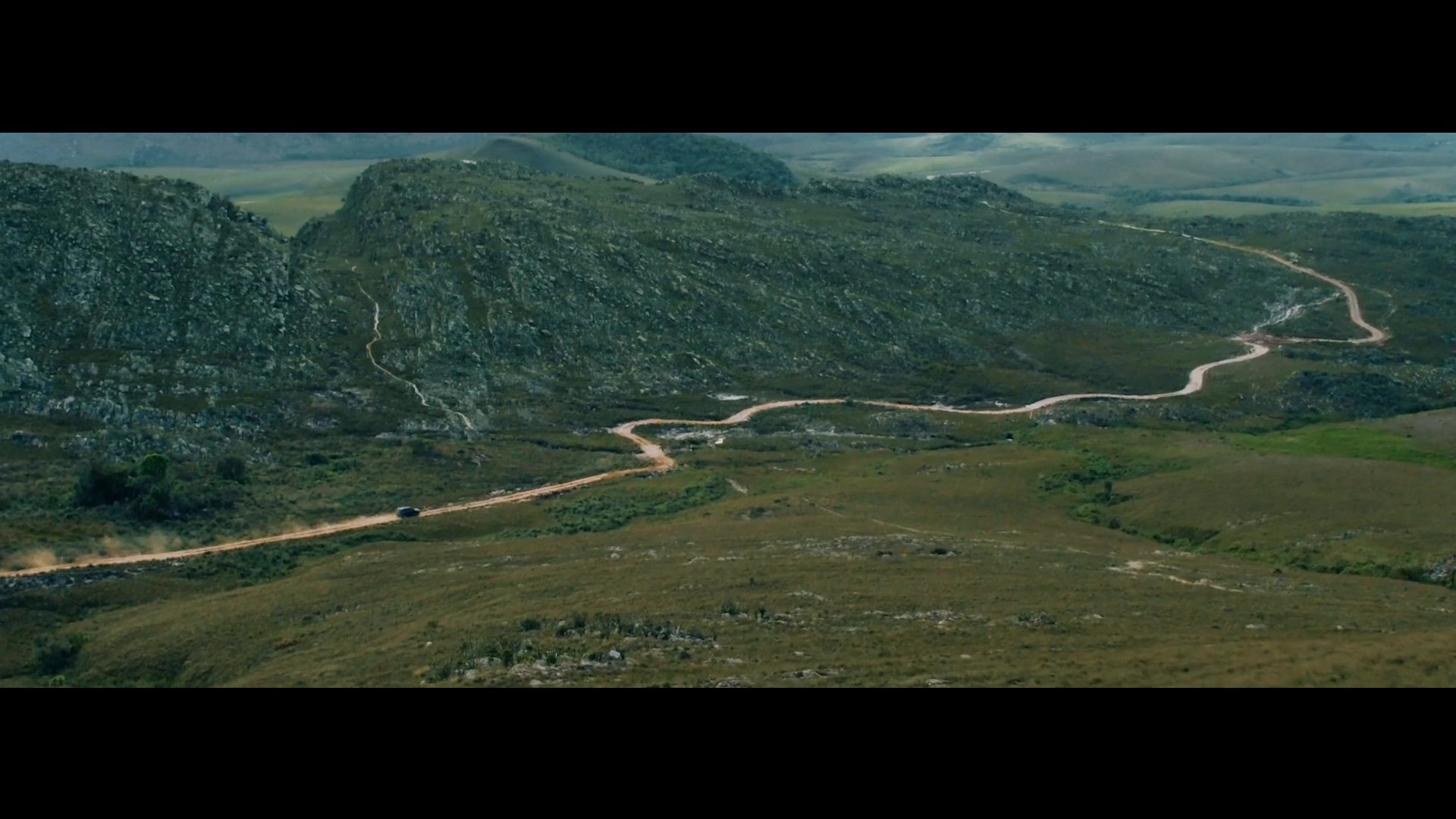
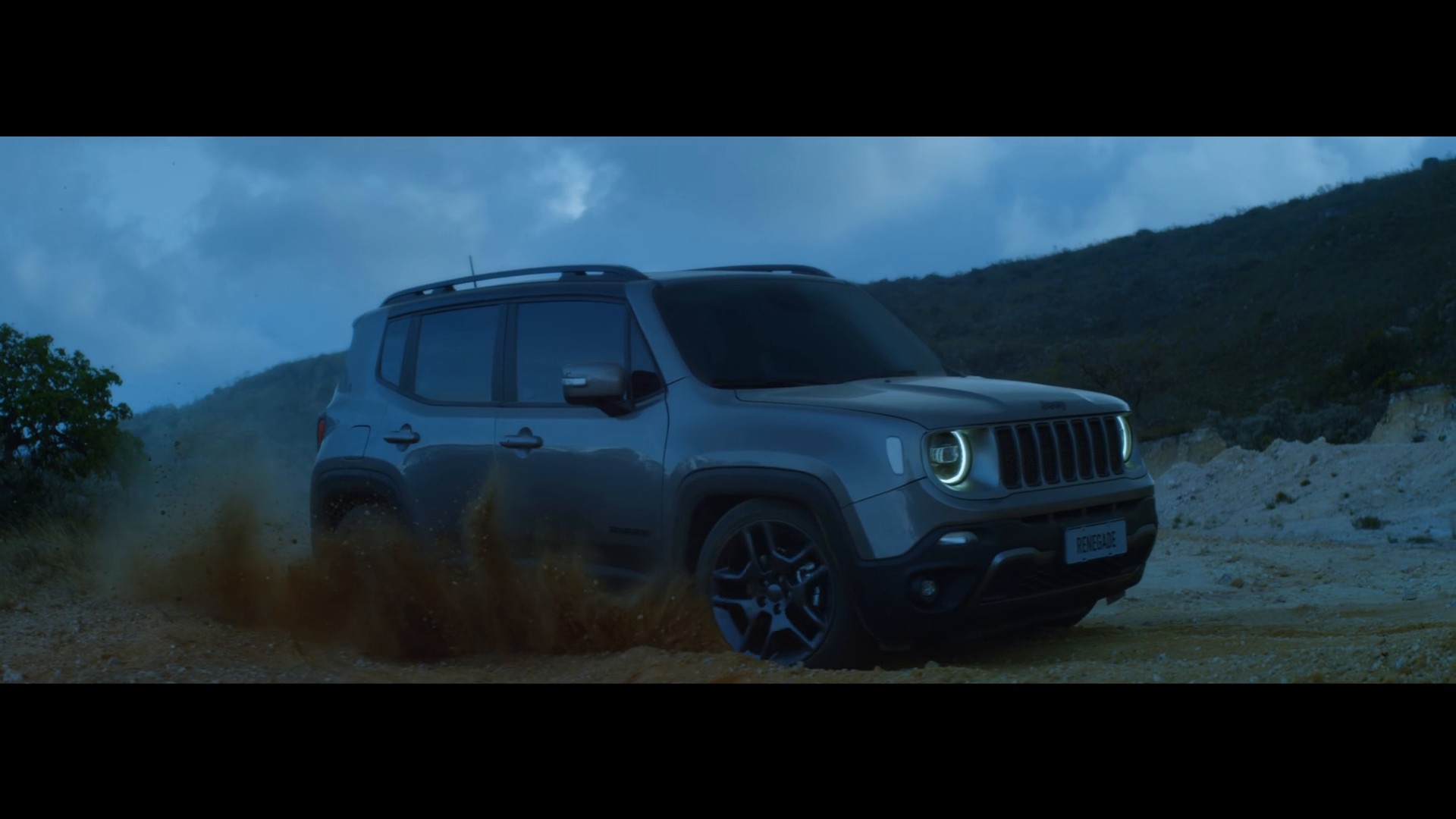
Разбирал каждый референс с частотой 8 кадров в секунду, перенося в промпт детали операторской работы: движение камеры, положение фокуса, развитие электрических разрядов, хроматические аберрации и блики. Световую схему и цветокоррекцию ориентировал на оригинальный ролик Porsche: молнии как источник света, холодный контровой и животные, читающиеся преимущественно силуэтами.
Jeep «Instinto»
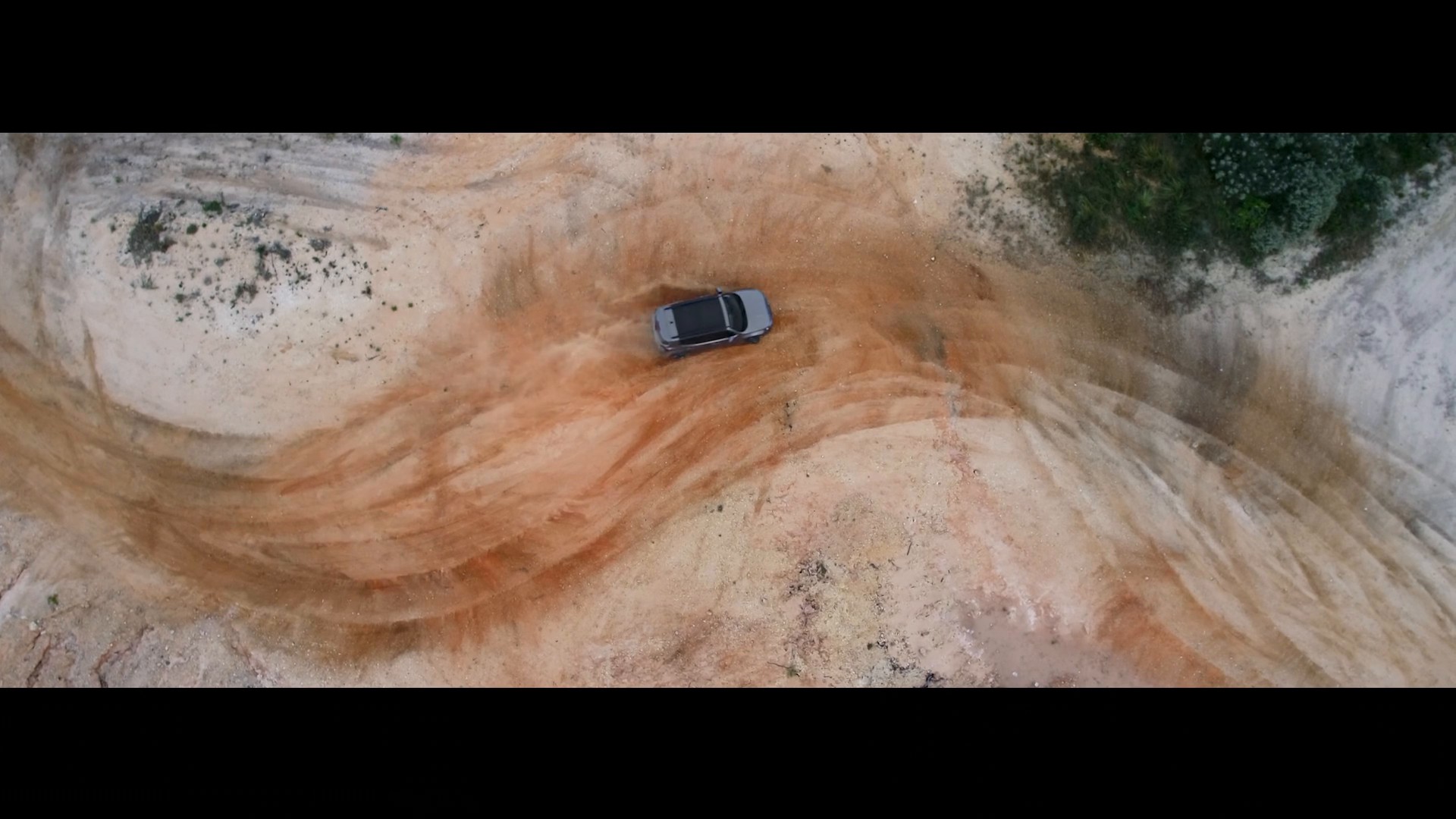
Инструменты и сервисы
- ПромптыClaude (кастомные скиллы)
- Листы персонажей и локацийSeedream 5.0 Pro
- Генерация видеоSeedance 2.5
- Апскейл видеоTopaz AI
- Апскейл изображенийFlux2 (ComfyUI)
- МонтажAdobe Premiere Pro, Adobe After Effects
- ЦветокоррекцияDaVinci Resolve
- МузыкаSuno AI v6
- Закадровый голосElevenLabs v4
- Саунд-дизайн, сведение, мастерингAvid Pro Tools Ultimate
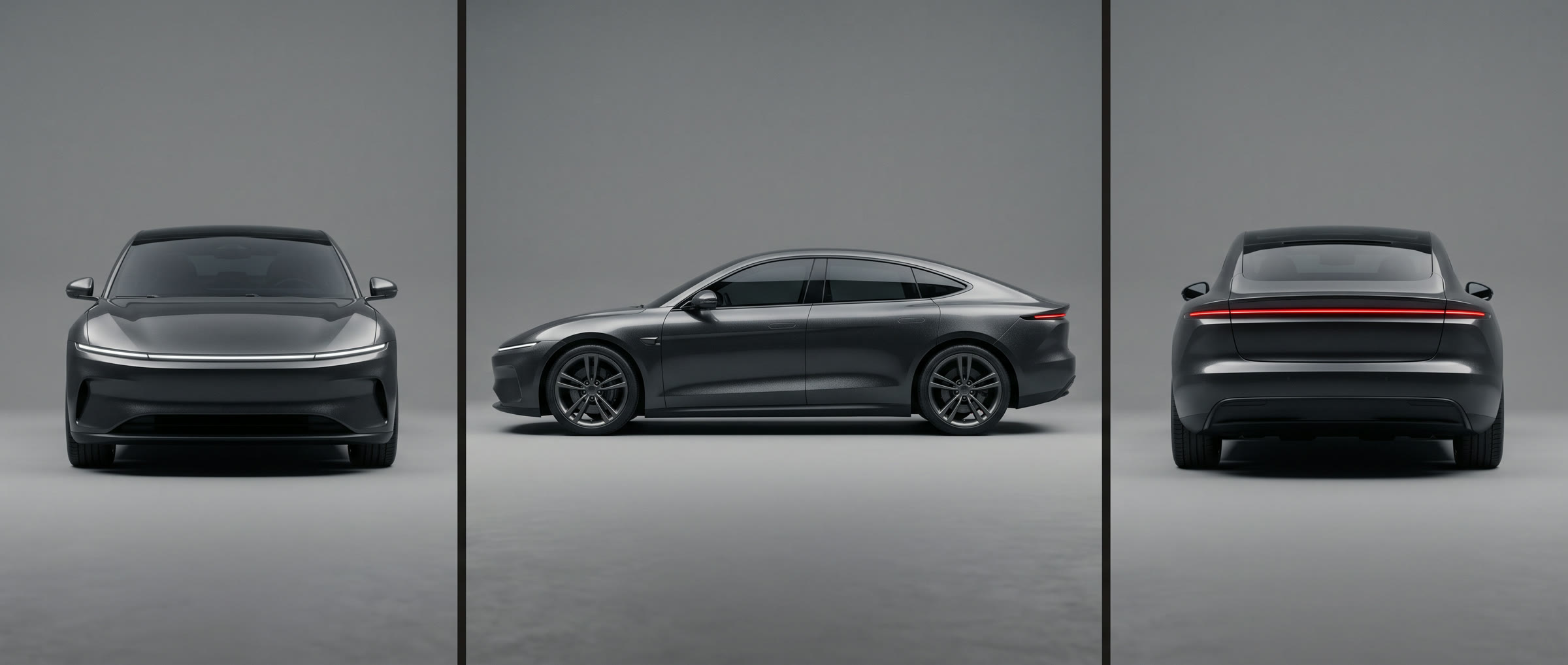
Машина
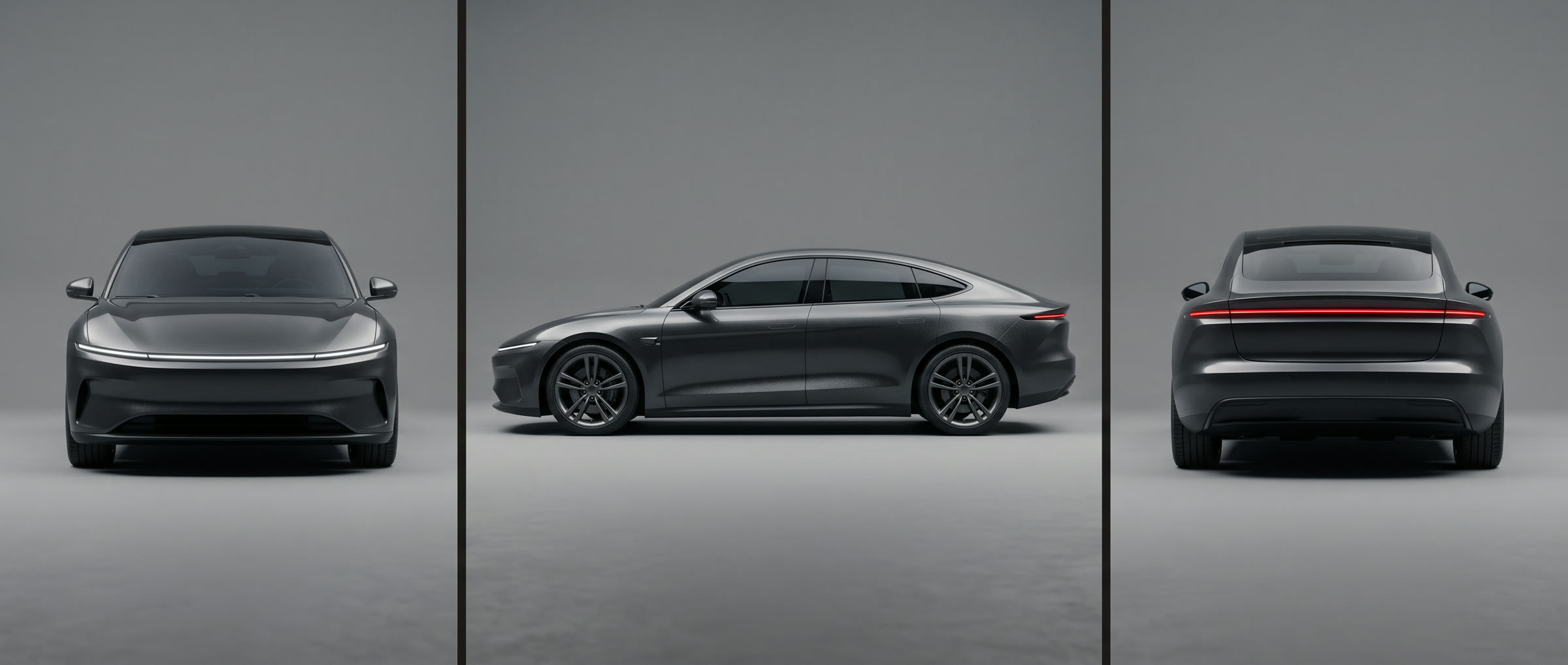
SCENE — ENVIRONMENT: Controlled automotive product-reference studio with a seamless uniform mid-grey backdrop, neutral around 18% grey, identical across all three panels; no gradient bands, texture, horizon line, visible backdrop edge or set dressing. The floor is neutral matte grey with only restrained physically plausible contact reflections beneath the tires. ERA: Contemporary near-future premium electric grand-tourer product photography. TIME OF DAY: Timeless controlled studio environment. ATMOSPHERE: Clean neutral studio air with no haze, smoke, dust or atmospheric effects. PHYSICAL DETAILS: Minimal surroundings isolate the vehicle and make silhouette, surfacing, paint, glazing, wheels, lighting signatures and body proportions completely readable.

SUBJECT — IDENTITY: ORAGE, a premium electric four-door grand-tourer and the advertised product, presented as the exact same vehicle in all three panels. APPEARANCE: Low, wide four-door electric grand-tourer approximately 5 meters long with a fastback body, short front and rear overhangs, long wheelbase and a long shallow roofline flowing continuously toward the tail. Broad muscular rear fenders create planted rear haunches without exaggerated vents or ornamental sculpting. Frameless side glass, flush door handles and one single crisp shoulder line extending continuously along the entire side of the vehicle. Exterior paint is deep graphite metallic containing a very fine restrained silver metallic sparkle, visible only where studio light catches the surface. Side windows are dark tinted. Panoramic glass roof is almost black and integrates smoothly into the upper greenhouse. Front end is completely smooth and closed with no conventional grille. A single extremely thin continuous WHITE light strip runs across the full width of the front. Rear carries a single extremely thin continuous RED light strip across the full width. Wheels are 21 inches with exactly five paired spokes, finished in dark titanium, fitted with low-profile road tires. No badges, logos, model names, lettering or branding anywhere on the body, wheels, glass or lights. FACIAL EXPRESSION: Not applicable; front graphic should communicate controlled premium performance through horizontal width, low stance and minimal detailing rather than aggressive decorative features. SKIN TEXTURE: Not applicable; exterior surface realism comes from physically accurate automotive paint with clearcoat depth, fine metallic flake, subtle orange-peel microtexture and realistic reflections. HAIR: Not applicable. KEY FEATURES: Low four-door fastback electric GT; approximately 5 meters long; short overhangs; long shallow roofline; wide rear fenders; frameless glass; flush handles; one continuous shoulder line; graphite metallic paint with fine silver sparkle; dark tinted glass; nearly black panoramic roof; grille-less smooth nose; one thin full-width white front light strip; one thin full-width red rear light strip; 21-inch five-paired-spoke dark-titanium wheels; low-profile tires; absolutely no badges, logos or text.

POSE — STANCE: Vehicle stationary on a level studio floor with suspension at natural road height, wheels straight and body settled evenly. HANDS: Not applicable. HEAD POSITION: Not applicable; vehicle orientation is controlled independently for each reference panel. BODY TENSION: Low planted grand-tourer stance with visual mass concentrated between the axles and over the broad rear haunches. MOVEMENT: Completely stationary product reference, no wheel rotation, motion blur, speed effects or artificial aerodynamic effects.

WARDROBE — STYLE: Not applicable; exterior finish is the product surface. DETAILS: Graphite metallic paint must remain identical across every panel, with subtle fine silver flake rather than coarse glitter. Panoramic roof nearly black; glazing dark tinted; trim restrained dark metallic or black. No chrome decoration unless required by functional glass boundaries. No decals, badges, emblems, lettering or license-plate text.

PRODUCTION DESIGN — ARCHITECTURE: No visible architecture; seamless uniform mid-grey studio backdrop. PROPS: None. VEHICLES: Only ORAGE; no secondary vehicles. DETAILS: Clean automotive reference environment. Studio illumination originates entirely outside the visible frame. Strictly no lighting equipment in frame: no softbox, light stand, umbrella, reflector, C-stand, flag, cable, clamp, tripod, backdrop edge or studio hardware. No license plate text, labels, arrows, measurements or readable text.

LIGHTING — SOURCE TYPE: Controlled automotive studio illumination from outside frame, using broad soft overhead and side sources designed to trace body surfacing. KEY LIGHT: Large soft front-top source creates long controlled highlights across hood, shoulder line, roof and rear haunches, revealing the graphite metallic paint and fine silver sparkle without clipping. FILL LIGHT: Broad neutral side fill preserves wheel, rocker-panel and lower-body detail while maintaining sculptural volume. BACK LIGHT: Restrained edge separation along roofline, rear shoulders and glass boundaries. CONTRAST RATIO: Approximately 3:1, premium automotive product contrast with detailed dark surfaces and protected light signatures. COLOR TEMPERATURE: Neutral approximately 5200K, with front light strip clean white and rear strip controlled deep red. SHADOW BEHAVIOR: Soft grounded tire shadows, smooth reflection transitions across paint and glazing, no hard uncontrolled hotspots.

COMPOSITION — SHOT SIZE: Three-panel automotive model sheet: strict frontal full-vehicle view, strict true lateral side-profile full-vehicle view, and strict rear full-vehicle view. FRAMING: Three equal vertical panels arranged left to right with thin dark divider lines. Entire vehicle remains visible in every panel without cropping bodywork, mirrors, wheels or light signatures. CAMERA ANGLE: Neutral automotive reference height, approximately at upper-wheel / lower-window level, avoiding dramatic high or low perspective. DEPTH LAYERS: Foreground: vehicle and tire contact area; midground: immediate neutral studio floor; background: seamless mid-grey field. FOCUS PRIORITY: Complete vehicle geometry, silhouette, roofline, shoulder line, front and rear lighting signatures, flush handles, glazing, wheels and paint finish. VISUAL BALANCE: Formal technical product-reference balance with consistent vehicle scale and optical treatment across all three panels.

CAMERA — MANDATORY CAMERA STRING: Shot on ARRI Alexa 35 with a Cooke Anamorphic/i 40mm lens. Shallow depth of field, soft oval anamorphic bokeh, and characteristic edge distortion. Kodak Vision / 2383 lut film color emulation — soft contrast, high film grain. FOCAL LENGTH: 40 mm. CAMERA MOVEMENT: Locked-off. EXPOSURE: Exposed for graphite metallic bodywork and illuminated light strips simultaneously; metallic highlights controlled, dark glass retains subtle surface information, white front strip and red rear strip never clip. FORMAT: Digital cinema capture with anamorphic optical character.

LENS BEHAVIOR — DISTORTION TYPE: strong vintage anamorphic edge warping and subtle curved frame deformation. BOKEH STYLE: large soft oval anamorphic bokeh with stretched cinematic light smearing. OPTICAL CHARACTER: visible lens breathing, strong halation, edge softness, organic film grain, realistic cinematic imperfections, and subtle image instability.

COLOR GRADING — PALETTE: Graphite metallic body with fine silver sparkle, nearly black panoramic glass, dark tinted windows, dark-titanium wheels, neutral grey studio surroundings, pure restrained white front lighting and deep controlled red rear lighting. CONTRAST: Soft cinematic contrast with compressed highlights and open detailed shadows, preserving dark automotive materials. HIGHLIGHT ROLLOFF: Smooth filmic rolloff across clearcoat reflections, glass, metallic flake and illuminated strips. FILM EMULATION: Kodak Vision / 2383 LUT-inspired color response with organic grain and restrained saturation.

VISUAL STYLE — MOOD: ultra cinematic workstation concentration. IMAGE CHARACTERISTICS: organic film grain, strong anamorphic halation, vintage optical softness, realistic cinematic deformation, stretched highlights, curved edge distortion, and visible filmic image instability.

ATMOSPHERE — ENVIRONMENTAL DEPTH: Minimal studio depth with crisp vehicle separation against neutral grey. AIR QUALITY: Clean controlled air without visible particulate. MOTION: Vehicle and environment completely still. EMOTIONAL TONE: Sophisticated, restrained, technological and premium; ORAGE reads as a believable production-ready flagship electric grand-tourer rather than a fantasy concept car.

TECHNICAL QUALITY — REALISM: live-action cinema realism. DETAIL LEVEL: Extremely detailed physically authentic automotive materials: graphite metallic paint with microscopic silver flake under clearcoat, realistic panel gaps, frameless glazing, flush handles, black panoramic roof, rubber seals, low-profile tire sidewalls, tread detail, dark-titanium wheel surfaces and realistic lamp optics. Body panels must maintain coherent manufacturing geometry and identical design between panels. DYNAMIC RANGE: Wide cinematic dynamic range with preserved highlights and detailed shadows. IMAGE INTEGRITY: Physically plausible automotive construction, consistent wheelbase and body proportions, realistic reflections, coherent scale, authentic paint, glass, rubber and metal materials, exact vehicle continuity across every panel.

SHEET — LAYOUT: One single image containing three equal vertical panels side by side from left to right, separated only by thin dark divider lines. Seamless uniform mid-grey studio backdrop identical in every panel. Same ORAGE vehicle, same body geometry, same paint, same wheels, same glass, same lighting signatures, same ride height and same scale throughout.

PANEL LEFT: Full-vehicle STRICT FRONTAL view of ORAGE. Camera positioned exactly on the longitudinal centerline of the car with zero horizontal angle. Entire vehicle visible from roof to tire contact patches and from outer mirror to outer mirror. Show a low, broad planted stance and completely smooth CLOSED ELECTRIC NOSE WITH NO GRILLE. A single extremely thin continuous WHITE illuminated strip runs horizontally across the entire width of the front, uninterrupted and visually precise. Front surfacing is minimal and aerodynamic, without decorative fake intakes or grille texture. Dark windshield and nearly black panoramic roof remain integrated into the upper silhouette. Both 21-inch front wheels are symmetrically positioned. No badge, emblem, lettering, logo or readable license plate.

PANEL CENTER: Full-vehicle STRICT TRUE SIDE-PROFILE view of the exact same ORAGE, shown perfectly from the side from front bumper to rear bumper and roof to tire contact patches. Camera axis exactly perpendicular at 90 degrees to the vehicle's longitudinal axis. TRUE LATERAL PROFILE ONLY: not front three-quarter, not rear three-quarter and not diagonal. Clearly show the approximately 5-meter-long proportions, very low four-door grand-tourer body, short front and rear overhangs, long wheelbase and continuous shallow fastback roofline flowing smoothly from windshield header toward the tail. The broad rear fender must create a strong muscular haunch without disrupting the clean silhouette. Show four doors with frameless dark-tinted glass and FLUSH door handles. Exactly ONE clean shoulder line runs continuously along the side; avoid multiple decorative creases. Panoramic roof is nearly black. Both visible wheels are 21 inches with EXACTLY FIVE PAIRED SPOKES each, dark titanium finish and low-profile tires. Wheel design must be identical front and rear. Graphite metallic paint carries subtle fine silver sparkle. No badges, logos, lettering, charging labels or decorative text.

PANEL RIGHT: Full-vehicle STRICT REAR view of the exact same ORAGE. Camera positioned exactly on the longitudinal centerline with zero horizontal angle. Entire vehicle visible. Rear emphasizes broad muscular fenders and low fastback tail. A single extremely thin continuous RED illuminated strip runs across the entire width of the rear, uninterrupted from side to side. Rear surfacing remains clean, smooth and premium with no fake exhaust outlets, no combustion exhaust pipes and no excessive vents. Fastback glass and nearly black panoramic roof flow naturally into the rear silhouette. Rear wheels maintain the same 21-inch five-paired-spoke dark-titanium design. No badge, emblem, model name, manufacturer name, logo, lettering or readable license plate.

CONSISTENCY: Exactly the same vehicle in all three panels: same approximately 5-meter length, same low four-door fastback proportions, same short overhangs, same long shallow roofline, same broad rear fenders, same frameless glazing, same flush handles, same single shoulder line, same graphite metallic paint with fine silver sparkle, same dark tinted glass, same nearly black panoramic roof, same smooth grille-less front, same thin white front light strip, same thin red rear light strip, same 21-inch five-paired-spoke dark-titanium wheels, same low-profile tires and same ride height. Absolutely no badges, logos or text anywhere.

NEGATIVE PROMPT — STYLE REJECTIONS: anime, 3D render, illustration, digital art, cartoon style, painterly style, CGI look, video game render, concept-art look. QUALITY REJECTIONS: low resolution, plastic materials, artificial lighting artifacts, amateur automotive photography, non-cinematic composition, excessive HDR, oversaturated colors, sterile digital sharpness, blown light strips, crushed bodywork. ARTIFACT REJECTIONS: text overlays, logos, watermarks, readable signage, manufacturer badges, model badges, emblems, lettering, license plate text, malformed vehicle geometry, mismatched body panels between views, different car design between panels, inconsistent wheelbase, extra doors, two-door coupe, SUV proportions, crossover proportions, tall roof, short wheelbase, long overhangs, conventional sedan trunk, station wagon body, conventional grille, fake grille, grille texture, oversized air intakes, combustion exhaust pipes, fake exhaust outlets, multiple shoulder lines, protruding door handles, framed side windows, bright chrome trim, clear untinted windows, body-colored roof, incorrect paint color, coarse glitter paint, mismatched wheels, different front and rear wheels, incorrect spoke count, five single spokes, six spokes, multi-spoke turbine wheels, small wheels, high-profile tires, front light clusters replacing the single strip, broken front light strip, multiple front light strips, rear lamps replacing the single strip, broken rear light strip, multiple rear light strips. CENTER PANEL REJECTIONS: front three-quarter, rear three-quarter, diagonal vehicle angle, foreshortened car, wheels turned, perspective shortening; center panel must be a strict 90-degree true lateral profile. LEFT PANEL REJECTIONS: three-quarter front view, asymmetric front angle. RIGHT PANEL REJECTIONS: rear three-quarter view, asymmetric rear angle. STUDIO REJECTIONS: people, other vehicles, props, different lighting between panels, softbox, light stand, umbrella, reflector, tripod, backdrop edge, floor seam, gradient backdrop, visible studio equipment.
photorealistic, ultra high detail textures, physically accurate materials, realistic specular highlights, global illumination, soft indirect lighting, natural light falloff, balanced exposure, dynamic range preserved (no clipped highlights or crushed shadows), color-accurate white balance, subtle tonal transitions, lifelike color reproduction
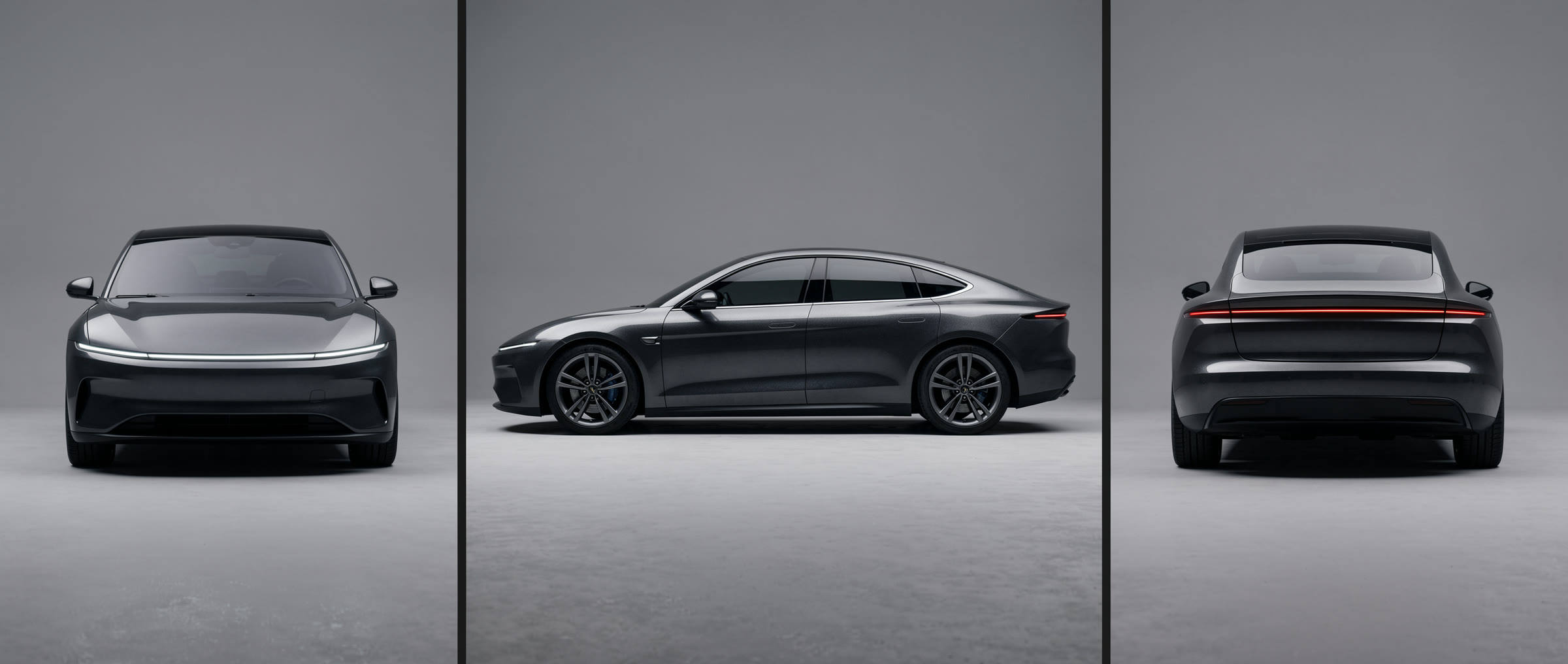
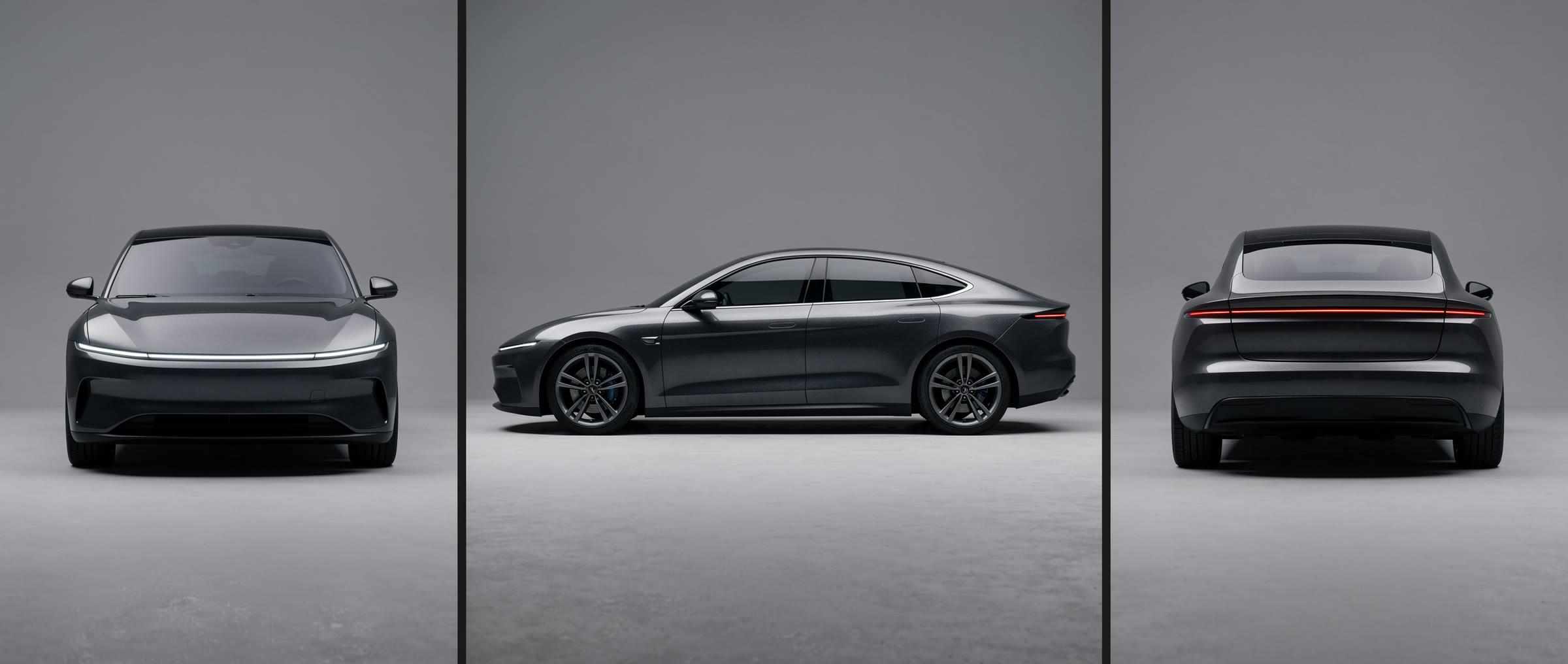
 ДоПосле

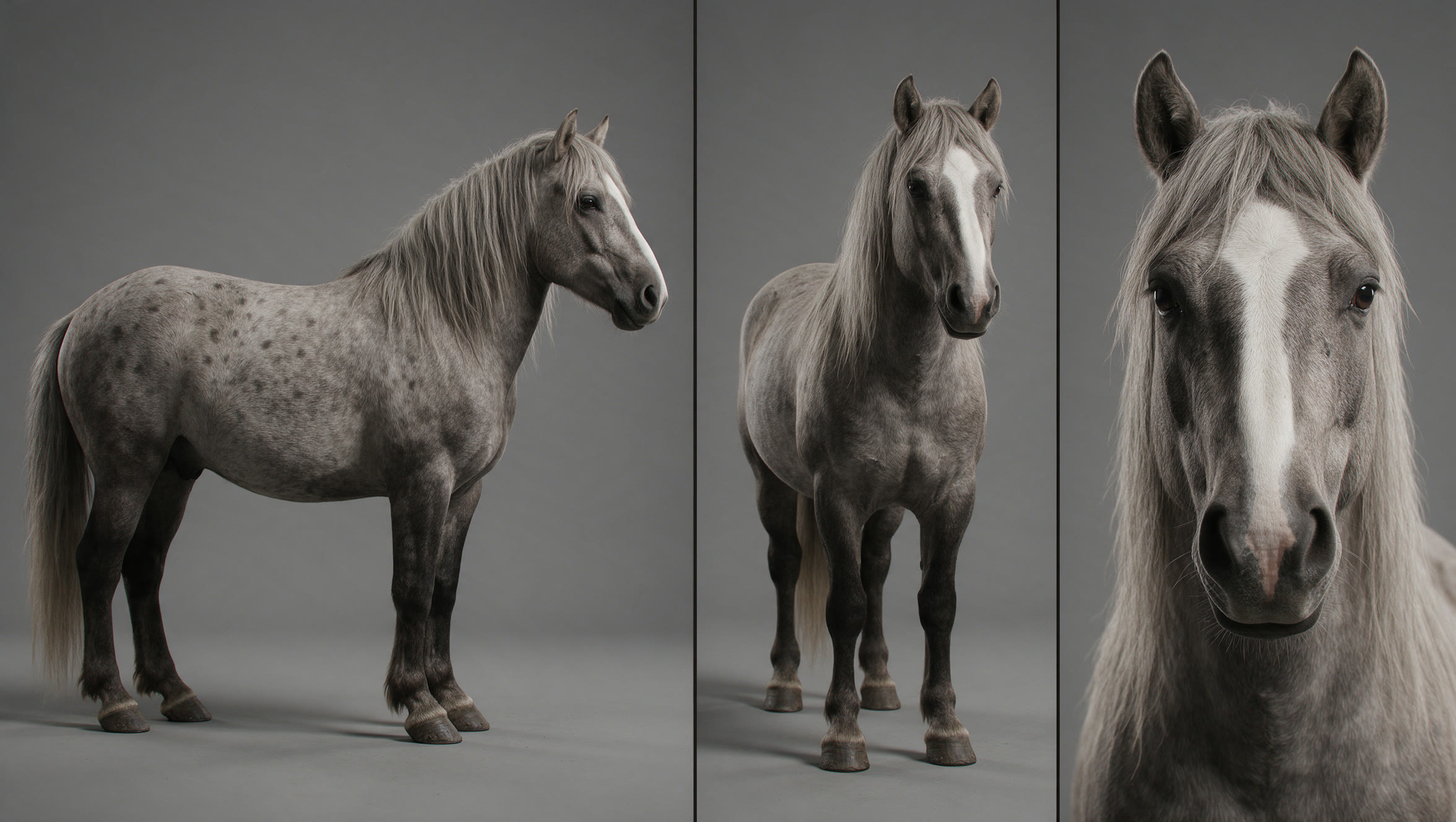
Животные
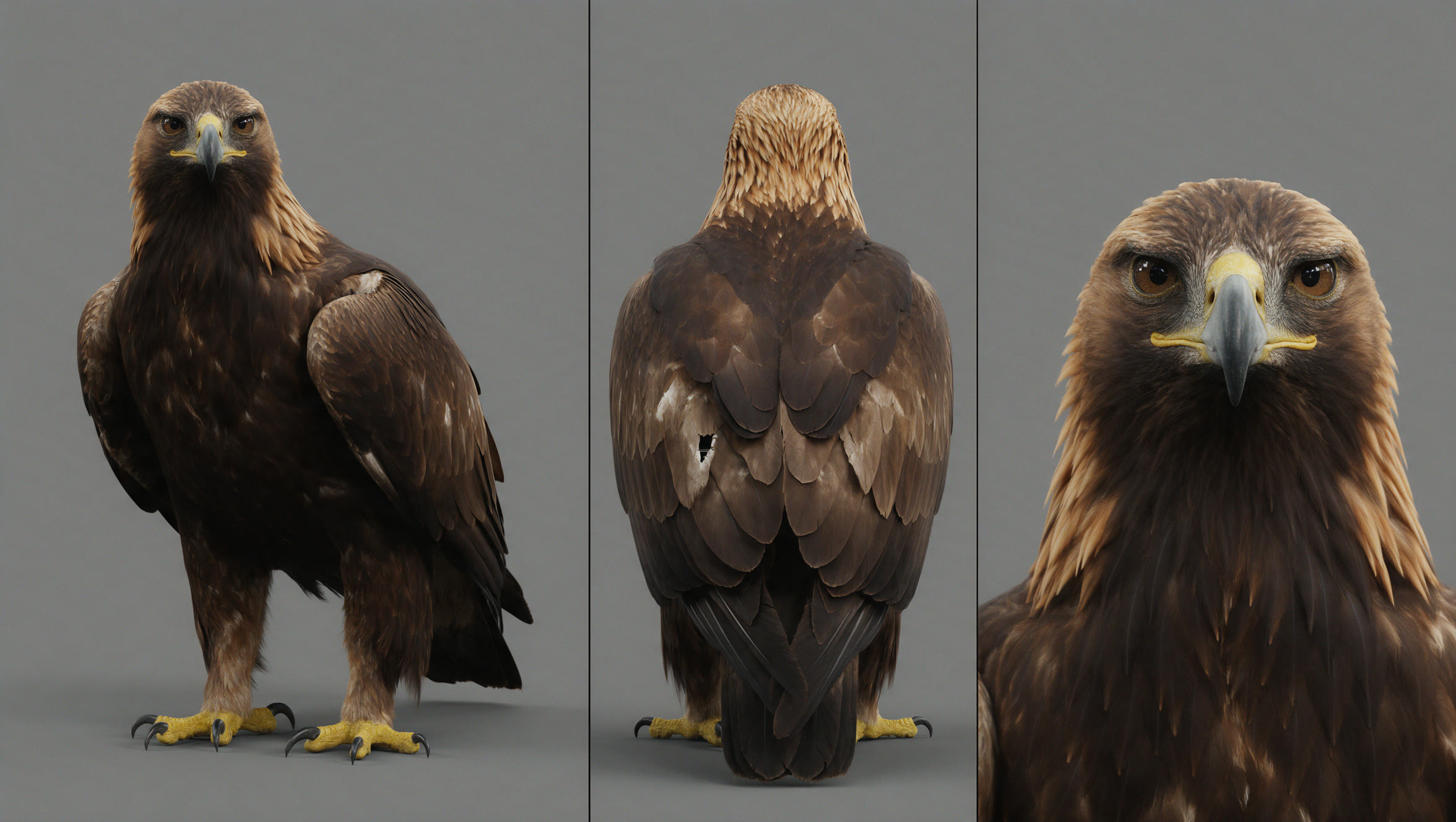
SCENE — ENVIRONMENT: A controlled animal reference studio built around a seamless uniform mid-grey backdrop, neutral around 18% grey, extending continuously behind and beneath the eagle with no visible horizon line, no floor edge, no gradient bands, no texture and no set dressing. ERA: Contemporary natural-history reference photography presented with live-action feature-film realism. TIME OF DAY: Timeless controlled studio environment with no exterior daylight cues. ATMOSPHERE: Clean, neutral studio air with no haze, fog, snow, dust or atmospheric effects that could obscure plumage structure, silhouette, talons or the diagnostic missing primary feather. PHYSICAL DETAILS: The background remains absolutely uniform across all three panels; every feather edge, worn feather tip, keratin surface and natural irregularity remains physically believable. The animal is presented as a reusable continuity reference rather than an action scene; the requested identity of an adult male golden eagle and all distinguishing marks remain consistent across the sheet.

SUBJECT — IDENTITY: BERKUT, an adult male golden eagle, presented as the exact same individual in all three panels of a cinematic animal model sheet. APPEARANCE: Large, powerfully built mature raptor with a wingspan of approximately 2.1 meters, massive compact torso, broad shoulders and substantial flight musculature. The head is strongly wedge-shaped. The beak is powerful and deeply hooked, dark grey, with a distinctly yellow cere. The eyes are hazel-brown beneath a pronounced overhanging brow ridge, giving the bird an intense naturally predatory gaze without anthropomorphic expression. Body and wing plumage is deep dark chocolate brown. The nape and neck carry clearly identifiable golden-straw feathers, distinct from the darker body. Lighter feather patches are visible at the shoulders. The legs are densely feathered all the way down toward the toes. The exposed toes are vivid yellow; the talons are long, sharply curved and naturally black. One primary flight feather is missing from the right wing, producing a clear narrow gap in the flight-feather array; this gap is an essential continuity marker and must appear in the anatomically identical location whenever the right wing is visible. No rings, bands, straps, jesses, tags or other human equipment. FACIAL EXPRESSION: Natural neutral-alert raptor expression, focused and watchful, driven entirely by real avian anatomy: hazel-brown eyes, heavy brow ridge and closed hooked beak; no human-like emotion or facial deformation. SKIN TEXTURE: Real avian surface detail wherever unfeathered anatomy is visible: finely textured yellow cere, naturally scaled bright-yellow toes, microscopic keratin irregularities, subtle wear and tiny authentic imperfections; absolutely no smoothing, waxiness or synthetic surface treatment. HAIR: Not applicable; replace mammalian hair characteristics with individually resolved natural plumage, including layered contour feathers, dense golden-straw nape feathers, overlapping dark-chocolate wing coverts, structurally distinct primary and secondary flight feathers, and subtle natural wear along exposed feather edges. KEY FEATURES: Approximately 2.1-meter wingspan; massive adult male build; wedge-shaped head; powerful hooked dark-grey beak; yellow cere; hazel-brown eyes beneath an overhanging brow ridge; dark-chocolate body and wings; golden-straw nape and neck; lighter shoulder patches; legs feathered down to the toes; vivid yellow toes; long black talons; one missing primary flight feather in the right wing forming a visible gap; absolutely no rings or straps.

POSE — STANCE: Neutral anatomical reference posture rather than the diving action associated with the character's story beat. In the full-body panels the eagle stands naturally and stably with weight distributed evenly through both feet, torso upright, wings arranged to make the overall anatomy and defining plumage readable without theatrical posing. The presentation must clearly communicate the eagle's massive build and natural proportions. HANDS: Not applicable; both feet and all visible toes are anatomically correct, with vivid yellow toes and long black talons clearly readable; no object is grasped and no equipment is attached. HEAD POSITION: Where the head is present, it is held naturally upright with the neck uncompressed; in the dedicated portrait panel the head faces strictly forward, centered on the facial axis, with both eyes equally visible. BODY TENSION: Calm, controlled neutral-alert muscular tension of a mature eagle at rest, powerful but not attacking, distressed or restrained. MOVEMENT: Completely still reference-sheet presentation with no wingbeat blur, diving motion, wind deformation or action blur; feather layering remains legible enough for continuity work.

WARDROBE — STYLE: No wardrobe; the eagle's natural plumage is the complete exterior appearance. DETAILS: Preserve the exact natural color zoning and feather construction in every panel: dark-chocolate body and wing feathers, golden-straw nape and neck, lighter shoulder patches, fully feathered legs, bright-yellow toes and black talons. Natural feather wear, tiny edge irregularities and subtle asymmetry should read as biological realism rather than cosmetic perfection. No rings, identification bands, falconry jesses, straps, harnesses, tracking devices, decorative elements or human-made accessories of any kind.

PRODUCTION DESIGN — ARCHITECTURE: No visible architecture; only the seamless uniform mid-grey studio backdrop, neutral around 18% grey, without texture, gradient, horizon line or floor edge. PROPS: None. VEHICLES: None. DETAILS: The frame contains only the three-panel animal reference presentation against the continuous neutral backdrop. Soft studio illumination originates entirely outside the visible frame. Strictly no lighting equipment in frame: no softbox, no light stand, no umbrella, no reflector, no C-stand, no flag, no cable, no clamp, no tripod, no backdrop edge, no floor seam and no studio hardware. No labels, arrows, measurements, captions or readable text.

LIGHTING — SOURCE TYPE: Controlled studio illumination originating outside the frame: a broad soft front-top key, gentle frontal fill and extremely subtle separation rim, identical across all three panels. KEY LIGHT: Large diffuse front-top source producing soft directional modeling across the layered feathers, hooked beak, brow ridge, legs and talons without flattening their texture; broad enough to reveal dark-chocolate feather detail while keeping the golden-straw nape distinct. FILL LIGHT: Gentle neutral fill approximately two stops below the key, sufficient to preserve individual feather structure inside the darkest chocolate plumage and underneath the wings without creating a second shadow direction. BACK LIGHT: Very restrained soft rim from high rear position, used only to separate dark wing and body contours from the mid-grey backdrop; never strong enough to create an artificial glowing outline. CONTRAST RATIO: Approximately 2:1 to 3:1 controlled studio contrast, preserving complete feather information and dimensional form with no crushed blacks and no clipped highlights. COLOR TEMPERATURE: Neutral studio balance around 5200K throughout all three panels, with no mixed-color contamination; natural golden-straw, chocolate-brown, yellow, dark-grey, hazel-brown and black colors remain accurate. SHADOW BEHAVIOR: Soft, short, low-density shadows with gradual falloff; no hard-edged cast shadows, dramatic spotlighting or specular blowouts. Feather microtexture, cere texture and keratin surfaces remain readable.

COMPOSITION — SHOT SIZE: Three-panel animal model sheet: two full-body anatomical reference views and one tight frontal head-and-upper-body portrait. FRAMING: Three vertical panels of equal width arranged left to right with thin dark divider lines. The same eagle is centered consistently in every panel. Panel framing prioritizes objective identification, anatomy, plumage distribution and continuity markers rather than dramatic composition. CAMERA ANGLE: Eye-level relative to the corresponding portion of the eagle, optically neutral and without exaggerated high- or low-angle perspective. DEPTH LAYERS: Foreground: the sharply resolved eagle anatomy and plumage; midground: the immediate neutral studio space around the bird; background: seamless uniform mid-grey field with no objects or visible transition. FOCUS PRIORITY: The eagle is the absolute focus priority; eyes, beak, feather layering, right-wing missing-primary gap, feathered legs, yellow toes and black talons must remain highly legible. Depth of field is controlled enough to retain the locked anamorphic optical character while keeping the reference anatomy usable. VISUAL BALANCE: Formal and neutral three-panel balance with consistent subject scale and vertical alignment; no panel receives more dramatic treatment than another.

CAMERA — MANDATORY CAMERA STRING: Shot on ARRI Alexa 35 with a Cooke Anamorphic/i 40mm lens. Shallow depth of field, soft oval anamorphic bokeh, and characteristic edge distortion. Kodak Vision / 2383 lut film color emulation — soft contrast, high film grain. FOCAL LENGTH: 40 mm. CAMERA MOVEMENT: Locked-off reference photography; no implied push, pan, tilt or handheld movement. EXPOSURE: Exposed conservatively for the pale golden-straw neck feathers, yellow cere and yellow toes while retaining fine structure throughout the dark-chocolate plumage; highlights protected, shadow detail retained, no clipping. FORMAT: Digital cinema capture with anamorphic optical character; identical optical treatment across all three panels.

LENS BEHAVIOR — DISTORTION TYPE: strong vintage anamorphic edge warping and subtle curved frame deformation. BOKEH STYLE: large soft oval anamorphic bokeh with stretched cinematic light smearing. OPTICAL CHARACTER: visible lens breathing, strong halation, edge softness, organic film grain, realistic cinematic imperfections, and subtle image instability.

COLOR GRADING — PALETTE: Restrained natural-history palette anchored by deep dark-chocolate plumage, golden-straw nape and neck, subdued lighter shoulder patches, vivid but biologically plausible yellow cere and toes, dark-grey beak, black talons, hazel-brown irises and neutral mid-grey surroundings. Preserve separation between the warm neck plumage and dark body without exaggerating saturation. CONTRAST: Soft cinematic contrast with compressed highlights and open detailed shadows; dark plumage retains layered tonal separation rather than collapsing into black. HIGHLIGHT ROLLOFF: Smooth filmic rolloff across the cere, beak edges, eye catchlights, feather shafts and talons, with no hard digital clipping or metallic-looking feather highlights. FILM EMULATION: Kodak Vision / 2383 LUT-inspired color response with organic grain and restrained saturation.

VISUAL STYLE — MOOD: ultra cinematic workstation concentration. IMAGE CHARACTERISTICS: organic film grain, strong anamorphic halation, vintage optical softness, realistic cinematic deformation, stretched highlights, curved edge distortion, and visible filmic image instability.

ATMOSPHERE — ENVIRONMENTAL DEPTH: Minimal studio depth with clean separation between the eagle silhouette and uniform mid-grey background; no atmospheric haze interfering with anatomical readability. AIR QUALITY: Clean controlled air with no visible smoke, dust, mist, snow or floating particulate. MOTION: Entire sheet frozen and neutral; no diving, flapping, attacking or wind-driven movement. Individual feathers remain naturally settled and structurally legible. EMOTIONAL TONE: Powerful, mature, austere and observational; the bird should feel like a real formidable adult golden eagle documented for feature-film continuity, not a fantasy creature or stylized wildlife illustration.

TECHNICAL QUALITY — REALISM: live-action cinema realism. DETAIL LEVEL: Extremely detailed natural eagle anatomy and plumage: authentic feather overlap and directional growth, individual primary and secondary flight-feather construction, subtle feather wear, golden-straw nape texture, dark-chocolate body layering, lighter shoulder markings, anatomically plausible wedge-shaped skull silhouette, dark-grey hooked beak with yellow cere, moist hazel-brown eyes with natural catchlights, feathered tarsi, scaled bright-yellow toes and long black keratin talons. The single missing primary feather in the right wing must create a physically credible gap rather than a damaged or amputated wing. No artificial symmetry in feather edges and no duplicated feather patterns. DYNAMIC RANGE: Wide cinematic dynamic range with preserved highlights and detailed shadows. IMAGE INTEGRITY: Physically plausible studio lighting, natural avian anatomy, coherent 2.1-meter wingspan scale, authentic feather and keratin materials, restrained optical imperfections, consistent identity and markings across all three panels.

SHEET — LAYOUT: One single image containing three equal vertical panels side by side, left to right, separated only by thin dark divider lines; seamless uniform mid-grey studio backdrop identical in every panel; same adult male golden eagle, same anatomy, same plumage colors, same markings, same missing right-wing primary feather, same light and same apparent scale throughout. PANEL LEFT: Full-body frontal animal reference view of BERKUT. Unlike a humanoid character sheet, the eagle remains anatomically complete with its head present because removing the head would destroy the animal reference anatomy. Show the entire bird from crown to talon tips, centered and neutrally posed, with the front anatomy, massive torso, wedge-shaped head, hooked dark-grey beak, yellow cere, hazel-brown eyes, golden-straw neck, dark-chocolate body, lighter shoulder patches, feathered legs, vivid-yellow toes and black talons clearly readable. Arrange the wings naturally enough that the right-wing flight-feather structure and the diagnostic gap caused by one missing primary feather can be identified without turning the pose into an action display. PANEL CENTER: Full-body strict rear view of the exact same eagle, head included, centered, complete from crown through tail and both feet. Show the back of the wedge-shaped head, golden-straw nape and neck, dark-chocolate mantle, lighter shoulder patches, layered wing coverts, tail, feathered legs and feet from behind. Preserve the right-wing missing-primary continuity marker wherever anatomically visible. No head turn and no action pose. PANEL RIGHT: Tight strictly frontal portrait of the same eagle's head and upper shoulders, camera exactly on the central axis of the head, no turn and no tilt. Both hazel-brown eyes equally visible beneath the overhanging brow ridge; both sides of the wedge-shaped head equally represented; hooked dark-grey beak centered; yellow cere fully readable; golden-straw neck feathers and the upper dark-chocolate shoulder plumage visible at the bottom. Resolve authentic feather filaments, cere texture, minute beak wear, eye moisture and natural catchlights. The expression remains neutral-alert and entirely avian. CONSISTENCY: The same individual animal, same adult male proportions, same plumage pattern, same golden-straw nape, same lighter shoulder patches, same right-wing missing primary feather, same beak and eye coloration, same feathered legs, same yellow toes, same black talons, same light and same scale in all three panels; absolutely no rings, bands, straps or other accessories.

NEGATIVE PROMPT — STYLE REJECTIONS: anime, 3D render, illustration, digital art, cartoon style, painterly style, CGI look, video game render. QUALITY REJECTIONS: low resolution, plastic skin, plastic feathers, waxy feathers, over-smoothed surfaces, artificial lighting artifacts, amateur photography, non-cinematic composition, excessive HDR, oversaturated colors, sterile digital sharpness, crushed dark plumage, clipped highlights, fake feather texture. ARTIFACT REJECTIONS: text overlays, logos, watermarks, readable signage, labels, arrows, size charts, captions, duplicated wings, duplicated feet, duplicated talons, extra toes, missing toes, malformed talons, fused feathers, repeated feather patterns, impossible wing anatomy, asymmetrical accidental anatomy, extra primary feathers, missing feathers other than the specified single primary in the right wing, missing-primary gap on the wrong wing, damaged or amputated wing, inconsistent markings between panels, inconsistent plumage color between panels, different eagle identity between panels, juvenile plumage, rings, leg bands, straps, jesses, harnesses, tracking devices, props, prey, blood, attack pose, diving pose, wingbeat motion blur, turned or tilted head in the right panel, profile portrait, three-quarter portrait, mismatched lighting between panels, softbox, light stand, umbrella, reflector, C-stand, flag, cable, clamp, tripod, backdrop edge, floor seam, gradient backdrop, textured backdrop, visible studio equipment.
photorealistic, ultra high detail textures, physically accurate materials, realistic specular highlights, global illumination, soft indirect lighting, natural light falloff, balanced exposure, dynamic range preserved (no clipped highlights or crushed shadows), color-accurate white balance, subtle tonal transitions, lifelike color reproduction
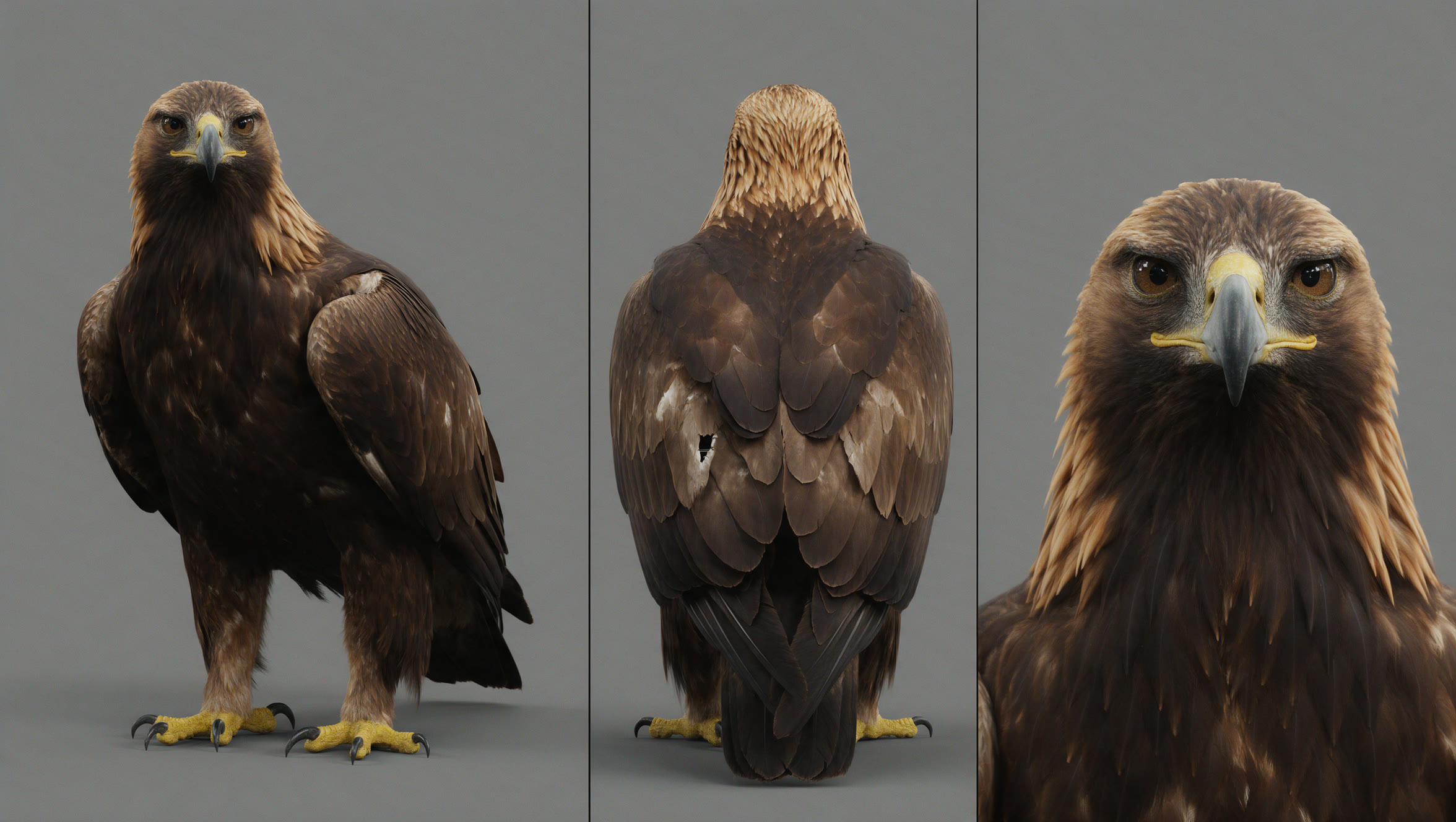 ДоПосле
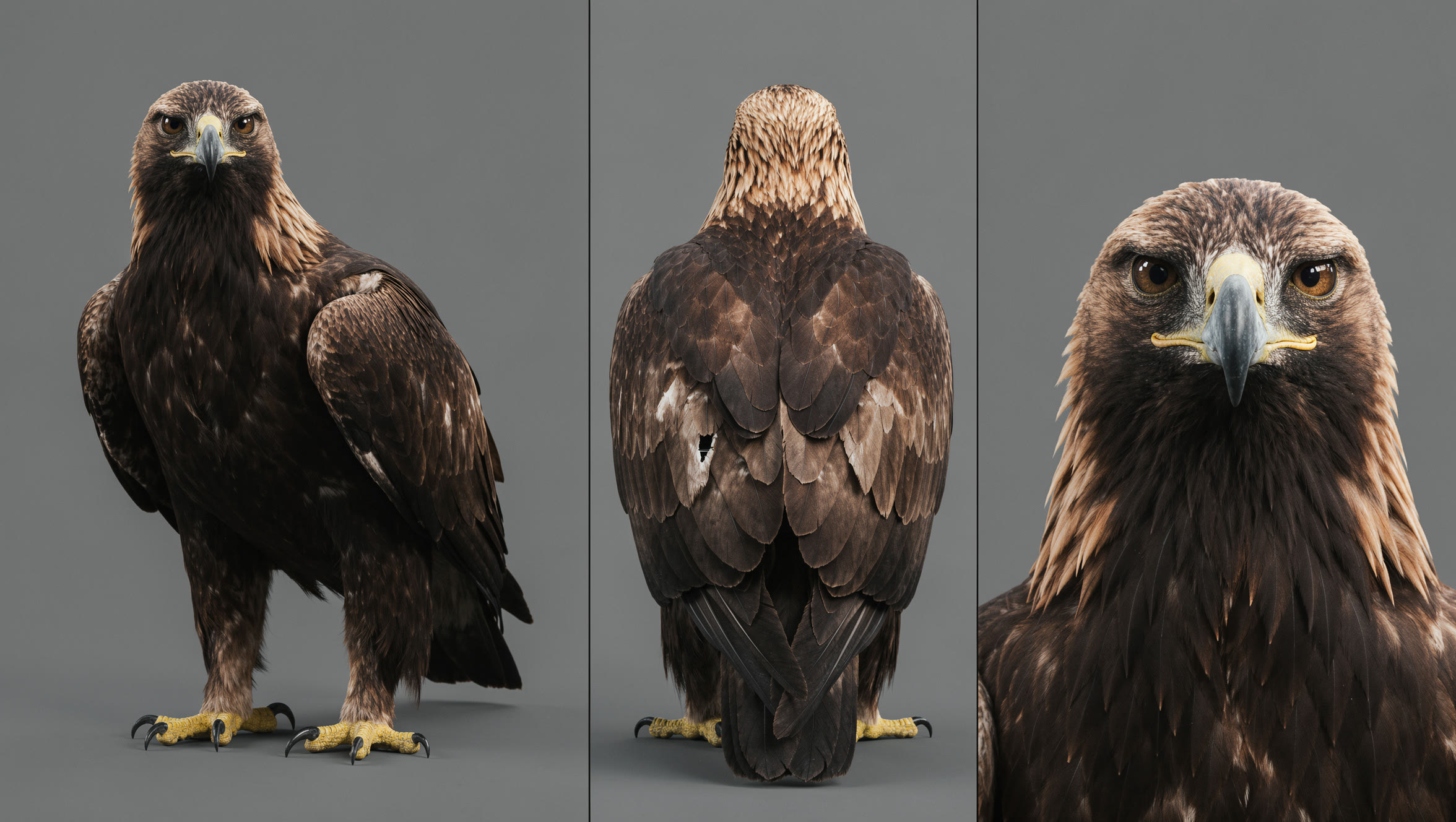
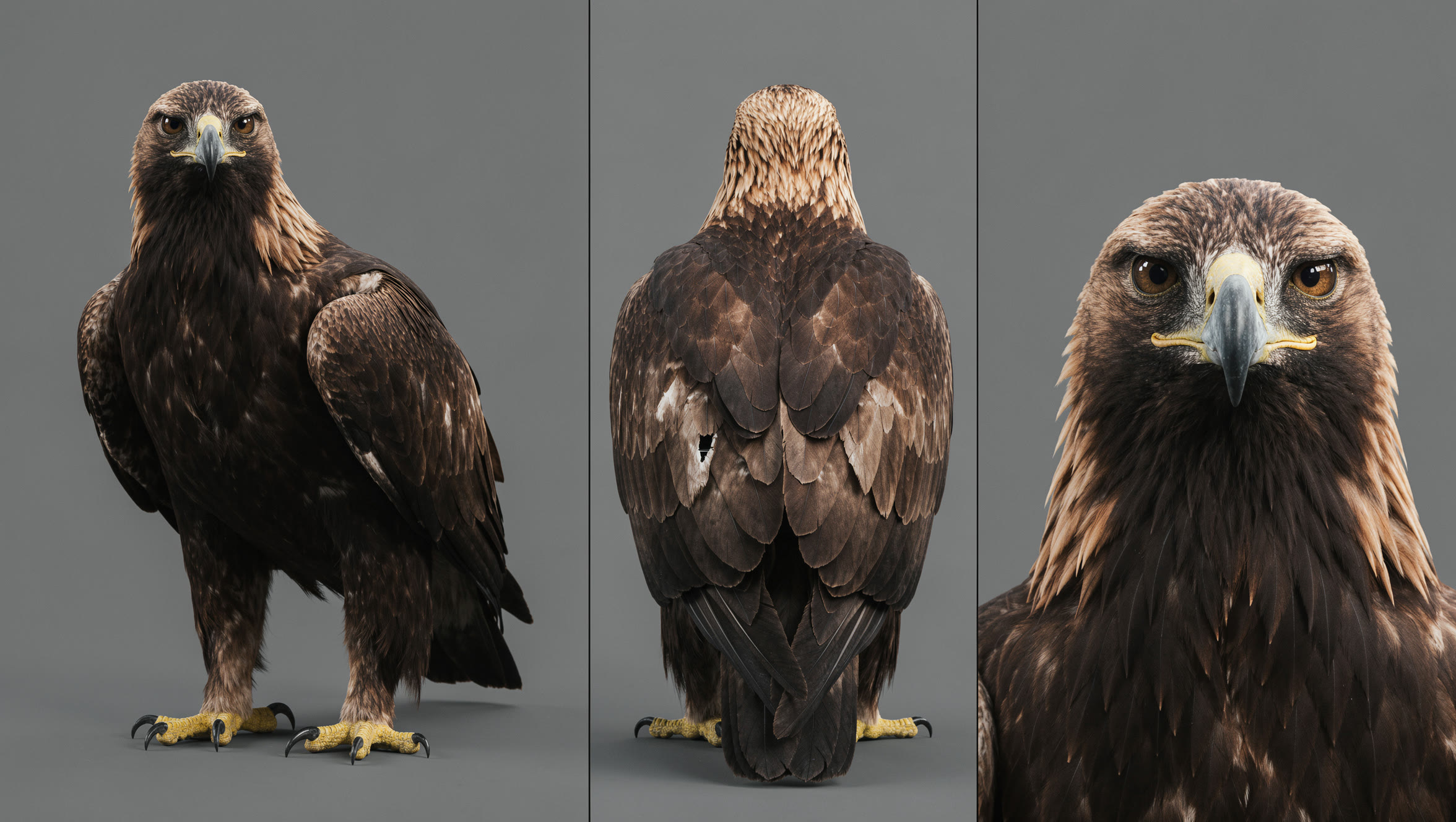
SCENE — ENVIRONMENT: A controlled animal reference studio built around a seamless uniform mid-grey backdrop, neutral around 18% grey, extending continuously behind and beneath the eagle with no visible horizon line, no floor edge, no gradient bands, no texture and no set dressing. ERA: Contemporary natural-history reference photography presented with live-action feature-film realism. TIME OF DAY: Timeless controlled studio environment with no exterior daylight cues. ATMOSPHERE: Clean, neutral studio air with no haze, fog, snow, dust or atmospheric effects that could obscure plumage structure, silhouette, talons or the diagnostic missing primary feather. PHYSICAL DETAILS: The background remains absolutely uniform across all three panels; every feather edge, worn feather tip, keratin surface and natural irregularity remains physically believable. The animal is presented as a reusable continuity reference rather than an action scene; the requested identity of an adult male golden eagle and all distinguishing marks remain consistent across the sheet.

SUBJECT — IDENTITY: BERKUT, an adult male golden eagle, presented as the exact same individual in all three panels of a cinematic animal model sheet. APPEARANCE: Large, powerfully built mature raptor with a wingspan of approximately 2.1 meters, massive compact torso, broad shoulders and substantial flight musculature. The head is strongly wedge-shaped. The beak is powerful and deeply hooked, dark grey, with a distinctly yellow cere. The eyes are hazel-brown beneath a pronounced overhanging brow ridge, giving the bird an intense naturally predatory gaze without anthropomorphic expression. Body and wing plumage is deep dark chocolate brown. The nape and neck carry clearly identifiable golden-straw feathers, distinct from the darker body. Lighter feather patches are visible at the shoulders. The legs are densely feathered all the way down toward the toes. The exposed toes are vivid yellow; the talons are long, sharply curved and naturally black. One primary flight feather is missing from the right wing, producing a clear narrow gap in the flight-feather array; this gap is an essential continuity marker and must appear in the anatomically identical location whenever the right wing is visible. No rings, bands, straps, jesses, tags or other human equipment. FACIAL EXPRESSION: Natural neutral-alert raptor expression, focused and watchful, driven entirely by real avian anatomy: hazel-brown eyes, heavy brow ridge and closed hooked beak; no human-like emotion or facial deformation. SKIN TEXTURE: Real avian surface detail wherever unfeathered anatomy is visible: finely textured yellow cere, naturally scaled bright-yellow toes, microscopic keratin irregularities, subtle wear and tiny authentic imperfections; absolutely no smoothing, waxiness or synthetic surface treatment. HAIR: Not applicable; replace mammalian hair characteristics with individually resolved natural plumage, including layered contour feathers, dense golden-straw nape feathers, overlapping dark-chocolate wing coverts, structurally distinct primary and secondary flight feathers, and subtle natural wear along exposed feather edges. KEY FEATURES: Approximately 2.1-meter wingspan; massive adult male build; wedge-shaped head; powerful hooked dark-grey beak; yellow cere; hazel-brown eyes beneath an overhanging brow ridge; dark-chocolate body and wings; golden-straw nape and neck; lighter shoulder patches; legs feathered down to the toes; vivid yellow toes; long black talons; one missing primary flight feather in the right wing forming a visible gap; absolutely no rings or straps.

POSE — STANCE: Neutral anatomical reference posture rather than the diving action associated with the character's story beat. In the full-body panels the eagle stands naturally and stably with weight distributed evenly through both feet, torso upright, wings arranged to make the overall anatomy and defining plumage readable without theatrical posing. The presentation must clearly communicate the eagle's massive build and natural proportions. HANDS: Not applicable; both feet and all visible toes are anatomically correct, with vivid yellow toes and long black talons clearly readable; no object is grasped and no equipment is attached. HEAD POSITION: Where the head is present, it is held naturally upright with the neck uncompressed; in the dedicated portrait panel the head faces strictly forward, centered on the facial axis, with both eyes equally visible. BODY TENSION: Calm, controlled neutral-alert muscular tension of a mature eagle at rest, powerful but not attacking, distressed or restrained. MOVEMENT: Completely still reference-sheet presentation with no wingbeat blur, diving motion, wind deformation or action blur; feather layering remains legible enough for continuity work.

WARDROBE — STYLE: No wardrobe; the eagle's natural plumage is the complete exterior appearance. DETAILS: Preserve the exact natural color zoning and feather construction in every panel: dark-chocolate body and wing feathers, golden-straw nape and neck, lighter shoulder patches, fully feathered legs, bright-yellow toes and black talons. Natural feather wear, tiny edge irregularities and subtle asymmetry should read as biological realism rather than cosmetic perfection. No rings, identification bands, falconry jesses, straps, harnesses, tracking devices, decorative elements or human-made accessories of any kind.

PRODUCTION DESIGN — ARCHITECTURE: No visible architecture; only the seamless uniform mid-grey studio backdrop, neutral around 18% grey, without texture, gradient, horizon line or floor edge. PROPS: None. VEHICLES: None. DETAILS: The frame contains only the three-panel animal reference presentation against the continuous neutral backdrop. Soft studio illumination originates entirely outside the visible frame. Strictly no lighting equipment in frame: no softbox, no light stand, no umbrella, no reflector, no C-stand, no flag, no cable, no clamp, no tripod, no backdrop edge, no floor seam and no studio hardware. No labels, arrows, measurements, captions or readable text.

LIGHTING — SOURCE TYPE: Controlled studio illumination originating outside the frame: a broad soft front-top key, gentle frontal fill and extremely subtle separation rim, identical across all three panels. KEY LIGHT: Large diffuse front-top source producing soft directional modeling across the layered feathers, hooked beak, brow ridge, legs and talons without flattening their texture; broad enough to reveal dark-chocolate feather detail while keeping the golden-straw nape distinct. FILL LIGHT: Gentle neutral fill approximately two stops below the key, sufficient to preserve individual feather structure inside the darkest chocolate plumage and underneath the wings without creating a second shadow direction. BACK LIGHT: Very restrained soft rim from high rear position, used only to separate dark wing and body contours from the mid-grey backdrop; never strong enough to create an artificial glowing outline. CONTRAST RATIO: Approximately 2:1 to 3:1 controlled studio contrast, preserving complete feather information and dimensional form with no crushed blacks and no clipped highlights. COLOR TEMPERATURE: Neutral studio balance around 5200K throughout all three panels, with no mixed-color contamination; natural golden-straw, chocolate-brown, yellow, dark-grey, hazel-brown and black colors remain accurate. SHADOW BEHAVIOR: Soft, short, low-density shadows with gradual falloff; no hard-edged cast shadows, dramatic spotlighting or specular blowouts. Feather microtexture, cere texture and keratin surfaces remain readable.

COMPOSITION — SHOT SIZE: Three-panel animal model sheet: two full-body anatomical reference views and one tight frontal head-and-upper-body portrait. FRAMING: Three vertical panels of equal width arranged left to right with thin dark divider lines. The same eagle is centered consistently in every panel. Panel framing prioritizes objective identification, anatomy, plumage distribution and continuity markers rather than dramatic composition. CAMERA ANGLE: Eye-level relative to the corresponding portion of the eagle, optically neutral and without exaggerated high- or low-angle perspective. DEPTH LAYERS: Foreground: the sharply resolved eagle anatomy and plumage; midground: the immediate neutral studio space around the bird; background: seamless uniform mid-grey field with no objects or visible transition. FOCUS PRIORITY: The eagle is the absolute focus priority; eyes, beak, feather layering, right-wing missing-primary gap, feathered legs, yellow toes and black talons must remain highly legible. Depth of field is controlled enough to retain the locked anamorphic optical character while keeping the reference anatomy usable. VISUAL BALANCE: Formal and neutral three-panel balance with consistent subject scale and vertical alignment; no panel receives more dramatic treatment than another.

CAMERA — MANDATORY CAMERA STRING: Shot on ARRI Alexa 35 with a Cooke Anamorphic/i 40mm lens. Shallow depth of field, soft oval anamorphic bokeh, and characteristic edge distortion. Kodak Vision / 2383 lut film color emulation — soft contrast, high film grain. FOCAL LENGTH: 40 mm. CAMERA MOVEMENT: Locked-off reference photography; no implied push, pan, tilt or handheld movement. EXPOSURE: Exposed conservatively for the pale golden-straw neck feathers, yellow cere and yellow toes while retaining fine structure throughout the dark-chocolate plumage; highlights protected, shadow detail retained, no clipping. FORMAT: Digital cinema capture with anamorphic optical character; identical optical treatment across all three panels.

LENS BEHAVIOR — DISTORTION TYPE: strong vintage anamorphic edge warping and subtle curved frame deformation. BOKEH STYLE: large soft oval anamorphic bokeh with stretched cinematic light smearing. OPTICAL CHARACTER: visible lens breathing, strong halation, edge softness, organic film grain, realistic cinematic imperfections, and subtle image instability.

COLOR GRADING — PALETTE: Restrained natural-history palette anchored by deep dark-chocolate plumage, golden-straw nape and neck, subdued lighter shoulder patches, vivid but biologically plausible yellow cere and toes, dark-grey beak, black talons, hazel-brown irises and neutral mid-grey surroundings. Preserve separation between the warm neck plumage and dark body without exaggerating saturation. CONTRAST: Soft cinematic contrast with compressed highlights and open detailed shadows; dark plumage retains layered tonal separation rather than collapsing into black. HIGHLIGHT ROLLOFF: Smooth filmic rolloff across the cere, beak edges, eye catchlights, feather shafts and talons, with no hard digital clipping or metallic-looking feather highlights. FILM EMULATION: Kodak Vision / 2383 LUT-inspired color response with organic grain and restrained saturation.

VISUAL STYLE — MOOD: ultra cinematic workstation concentration. IMAGE CHARACTERISTICS: organic film grain, strong anamorphic halation, vintage optical softness, realistic cinematic deformation, stretched highlights, curved edge distortion, and visible filmic image instability.

ATMOSPHERE — ENVIRONMENTAL DEPTH: Minimal studio depth with clean separation between the eagle silhouette and uniform mid-grey background; no atmospheric haze interfering with anatomical readability. AIR QUALITY: Clean controlled air with no visible smoke, dust, mist, snow or floating particulate. MOTION: Entire sheet frozen and neutral; no diving, flapping, attacking or wind-driven movement. Individual feathers remain naturally settled and structurally legible. EMOTIONAL TONE: Powerful, mature, austere and observational; the bird should feel like a real formidable adult golden eagle documented for feature-film continuity, not a fantasy creature or stylized wildlife illustration.

TECHNICAL QUALITY — REALISM: live-action cinema realism. DETAIL LEVEL: Extremely detailed natural eagle anatomy and plumage: authentic feather overlap and directional growth, individual primary and secondary flight-feather construction, subtle feather wear, golden-straw nape texture, dark-chocolate body layering, lighter shoulder markings, anatomically plausible wedge-shaped skull silhouette, dark-grey hooked beak with yellow cere, moist hazel-brown eyes with natural catchlights, feathered tarsi, scaled bright-yellow toes and long black keratin talons. The single missing primary feather in the right wing must create a physically credible gap rather than a damaged or amputated wing. No artificial symmetry in feather edges and no duplicated feather patterns. DYNAMIC RANGE: Wide cinematic dynamic range with preserved highlights and detailed shadows. IMAGE INTEGRITY: Physically plausible studio lighting, natural avian anatomy, coherent 2.1-meter wingspan scale, authentic feather and keratin materials, restrained optical imperfections, consistent identity and markings across all three panels.

SHEET — LAYOUT: One single image containing three equal vertical panels side by side, left to right, separated only by thin dark divider lines; seamless uniform mid-grey studio backdrop identical in every panel; same adult male golden eagle, same anatomy, same plumage colors, same markings, same missing right-wing primary feather, same light and same apparent scale throughout. PANEL LEFT: Full-body frontal animal reference view of BERKUT. Unlike a humanoid character sheet, the eagle remains anatomically complete with its head present because removing the head would destroy the animal reference anatomy. Show the entire bird from crown to talon tips, centered and neutrally posed, with the front anatomy, massive torso, wedge-shaped head, hooked dark-grey beak, yellow cere, hazel-brown eyes, golden-straw neck, dark-chocolate body, lighter shoulder patches, feathered legs, vivid-yellow toes and black talons clearly readable. Arrange the wings naturally enough that the right-wing flight-feather structure and the diagnostic gap caused by one missing primary feather can be identified without turning the pose into an action display. PANEL CENTER: Full-body strict rear view of the exact same eagle, head included, centered, complete from crown through tail and both feet. Show the back of the wedge-shaped head, golden-straw nape and neck, dark-chocolate mantle, lighter shoulder patches, layered wing coverts, tail, feathered legs and feet from behind. Preserve the right-wing missing-primary continuity marker wherever anatomically visible. No head turn and no action pose. PANEL RIGHT: Tight strictly frontal portrait of the same eagle's head and upper shoulders, camera exactly on the central axis of the head, no turn and no tilt. Both hazel-brown eyes equally visible beneath the overhanging brow ridge; both sides of the wedge-shaped head equally represented; hooked dark-grey beak centered; yellow cere fully readable; golden-straw neck feathers and the upper dark-chocolate shoulder plumage visible at the bottom. Resolve authentic feather filaments, cere texture, minute beak wear, eye moisture and natural catchlights. The expression remains neutral-alert and entirely avian. CONSISTENCY: The same individual animal, same adult male proportions, same plumage pattern, same golden-straw nape, same lighter shoulder patches, same right-wing missing primary feather, same beak and eye coloration, same feathered legs, same yellow toes, same black talons, same light and same scale in all three panels; absolutely no rings, bands, straps or other accessories.

NEGATIVE PROMPT — STYLE REJECTIONS: anime, 3D render, illustration, digital art, cartoon style, painterly style, CGI look, video game render. QUALITY REJECTIONS: low resolution, plastic skin, plastic feathers, waxy feathers, over-smoothed surfaces, artificial lighting artifacts, amateur photography, non-cinematic composition, excessive HDR, oversaturated colors, sterile digital sharpness, crushed dark plumage, clipped highlights, fake feather texture. ARTIFACT REJECTIONS: text overlays, logos, watermarks, readable signage, labels, arrows, size charts, captions, duplicated wings, duplicated feet, duplicated talons, extra toes, missing toes, malformed talons, fused feathers, repeated feather patterns, impossible wing anatomy, asymmetrical accidental anatomy, extra primary feathers, missing feathers other than the specified single primary in the right wing, missing-primary gap on the wrong wing, damaged or amputated wing, inconsistent markings between panels, inconsistent plumage color between panels, different eagle identity between panels, juvenile plumage, rings, leg bands, straps, jesses, harnesses, tracking devices, props, prey, blood, attack pose, diving pose, wingbeat motion blur, turned or tilted head in the right panel, profile portrait, three-quarter portrait, mismatched lighting between panels, softbox, light stand, umbrella, reflector, C-stand, flag, cable, clamp, tripod, backdrop edge, floor seam, gradient backdrop, textured backdrop, visible studio equipment.
photorealistic, ultra high detail textures, physically accurate materials, realistic specular highlights, global illumination, soft indirect lighting, natural light falloff, balanced exposure, dynamic range preserved (no clipped highlights or crushed shadows), color-accurate white balance, subtle tonal transitions, lifelike color reproduction
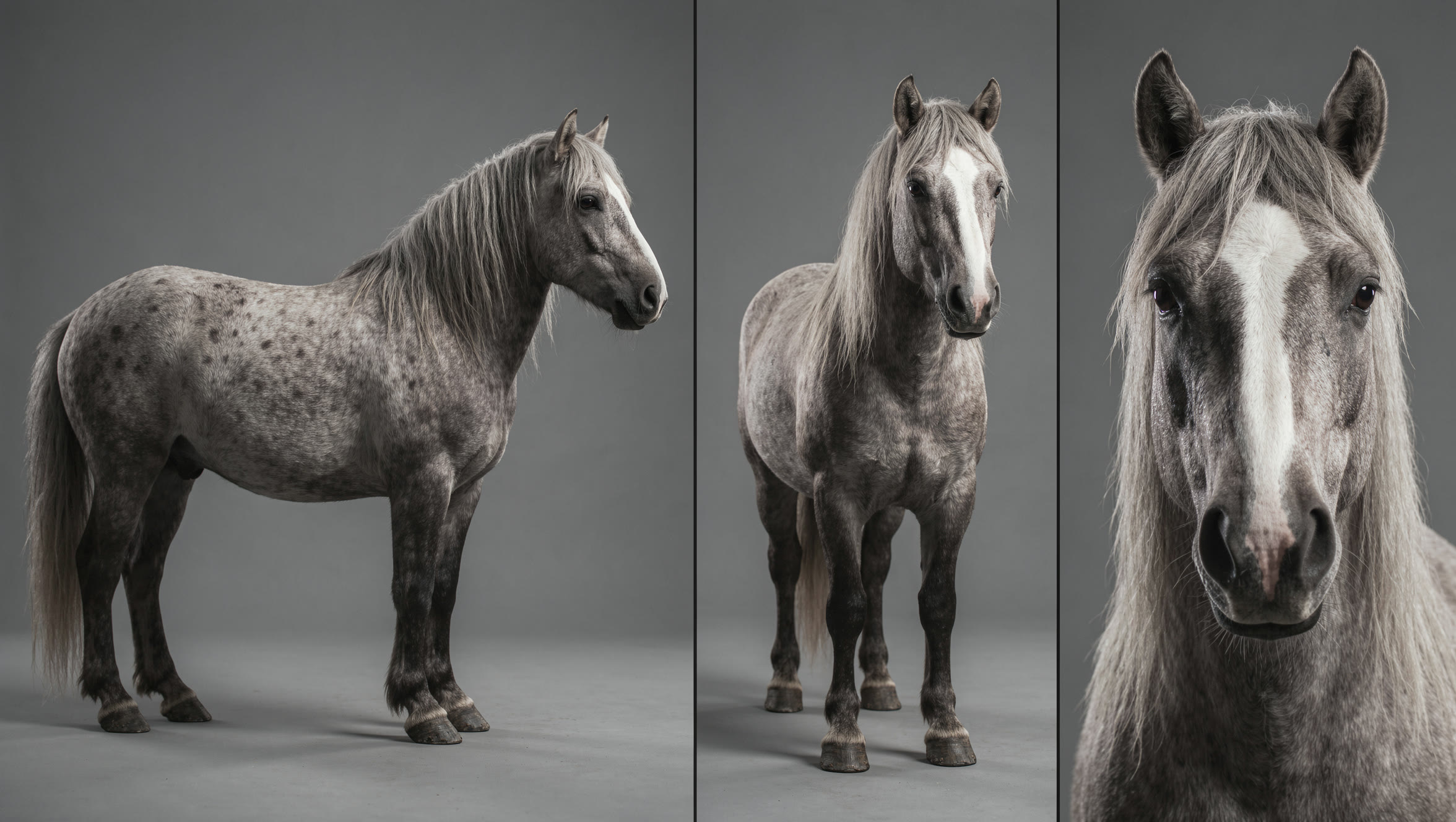
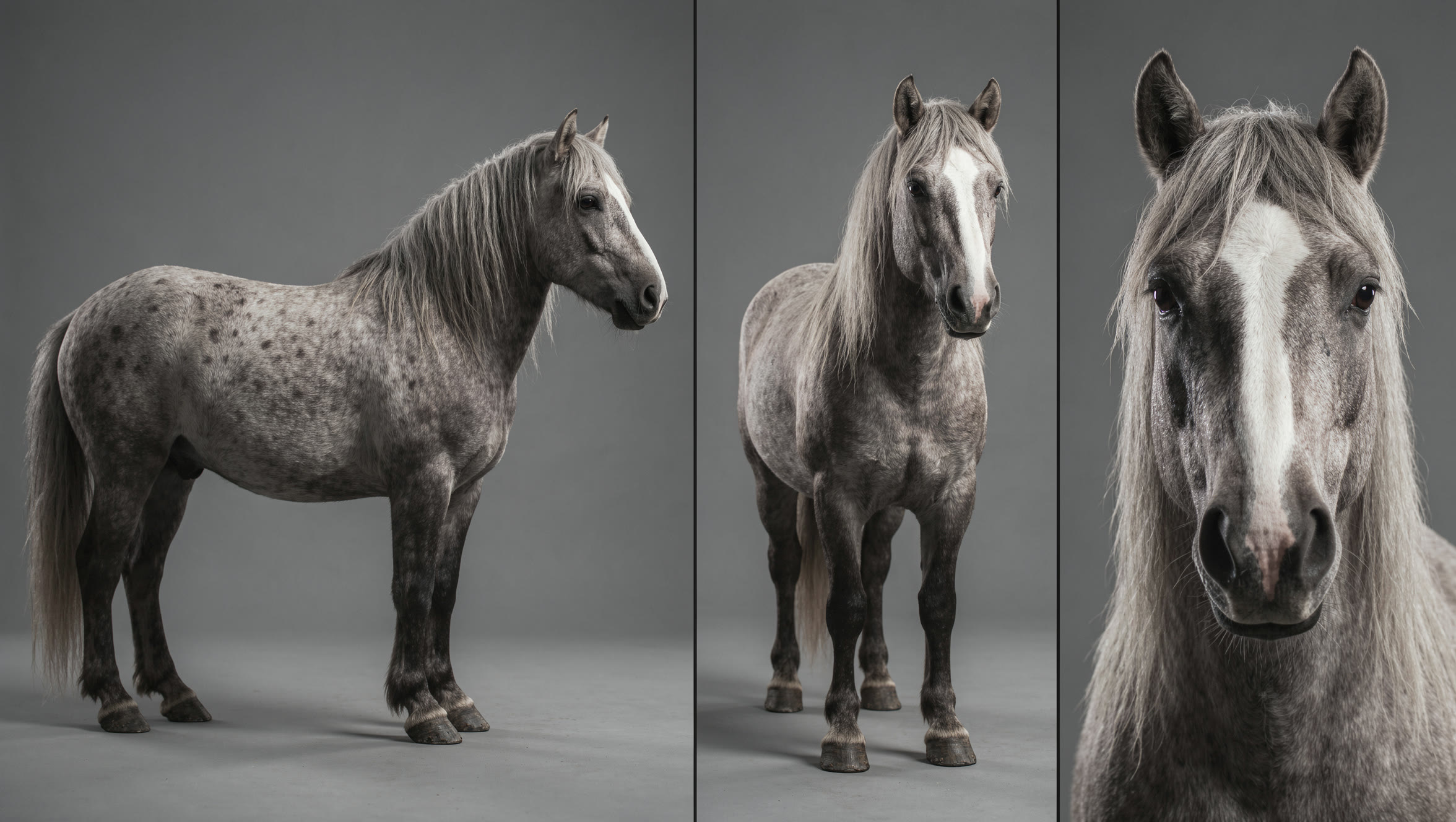
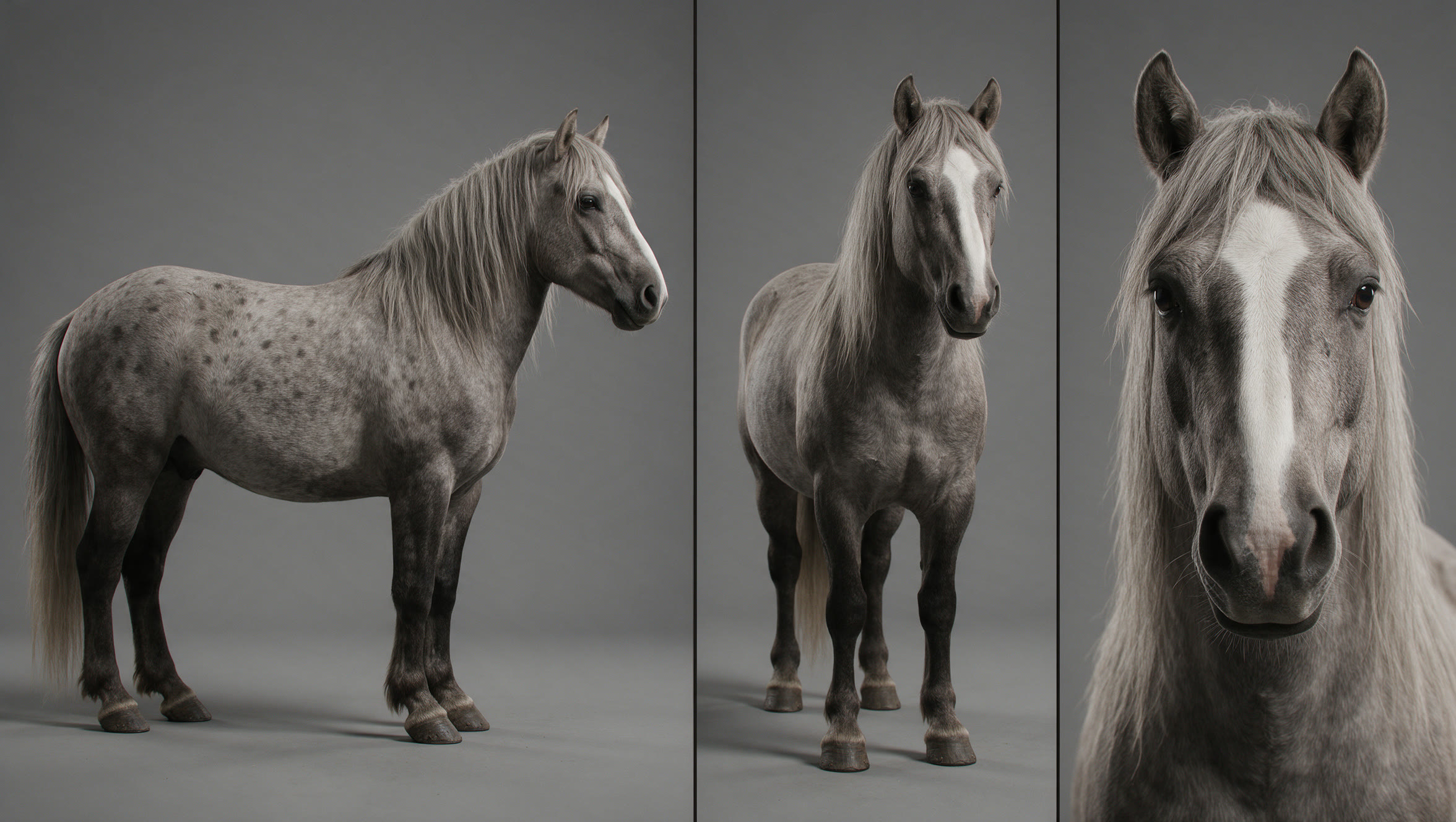
 ДоПосле
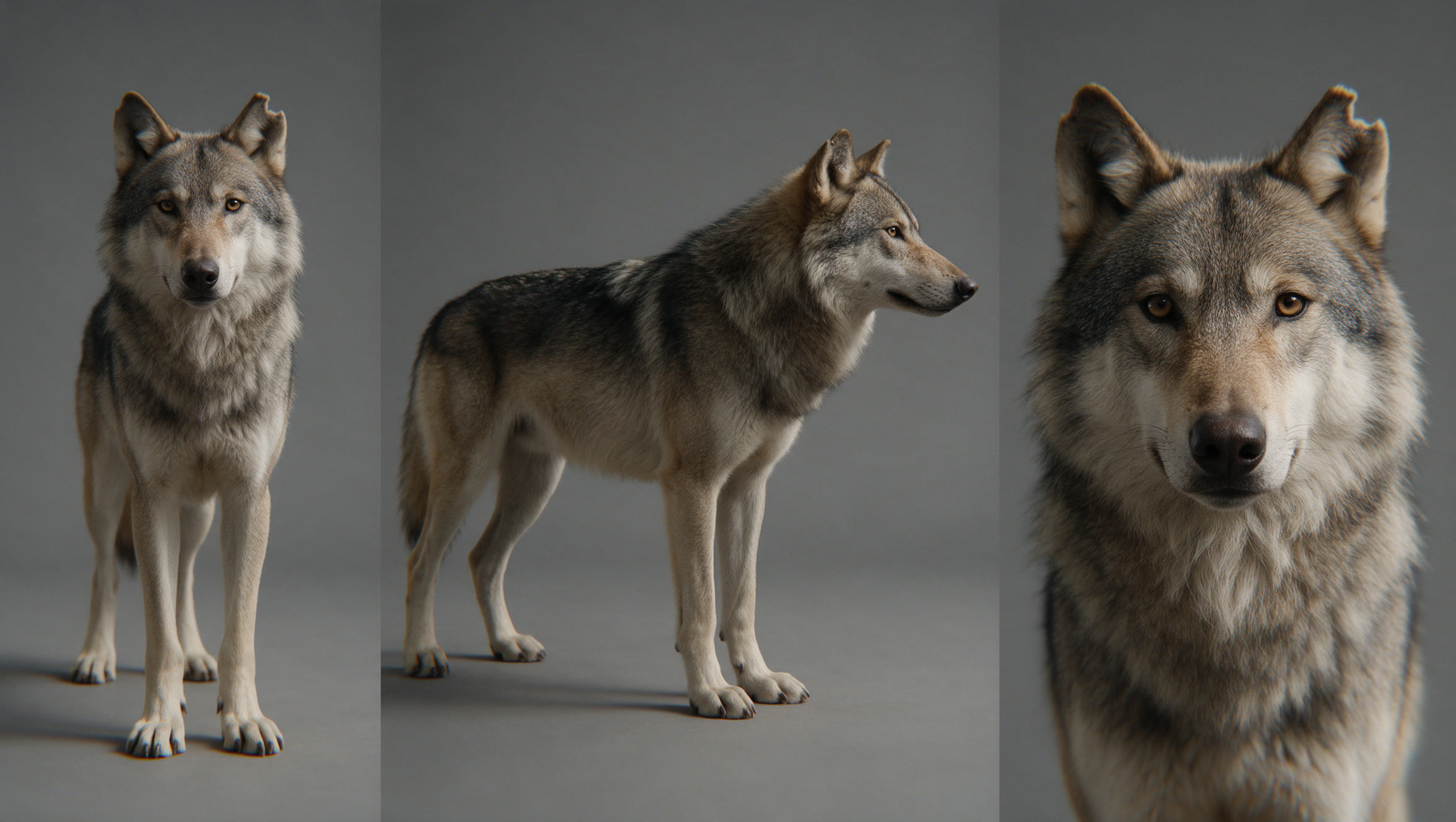
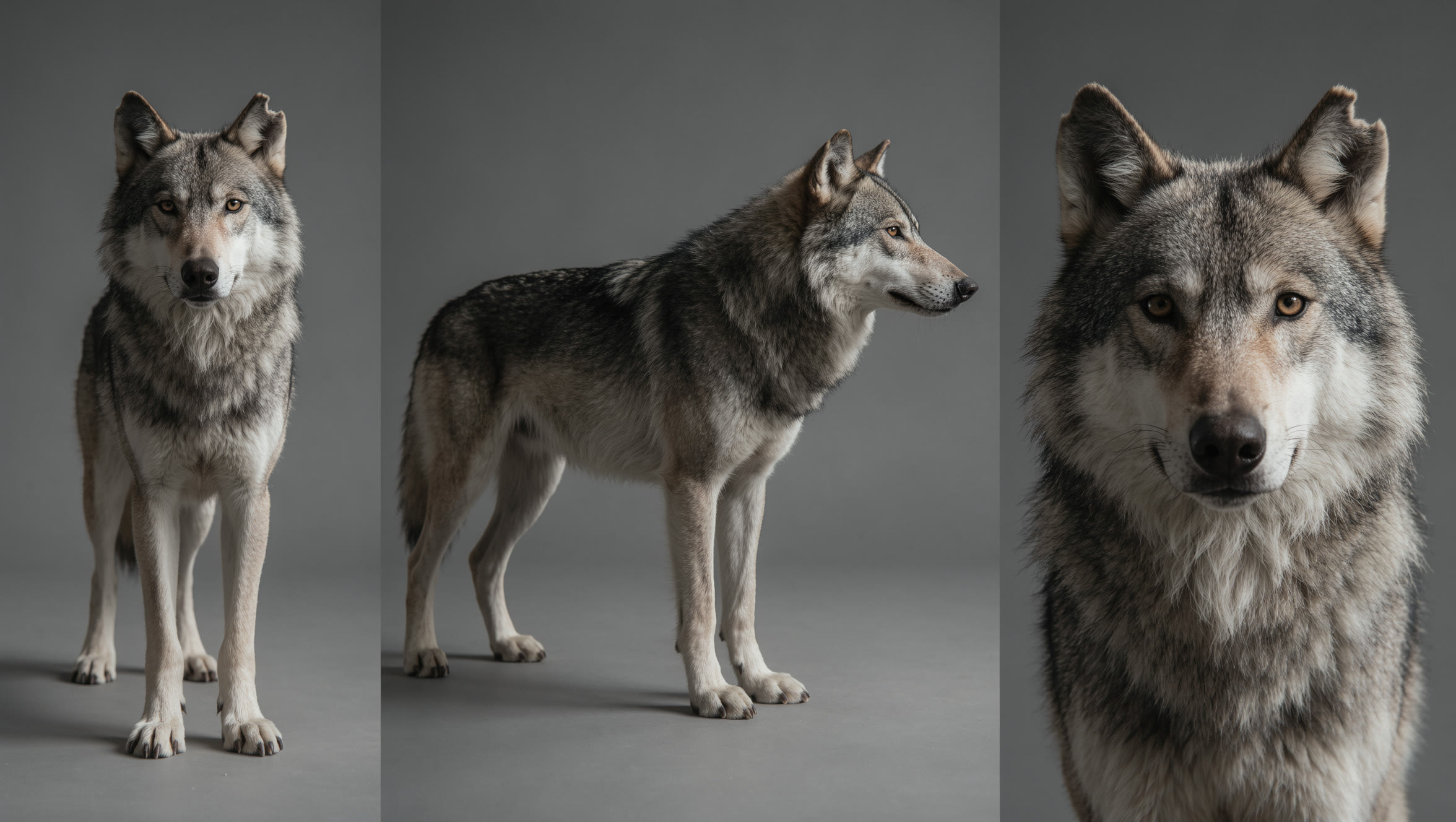
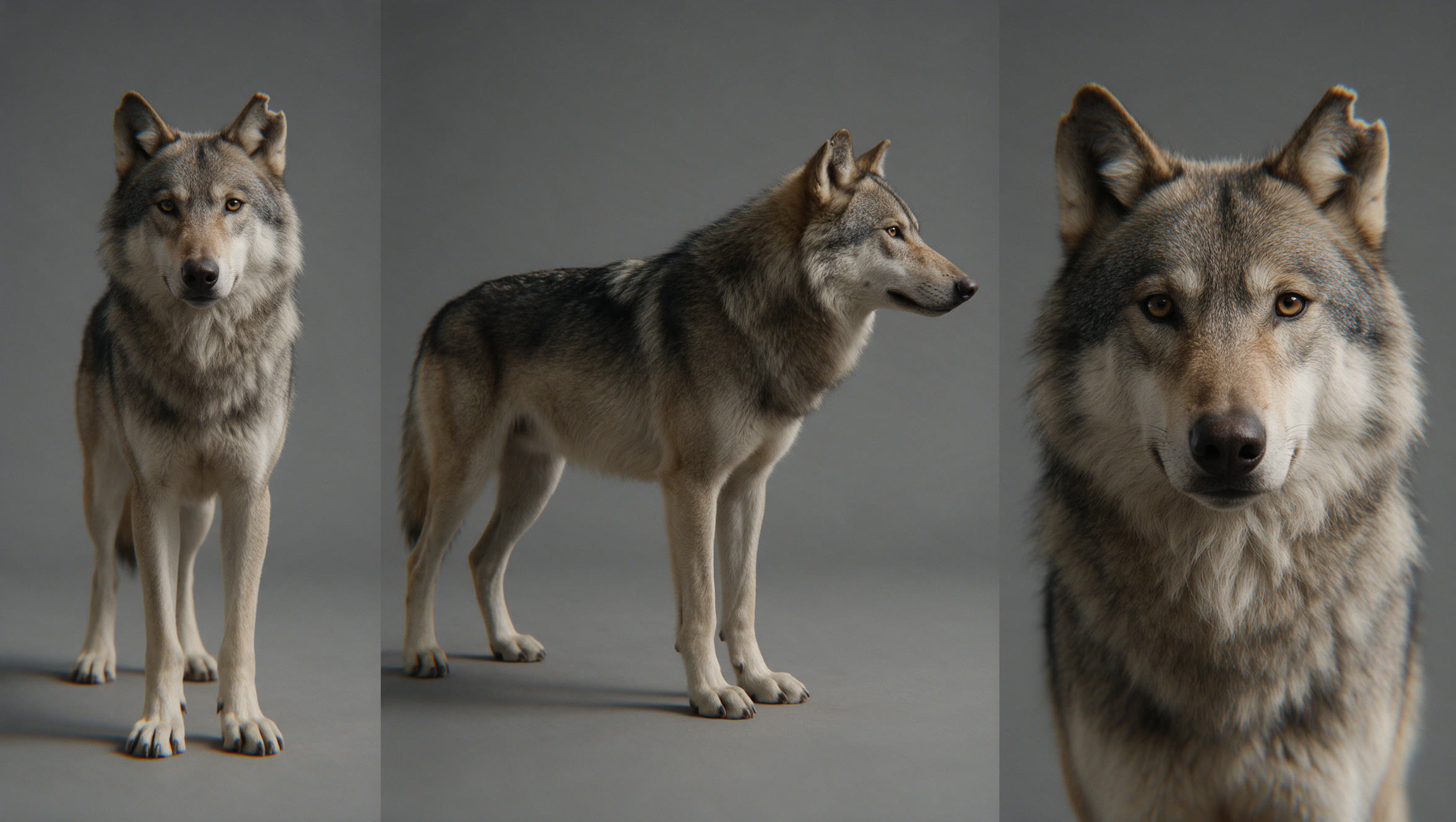
SCENE — ENVIRONMENT: Controlled animal reference studio with a seamless uniform mid-grey backdrop, neutral around 18% grey, identical across all three panels; no gradient, texture, horizon line, floor edge or set dressing. ERA: Contemporary live-action cinematic wildlife reference photography. TIME OF DAY: Timeless controlled studio environment. ATMOSPHERE: Clean neutral air with no haze, fog, smoke, snow or dust obscuring fur, paws or silhouette. PHYSICAL DETAILS: Neutral surroundings keep coat coloration, fur layering, body proportions, paws, claws and the damaged left ear clearly readable.

SUBJECT — IDENTITY: VOLK, a male Eurasian grey wolf approximately six years old, presented as the exact same individual in all three panels. APPEARANCE: Large mature Eurasian grey wolf approximately 85 cm at the shoulder, tall and lean rather than bulky, with long athletic legs, relatively narrow chest, powerful but streamlined torso, broad head and distinctly long muzzle. Eyes are almond-shaped and amber, alert and naturally predatory without anthropomorphic expression. The dorsal coat forms a very dark, almost charcoal-grey saddle extending across the upper back, contrasting with cream-grey cheeks, throat and belly. Dense natural grey transitional fur connects these zones. A thick heavy ruff surrounds the neck, creating a visibly dense collar of natural fur. Paws are large and cream-grey with dark claws. The tip of the LEFT EAR is missing, leaving an old healed irregular edge; this is an essential permanent identity marker and must remain identical in every panel where the left ear is visible. No collar or human equipment. FACIAL EXPRESSION: Neutral-alert adult wolf expression; calm vigilance conveyed by natural ear position, almond-shaped amber eyes and relaxed closed mouth. No snarling or human-like emotion. SKIN TEXTURE: Real skin visible around nose, eyelids, lips and damaged ear edge, with natural pores, minor scars and biological imperfections. Nose moist and naturally textured. HAIR: Authentic dense double coat with individually readable guard hairs and softer undercoat; thick neck ruff; charcoal dorsal saddle; cream-grey cheeks, throat, belly and paws; natural irregular transitions rather than painted color boundaries. KEY FEATURES: Male Eurasian grey wolf, approximately six years old; 85 cm shoulder height; large tall frame; long legs; narrow chest; broad head; long muzzle; almond-shaped amber eyes; nearly charcoal-grey dorsal saddle; cream-grey cheeks, throat and belly; thick neck ruff; large cream-grey paws; dark claws; missing tip of left ear; absolutely no collar.

POSE — STANCE: Neutral anatomical reference stance. In both full-body panels the wolf stands naturally on all four paws with balanced weight and relaxed but alert posture. No walking, running, crouching, jumping or attack posture. HANDS: Not applicable; all four paws anatomically correct, large and naturally spread under body weight, with dark claws visible where physically appropriate. HEAD POSITION: Front panel head upright and centered; center side-profile panel head points straight forward along the body's longitudinal axis without turning toward camera; right portrait head strictly frontal. BODY TENSION: Controlled neutral-alert muscular tone, powerful but relaxed. MOVEMENT: Completely still reference presentation with no motion blur and no windblown fur.

WARDROBE — STYLE: No wardrobe or equipment; natural coat only. DETAILS: Preserve identical charcoal dorsal saddle, cream-grey cheeks, throat, belly and paws, dense neck ruff and missing left-ear tip across all panels. Absolutely no collar, harness, tracking device, tag, chain, rope or other human-made object.

PRODUCTION DESIGN — ARCHITECTURE: No visible architecture; seamless uniform mid-grey studio backdrop, neutral around 18% grey, without texture, gradient, horizon or floor edge. PROPS: None. VEHICLES: None. DETAILS: Only the three-panel wolf reference. Strictly no lighting equipment in frame: no softbox, light stand, umbrella, reflector, C-stand, flag, cable, clamp, tripod, backdrop edge or floor seam. No labels, arrows, measurements, captions or readable text.

LIGHTING — SOURCE TYPE: Soft controlled studio illumination originating outside frame and identical across all panels. KEY LIGHT: Broad diffuse front-top key revealing individual guard hairs, dense neck ruff, facial anatomy, charcoal saddle and cream-grey fur without flattening the animal. FILL LIGHT: Gentle neutral fill approximately two stops below key, preserving detail inside the darkest dorsal fur and around the eyes. BACK LIGHT: Subtle high rear rim separating ears, neck ruff, back and tail from the mid-grey background without creating a glowing outline. CONTRAST RATIO: Approximately 2:1 to 3:1, detailed shadows and protected highlights. COLOR TEMPERATURE: Neutral approximately 5200K, maintaining natural grey, charcoal, cream and amber coloration. SHADOW BEHAVIOR: Soft short shadows with gradual falloff and physically plausible contact shadows beneath the paws.

COMPOSITION — SHOT SIZE: Three-panel animal model sheet: complete frontal full-body view, complete strict lateral side-profile view, and tight frontal head-and-upper-chest portrait. FRAMING: Three equal vertical panels arranged left to right with thin dark divider lines. Same wolf centered consistently in each panel. Full-body panels show the complete animal without cropping ears, paws or tail. CAMERA ANGLE: Neutral eye-level anatomical reference angle. DEPTH LAYERS: Foreground: sharply resolved wolf; midground: immediate neutral studio space; background: seamless uniform mid-grey field. FOCUS PRIORITY: Amber eyes, broad head, long muzzle, missing left-ear tip, neck ruff, charcoal dorsal saddle, cream-grey underside, long legs, large paws and dark claws. VISUAL BALANCE: Formal objective reference composition with consistent scale and alignment.

CAMERA — MANDATORY CAMERA STRING: Shot on ARRI Alexa 35 with a Cooke Anamorphic/i 40mm lens. Shallow depth of field, soft oval anamorphic bokeh, and characteristic edge distortion. Kodak Vision / 2383 lut film color emulation — soft contrast, high film grain. FOCAL LENGTH: 40 mm. CAMERA MOVEMENT: Locked-off. EXPOSURE: Exposed to preserve individual pale guard hairs while retaining texture in the almost charcoal-grey dorsal saddle; highlights protected, shadow detail retained, no clipping. FORMAT: Digital cinema capture with anamorphic optical character.

LENS BEHAVIOR — DISTORTION TYPE: strong vintage anamorphic edge warping and subtle curved frame deformation. BOKEH STYLE: large soft oval anamorphic bokeh with stretched cinematic light smearing. OPTICAL CHARACTER: visible lens breathing, strong halation, edge softness, organic film grain, realistic cinematic imperfections, and subtle image instability.

COLOR GRADING — PALETTE: Restrained natural palette of charcoal grey, medium neutral grey and cream-grey fur, deep black-brown nose and claws, warm amber eyes and neutral mid-grey surroundings. Preserve clear but organic separation between the dark dorsal saddle and lighter cheeks, throat, belly and paws. CONTRAST: Soft cinematic contrast with compressed highlights and open detailed shadows. HIGHLIGHT ROLLOFF: Smooth filmic rolloff across pale guard hairs, eyes and nose highlights. FILM EMULATION: Kodak Vision / 2383 LUT-inspired color response with organic grain and restrained saturation.

VISUAL STYLE — MOOD: ultra cinematic workstation concentration. IMAGE CHARACTERISTICS: organic film grain, strong anamorphic halation, vintage optical softness, realistic cinematic deformation, stretched highlights, curved edge distortion, and visible filmic image instability.

ATMOSPHERE — ENVIRONMENTAL DEPTH: Minimal clean studio depth with clear separation between wolf silhouette and background. AIR QUALITY: Clean controlled air with no visible particulate. MOTION: Wolf completely still; fur rests naturally without artificial wind. EMOTIONAL TONE: Mature, watchful, powerful and observational; a real wild Eurasian wolf documented as a reusable feature-film continuity reference, not a fantasy creature or domestic dog.

TECHNICAL QUALITY — REALISM: live-action cinema realism. DETAIL LEVEL: Extremely detailed authentic wolf anatomy and coat: individually resolved guard hairs, dense undercoat, thick neck ruff, natural charcoal dorsal saddle, cream-grey cheeks, throat, belly and paws, long lean legs, narrow chest, broad skull, long muzzle, almond-shaped amber eyes with real catchlights, textured moist nose, large paws and dark claws. Missing left-ear tip must appear as an old naturally healed irregular edge, never a fresh wound. Maintain coherent scale for approximately 85 cm shoulder height and unmistakably wild Eurasian wolf proportions rather than domestic dog anatomy. DYNAMIC RANGE: Wide cinematic dynamic range with preserved highlights and detailed shadows. IMAGE INTEGRITY: Physically plausible lighting, natural wolf anatomy, coherent scale, authentic fur and skin materials and exact identity continuity across all panels.

SHEET — LAYOUT: One image containing three equal vertical panels side by side from left to right, separated by thin dark divider lines. Seamless uniform mid-grey studio backdrop identical in every panel. Same wolf, anatomy, coat pattern, ear damage, lighting and scale throughout.

PANEL LEFT: Full-body strict frontal view of VOLK, anatomically complete from ear tips to paw soles. Camera exactly in front on the central body axis. Wolf stands square and neutral on all four paws. Clearly show the narrow chest, long legs, broad head, long muzzle, almond-shaped amber eyes, dense neck ruff, cream-grey cheeks and throat, cream-grey front paws with dark claws and the nearly charcoal dorsal coloration visible around the shoulders and upper body. The LEFT EAR has its tip missing with a healed irregular edge. Both ears remain naturally positioned. No collar and no action pose.

PANEL CENTER: Full-body STRICT TRUE SIDE-PROFILE view of the exact same wolf, complete from nose to tail and from ear tips to paw soles. Camera axis exactly perpendicular at 90 degrees to the wolf's longitudinal body axis. TRUE LATERAL PROFILE ONLY: not three-quarter, not rear, not diagonal. Torso seen perfectly broadside. Wolf stands neutrally at rest on all four legs. Head points straight forward along the body's axis and NEVER turns toward camera. Clearly reveal the complete lateral silhouette: approximately 85 cm shoulder height, long athletic legs, relatively narrow deep chest, lean powerful torso, broad head and distinctly long muzzle. The almost charcoal-grey saddle extends naturally across the upper back and contrasts with cream-grey throat, underside and paws. Thick dense neck ruff is clearly visible in profile. Tail hangs naturally in a relaxed low position. Large cream-grey paws rest flat on the floor with dark claws. The missing tip of the left ear remains anatomically consistent whenever visible from this side. No collar, no walking pose, no foreshortening and no action.

PANEL RIGHT: Tight strictly frontal portrait of the exact same wolf's head, neck ruff and upper chest. Camera exactly on the central facial axis. Zero head turn and zero tilt. Both almond-shaped amber eyes equally visible with natural catchlights. Broad head and long muzzle centered. Both cheeks equally visible and cream-grey. Dense thick neck ruff surrounds the lower head. The LEFT EAR must clearly retain its missing tip and old healed irregular edge, while the right ear remains complete. Resolve individual facial guard hairs, whiskers, eyelid texture, nose texture and subtle natural imperfections. Mouth closed, expression neutral-alert. No snarling, exposed teeth or anthropomorphic emotion.

CONSISTENCY: Exactly the same individual wolf in all three panels: same approximately six-year-old age, same 85 cm shoulder height, same long-legged narrow-chested proportions, same broad head and long muzzle, same almond-shaped amber eyes, same charcoal dorsal saddle, same cream-grey cheeks, throat, belly and paws, same dense neck ruff, same large paws and dark claws, same missing tip of the LEFT EAR, same lighting and scale. Absolutely no collar.

NEGATIVE PROMPT — STYLE REJECTIONS: anime, 3D render, illustration, digital art, cartoon style, painterly style, CGI look, video game render. QUALITY REJECTIONS: low resolution, plastic fur, over-smoothed coat, artificial lighting artifacts, amateur photography, non-cinematic composition, excessive HDR, oversaturated colors, sterile digital sharpness. ARTIFACT REJECTIONS: text overlays, logos, watermarks, readable signage, labels, arrows, size charts, malformed wolf anatomy, domestic dog anatomy, German shepherd appearance, husky appearance, extra legs, missing legs, fused paws, duplicated paws, malformed paws, extra claws, repetitive artificial fur pattern, mismatched coat markings between panels, different wolf identity between panels, incorrect eye color, round eyes, short muzzle, overly broad chest, short legs, missing neck ruff, wrong ear damaged, missing right-ear tip, both ears damaged, fresh bloody ear injury, intact left-ear tip, collar, harness, tracking collar, tag, chain, rope, aggressive attack pose, snarling, exposed teeth, running, walking stride, crouching, windblown fur, motion blur. CENTER PANEL REJECTIONS: rear view, frontal view, rear three-quarter, front three-quarter, diagonal body angle, wolf turned toward camera, head turned toward camera, foreshortened body; center panel must be a strict 90-degree true lateral side profile. RIGHT PANEL REJECTIONS: turned head, tilted head, profile portrait, three-quarter portrait. STUDIO REJECTIONS: different lighting between panels, softbox, light stand, umbrella, reflector, tripod, backdrop edge, floor seam, gradient backdrop, visible studio equipment.
photorealistic, ultra high detail textures, physically accurate materials, realistic specular highlights, global illumination, soft indirect lighting, natural light falloff, balanced exposure, dynamic range preserved (no clipped highlights or crushed shadows), color-accurate white balance, subtle tonal transitions, lifelike color reproduction

 ДоПосле
Локации
SCENE: Environment — a rock ledge at the edge of a high plateau above a wide dry riverbed, at night during a thunderstorm, empty, seen from the side at a three-quarter angle with the camera at the height of the ledge's top edge. The camera stands on the plateau a few metres back along the rim and looks diagonally along it: in the foreground the very edge of the plateau with wet grass and stones right at the brink; in the middle the dark basalt ledge juts out from the rim, its sheer wall about 8 m high dropping away on the left, seen at an angle so both its outer face and its top are visible. On the left, far below the ledge, a wide dry riverbed of large rounded boulders. On the right the flat plateau runs back from the edge into the darkness. In the distance, beyond the riverbed, the foot of a mountain ridge with the dark cleft of a canyon cut into it, and heavy storm clouds above the ridge. Era — timeless, untouched natural landscape, no human traces. Time of day — deep night during a thunderstorm. Atmosphere — a massive storm sky: dark towering cloud banks with deep folds and heavy rolling undersides over the ridge, lit from inside by lightning; humid charged air; the plateau soaked and wet, the riverbed below dry. Physical details — the foreground: the broken edge of the plateau, tufts of wet feather grass, fescue and short steppe grass growing right to the brink, loose wet stones and gravel at the lip, a few stones balanced on the very edge; the ledge: dark, almost black basalt with a flat grassy top, its 8 m outer wall sheer and vertical, broken by horizontal ledges, deep vertical cracks and rough columns, overhanging lips, small rock shelves, chips and fallen blocks piled at its foot; the riverbed below: a wide flat band of large rounded water-worn boulders and cobbles, grey and pale, dry, with coarse sand between them, scattered dead branches, no water; the far ridge: a steep dark mountain wall rising from a long apron of scree, split by the narrow black cleft of a canyon.

SUBJECT: Identity — the location itself: a basalt ledge above a dry riverbed on a stormy night, a reference plate of the space. Appearance — wet grass and stones at the plateau edge in front, the dark 8 m basalt ledge with its sheer face in the middle, the wide dry boulder riverbed far below on the left, the flat plateau on the right, the ridge foot with a dark canyon cleft and storm clouds in the distance; clear separation of the three depth layers and a strong sense of the 8 m drop. Facial expression — not applicable. Skin texture — surfaces: wet grass blades and feather grass plumes with water drops catching the light, translucent at their edges; wet stones at the brink with a dark sheen and glinting edges; basalt with a dense fine-grained dark texture, small vesicles and pits, sharp fracture edges, wet and glossy on top and along the upper edge, drier and matte lower down the face, thin lines of rainwater trickling over the lip; riverbed boulders rounded and smooth, pale grey, dull and dry, with fine sand in the gaps; ridge rock dark and rough. Hair — not applicable. Key features — side three-quarter view at the height of the ledge's edge, wet grass and stones at the brink in the foreground, a sheer dark basalt ledge 8 m high with ledges and cracks, a wide dry riverbed of large rounded boulders deep below on the left, a flat plateau running back on the right, the foot of a ridge with a dark canyon cleft beyond the riverbed, heavy storm clouds over the ridge, cold white-blue lightning over the ridge, a bright rim along the edge of the ledge, the riverbed in deep shadow.

POSE: Stance — not applicable; the location is empty. Hands — not applicable. Head position — not applicable. Body tension — not applicable. Movement — no people, no animals, no vehicles; only the storm clouds and the grass bent by the wind, frozen in the still.

WARDROBE: Style — not applicable. Details — not applicable; no people in frame.

PRODUCTION DESIGN: Architecture — none; natural landforms only: plateau, basalt ledge, dry riverbed, ridge, canyon cleft. Props — none; no railings, no ropes, no cairns, no markers, no paths, no tracks, no bridges. Vehicles — none. Details — nature untouched by people; no man-made objects, no lights in the valley or on the horizon, no signs.

LIGHTING: Source type — natural night storm light: lightning above the ridge in the distance, branching bolts falling from the cloud base onto the ridge, sheet lightning glowing inside the clouds; the lit cloud bases act as a huge cold back light; no other light sources. Key light — cold white-blue lightning light from behind the ridge toward the camera, low and raking across the top of the plateau: drawing a thin bright rim along the whole top edge of the ledge and its corners, catching the lip stones, the wet grass tips and plumes at the brink, glinting on the wet top surface of the ledge and on the upper horizontal shelves of the face. Shadow behavior — the light does not reach down: the lower part of the ledge face falls into darkness and the dry riverbed lies in deep shadow, its boulders only faintly readable as pale rounded forms by the weak ambient light; long shadows falling toward the camera from every tuft and stone on the plateau; consistent direction across the whole plate. Fill light — very low cold ambient light from the lit clouds overhead, keeping the outer face of the ledge, the riverbed boulders and the plateau readable in deep blue-grey, shadow detail preserved. Back light — the lightning behind the ridge silhouetting the ridge line and outlining the dark cleft of the canyon. Contrast ratio — approximately 12:1 low-key, the rims and the clouds bright, the riverbed deep, with detail retained. Color temperature — lightning around 8000K cold white-blue, ambient around 9000K deep blue, faint violet in the brightest cloud cores, no warm sources.

COMPOSITION: Shot size — wide establishing location plate. Framing — side three-quarter view at the height of the ledge's edge: the plateau edge with wet grass and stones across the bottom and the right of the frame close to the lens, the rim running diagonally from the right foreground into the middle of the frame where the ledge juts out to the left; the ledge's sheer face dropping on the left side of the frame into the riverbed far below; the riverbed spreading away across the lower left; the flat plateau running back on the right; the ridge with the canyon cleft and the storm sky across the top; asymmetric, no central vanishing point, never a frontal flat elevation of the cliff. Camera angle — level, at the height of the ledge's top edge, so the top of the plateau is seen almost edge-on and the drop to the riverbed reads clearly below the horizon line of the rim; no drone, no high angle, no view from below. Depth layers — foreground: wet grass tufts, stones and gravel at the very brink of the plateau, close to the lens; midground: the dark basalt ledge 8 m high with its rimmed top edge and its shadowed face, the flat plateau on the right, the dry boulder riverbed deep below on the left; background: the foot of the ridge beyond the riverbed, the dark cleft of the canyon, the steep ridge rising into the storm clouds with lightning above. Focus priority — deep focus, the whole space readable from the foreground grass to the ridge; the eye lands first on the bright rim of the ledge edge, then drops into the dark riverbed, then rises to the lightning. Visual balance — the dark mass of the ledge and the plateau on the right against the deep open void of the riverbed on the left; the bright lightning over the ridge above the void. Space map for later generations: foreground — plateau edge, wet grass and stones at the brink; middle — dark basalt ledge with a sheer 8 m wall, ledges and cracks; left — wide dry riverbed of large rounded boulders far below; right — flat plateau running back from the edge; far — foot of the ridge with a dark canyon cleft, storm clouds above; light — lightning over the ridge, rim on the ledge edge, riverbed in deep shadow.

CAMERA: Mandatory camera string — Shot on ARRI Alexa 35 with a Cooke Anamorphic/i 32mm lens. Shallow depth of field, soft oval anamorphic bokeh, and characteristic edge distortion. Kodak Vision / 2383 lut film color emulation — soft contrast, high film grain. Focal length — 32 mm. Camera movement — locked-off. Exposure — exposed for the lightning-lit clouds and the rim on the ledge edge without clipping, the riverbed deep but retaining detail. Format — digital cinema capture with anamorphic optical character.

LENS BEHAVIOR: Distortion type — strong vintage anamorphic edge warping and subtle curved frame deformation. Bokeh style — large soft oval anamorphic bokeh with stretched cinematic light smearing. Optical character — visible lens breathing, strong halation, edge softness, organic film grain, realistic cinematic imperfections, and subtle image instability.

COLOR GRADING: Palette — deep blue-black night, slate and steel-blue storm clouds with white-blue and faint violet cores, a thin cold white rim on the ledge edge and the grass tips, near-black basalt with blue sheen on the wet top, dark olive-grey wet grass, pale blue-grey boulders sinking into shadow, near-black ridge and canyon cleft. Contrast — deep but soft cinematic low-key contrast, open shadows. Highlight rolloff — smooth filmic rolloff on the lightning, the cloud cores, the ledge rim and the wet glints, soft halation around the bolts. Film emulation — Kodak Vision / 2383 LUT-inspired color response with organic grain and restrained saturation.

VISUAL STYLE: Mood — ultra cinematic workstation concentration. Image characteristics — organic film grain, strong anamorphic halation, vintage optical softness, realistic cinematic deformation, stretched highlights, curved edge distortion, and visible filmic image instability.

ATMOSPHERE: Environmental depth — moist air softening the ridge with distance, a faint mist lying in the canyon cleft, a veil of rain hanging under the far clouds over the ridge and lit by the lightning. Air quality — heavy humid storm air, fine moisture visible only against the backlight. Motion — clouds rolling and grass bent by the wind, frozen in the still. Emotional tone — vertiginous, tense, solemn; the edge of the world above a dry riverbed under the storm.

TECHNICAL QUALITY: Realism — high-end live-action cinema realism, a real location photographed at night in a storm, the landscape of a premium film. Detail level — extremely detailed wet grass and stones at the brink, basalt texture, cracks, ledges and fallen blocks, riverbed boulders, ridge rock, canyon cleft, cloud structure, lightning branches. Dynamic range — wide cinematic dynamic range with preserved highlights and detailed shadows. Image integrity — physically plausible backlighting with one consistent light direction, natural perspective, a believable 8 m height of the ledge against the size of the boulders, true large scale of the ridge, authentic textures, restrained optical imperfections.

NEGATIVE PROMPT: anime, 3D render, illustration, digital art, cartoon style, painterly style, CGI look, video game render, low resolution, artificial lighting artifacts, amateur photography, non-cinematic composition, excessive HDR, oversaturated colors, sterile digital sharpness, text overlays, logos, watermarks, readable signage, frontal flat elevation of the cliff, symmetrical one-point perspective, centered vanishing point, people, crowds, animals, vehicles, roads, paths, railings, fences, ropes, bridges, cairns, power lines, lights in the valley, drone view, high angle, view from the riverbed, fisheye, painted backdrop look, matte-painting look, tilt-shift miniature, water in the riverbed, flowing river, puddles in the riverbed, wet riverbed, sand dunes, giant cliff hundreds of metres high, low step of rock, sloping cliff, red or yellow sandstone, light-coloured rock on the ledge, flat lawn-like grass, mowed grass, plastic grass, empty flat sky, uniform haze, tiny distant mountains, smooth rounded mountains, snow-covered ridge, no canyon cleft, lit riverbed, daylight, moon, stars, clear sky, warm light, sunset colors, dry grass on the plateau, snow, light coming from the left or right, front-lit ledge, inconsistent shadow directions, cartoon zigzag lightning, warped landscape, impossible perspective.

</parameter>
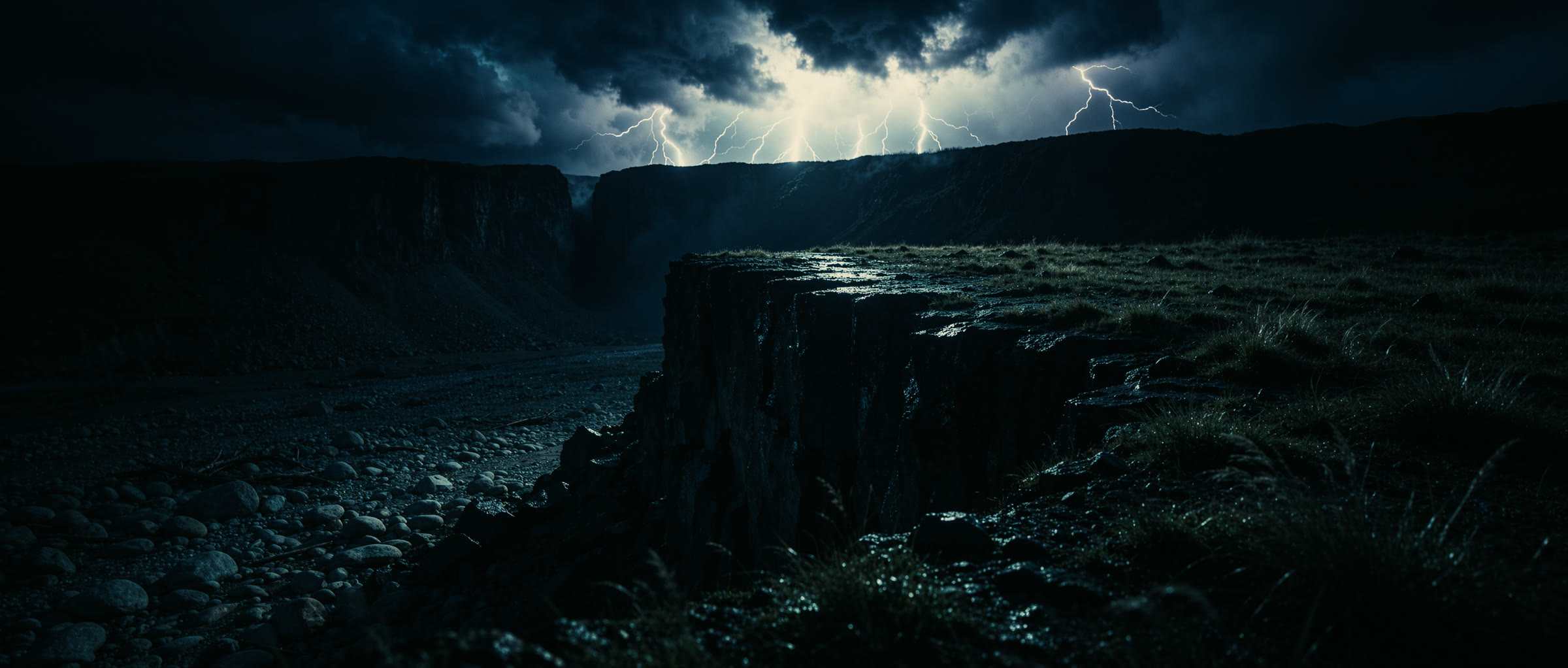
SCENE: Environment — the floor of a wide canyon at night during a thunderstorm, empty, seen from ground level along the canyon at a three-quarter angle. The camera stands low on the canyon floor off-center toward the left wall and looks along the canyon, so the right wall is seen at an angle as a long receding faceted face and the left wall rises close on the left edge of the frame. In the foreground wet black basalt slabs and shallow puddles. In the middle an open, empty, level area across the canyon floor, about 30 m wide. On the left and on the right tall dark wet canyon walls with sharp angular faces. In the distance the canyon bends to the right and leads to a gentle sloping exit that rises out of the canyon. Era — timeless, untouched natural landscape. Time of day — deep night during a thunderstorm. Atmosphere — the core of the storm hanging directly over the canyon, heavy churning clouds filling the sky between the rims, cold humid air, everything wet. Physical details — the foreground of flat and slightly tilted black basalt slabs with straight cracks and joints between them, polished by water and weather, wet and glossy, with shallow puddles lying in the dips and along the joints; the level open area of compact dark gravel, flat stone and fine wet grit, clean and free of boulders; both walls of dark, almost black basalt broken into large angular facets and vertical columns, with sharp edges, ledges, overhangs and scree fans at their feet; thin streaks of rainwater running down the walls; the exit in the distance a gentle natural slope of dark gravel and stone climbing to the right out of the canyon toward the open sky.

SUBJECT: Identity — the location itself: the floor of a basalt canyon at night in a storm, a reference plate of the space. Appearance — wet black basalt slabs and puddles in the front, a 30 m wide empty level area in the middle, tall faceted dark walls on both sides, the canyon bending right toward a gentle exit in the distance; clear separation of the three depth layers. Facial expression — not applicable. Skin texture — surfaces: wet basalt slabs with a dense fine-grained texture, glossy under the water film, pitted with small vesicles, cracks filled with dark grit; puddles with black mirror-like water reflecting the lit storm clouds, faint rings and ripples from dripping water; wet gravel and grit on the open area with tiny glints on each stone; the walls with matte dark rock turning glossy where water runs, sharp fracture edges catching light. Hair — not applicable. Key features — low view from the canyon floor at three-quarter, wet black basalt slabs and shallow puddles in the foreground, an empty level area about 30 m wide in the middle, tall dark wet faceted walls on both sides, the canyon bending to the right toward a gentle sloping exit, the storm core directly above, cold white-blue lightning light from above, glints on the wet stone.

POSE: Stance — not applicable; the location is empty. Hands — not applicable. Head position — not applicable. Body tension — not applicable. Movement — no people, no animals, no vehicles; only the storm clouds and thin water streaks on the walls, frozen in the still.

WARDROBE: Style — not applicable. Details — not applicable; no people in frame.

PRODUCTION DESIGN: Architecture — none; natural rock only: basalt slabs, the level floor, the faceted walls, the natural exit slope. Props — none; no cones, no barriers, no poles, no ropes, no tracks or tyre marks on the floor. Vehicles — none. Details — nature untouched by people; no paved road, no road markings, no man-made objects, no lights, no signs; wet surfaces everywhere.

LIGHTING: Source type — natural night storm light: the core of the thunderstorm directly over the canyon, lightning discharges inside the cloud base straight above, the flash-lit clouds acting as a huge cold overhead soft source; no other light sources. Key light — cold white-blue lightning light falling from directly above, lighting the top surfaces of the basalt slabs and the level floor, laying sharp specular glints on every wet stone and gravel grain, catching the upward-facing ledges and the top edges of the facets on both walls, outlining both canyon rims against the sky. Reflections — the puddles in the foreground mirroring the bright churning storm clouds overhead, the wet slabs carrying soft sheens of the lit sky. Fill light — low cold ambient light bouncing off the wet floor and the clouds, keeping the vertical faces of the walls readable in deep blue-grey, shadow detail preserved. Back light — the brighter sky over the exit in the distance separating the bend of the canyon and the exit slope from the clouds. Contrast ratio — approximately 6:1 low-key, the floor clearly lit, the vertical walls darker, shadow detail preserved. Color temperature — lightning around 8000K cold white-blue, ambient around 9000K deep blue, no warm sources. Shadow behavior — short shadows falling straight down under ledges, overhangs and slab edges, consistent overhead direction across the whole plate; the lower parts of the walls under overhangs in deep shadow.

COMPOSITION: Shot size — wide establishing location plate. Framing — three-quarter view along the canyon from ground level: the wet slabs and puddles across the bottom of the frame, the empty level area spreading through the middle, the left wall rising close on the left edge, the right wall receding at an angle, the canyon turning right in the distance toward the exit; asymmetric, the depth leading to the right, never a centered one-point corridor; the walls occupy the sides and much of the frame height, the storm sky a wide band between the rims. Camera angle — low, near the ground, slight upward tilt to include both rims and the storm core, level horizon, no drone, no high angle. Depth layers — foreground: wet black basalt slabs and shallow puddles close to the lens; midground: the open empty level area about 30 m wide on the canyon floor, scree at the feet of both walls; background: the canyon bending to the right and the gentle sloping exit rising out of it, the faceted walls continuing into the bend. Focus priority — deep focus, the whole space readable from the foreground puddles to the exit. Visual balance — the near dark left wall weighed against the long lit right wall; the empty open area in the center of the plate as a stage; the bright puddle reflections in the front echoing the bright storm core above. Space map for later generations: left — tall dark faceted basalt wall; right — tall dark faceted basalt wall receding toward the bend; front — wet black basalt slabs and shallow puddles; center — empty level area about 30 m wide; far — the canyon bends right to a gentle sloping exit; light — always from directly above, glints on wet stone.

CAMERA: Mandatory camera string — Shot on ARRI Alexa 35 with a Cooke Anamorphic/i 32mm lens. Shallow depth of field, soft oval anamorphic bokeh, and characteristic edge distortion. Kodak Vision / 2383 lut film color emulation — soft contrast, high film grain. Focal length — 32 mm. Camera movement — locked-off. Exposure — exposed for the lit storm clouds and the puddle reflections, holding them without clipping, the walls deep but retaining detail. Format — digital cinema capture with anamorphic optical character.

LENS BEHAVIOR: Distortion type — strong vintage anamorphic edge warping and subtle curved frame deformation. Bokeh style — large soft oval anamorphic bokeh with stretched cinematic light smearing. Optical character — visible lens breathing, strong halation, edge softness, organic film grain, realistic cinematic imperfections, and subtle image instability.

COLOR GRADING: Palette — black wet basalt with blue-grey sheen, silver-white puddle reflections, cold white-blue glints, deep blue-grey ambient on the walls, churning storm clouds from bright silver-blue at the core to dark slate at the edges, dark charcoal gravel. Contrast — soft cinematic low-key contrast, deep but open shadows. Highlight rolloff — smooth filmic rolloff on the storm core, the puddles and the glints. Film emulation — Kodak Vision / 2383 LUT-inspired color response with organic grain and restrained saturation.

VISUAL STYLE: Mood — ultra cinematic workstation concentration. Image characteristics — organic film grain, strong anamorphic halation, vintage optical softness, realistic cinematic deformation, stretched highlights, curved edge distortion, and visible filmic image instability.

ATMOSPHERE: Environmental depth — thin damp haze filling the bend of the canyon, slightly lifting the tone of the far walls and the exit. Air quality — heavy storm air, fine moisture visible only against the bright clouds. Motion — still image of churning storm clouds and thin water streaks, nothing else moves. Emotional tone — vast, cold, charged; an empty stone arena under the heart of the storm, waiting.

TECHNICAL QUALITY: Realism — high-end live-action cinema realism, a real location photographed at night in a storm. Detail level — extremely detailed wet basalt slabs and joints, puddle reflections, gravel glints, faceted wall surfaces and edges, water streaks, cloud structure. Dynamic range — wide cinematic dynamic range with preserved highlights and detailed shadows. Image integrity — physically plausible lighting with one consistent overhead light direction, natural perspective, coherent scale of the 30 m floor and the tall walls, authentic textures, restrained optical imperfections.

NEGATIVE PROMPT: anime, 3D render, illustration, digital art, cartoon style, painterly style, CGI look, video game render, low resolution, artificial lighting artifacts, amateur photography, non-cinematic composition, excessive HDR, oversaturated colors, sterile digital sharpness, text overlays, logos, watermarks, readable signage, frontal flat elevation, symmetrical one-point perspective, centered vanishing point, symmetrical corridor, people, crowds, animals, cars, vehicles, tyre tracks, paved road, road markings, cones, barriers, ropes, man-made lights, drone view, high angle, fisheye, painted backdrop look, matte-painting look, tilt-shift miniature, narrow slot canyon, boulders on the open area, river on the canyon floor, red or yellow sandstone, light-coloured rock, layered sedimentary rock, smooth rounded walls, vegetation, trees, canyon bending to the left, steep exit, sunlight, daylight, moon, stars, clear sky, warm light, sunset colors, dry rock, snow, light from the side, inconsistent shadow directions, warped rock, impossible perspective.
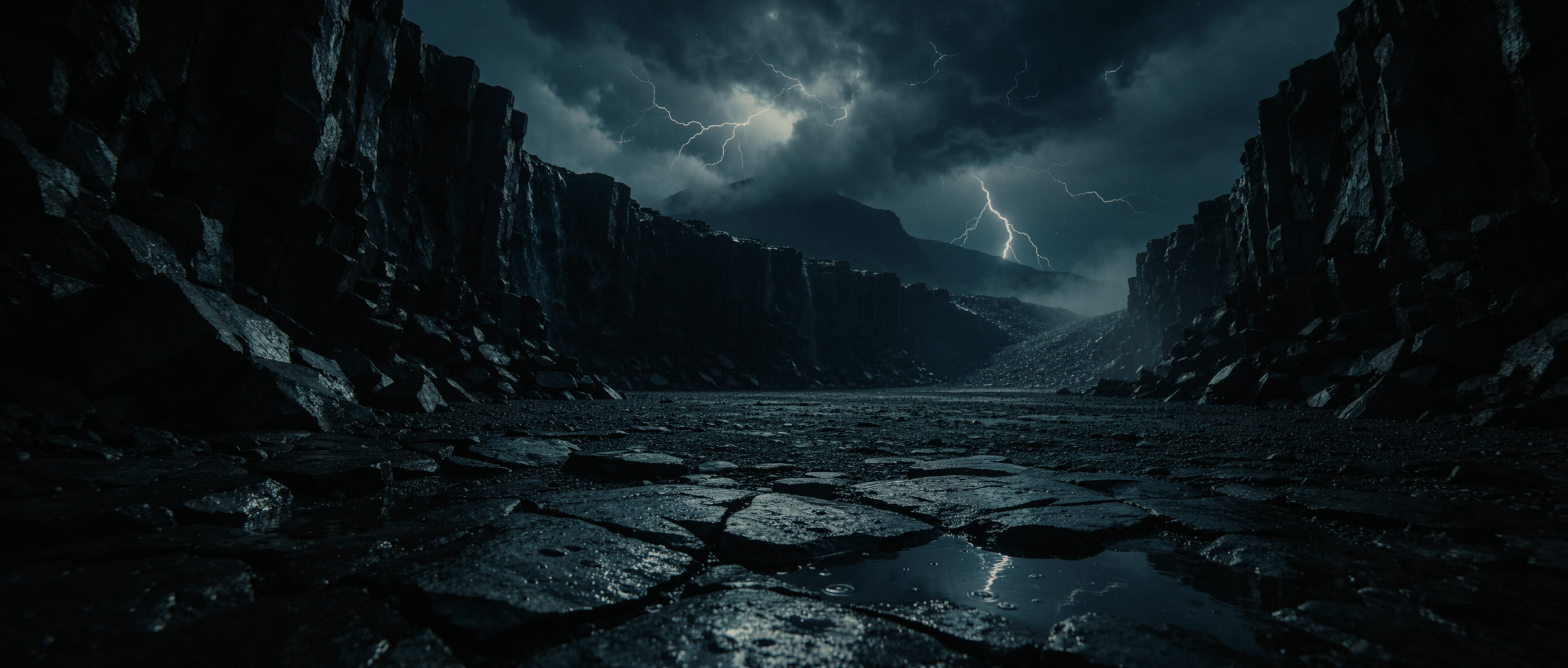
SCENE: Environment — a vast high Tien Shan plateau at night during a thunderstorm, empty, seen from a three-quarter angle with the camera low to the ground. In the foreground wet steppe grass, dark mud and shallow puddles. Through the middle a wide, level plateau stretches far into the distance, and in the middle of it stands a single dark granite outcrop about 3 m high with a flat top, seen at three-quarter so two of its faces are visible. On the left the plateau runs away toward low dark rolling hills. On the right the plateau runs out to the edge of a rock cliff: the ground ends in a straight dark broken edge, beyond it only empty darkness and air. In the far distance a high jagged mountain ridge stretches across the full width of the horizon. Era — timeless, untouched natural landscape, no human traces. Time of day — deep night during a thunderstorm. Atmosphere — a heavy, massive storm sky: towering dark cloud banks with deep folds and rolling undersides, lit from inside by lightning over the ridge; humid charged air; the ground soaked and wet. Physical details — the foreground: real wild steppe vegetation, tall feather grass with heavy wet plumes, tussocks of fescue, silvery wormwood, short grass between, bent by the wind and beaded with water; patches of dark glistening mud between the tussocks, shallow puddles of different sizes reflecting the lit clouds; the plateau surface of low wet grass with scattered dark stones; the granite outcrop a solid block of dark grey coarse-grained granite with rounded weathered corners, vertical cracks and horizontal sheet joints, a flat roughly level top, small fallen blocks and gravel at its foot, wet and glinting at its edges; the low hills on the left smooth and grassy, black against the clouds; the cliff edge on the right a sharp line of broken dark rock; the ridge in the distance a long wall of jagged peaks and saw-tooth crests, steep and dark.

SUBJECT: Identity — the location itself: a stormy night plateau with a lone granite outcrop, a reference plate of the space. Appearance — wet grass, mud and puddles in front, the flat wide plateau with the 3 m flat-topped granite outcrop in the middle, low hills on the left, the cliff edge on the right, the jagged ridge across the whole horizon, a dramatic storm sky lit by lightning over the ridge; clear separation of the three depth layers. Facial expression — not applicable. Skin texture — surfaces: feather grass plumes silky and translucent, glowing at their edges in the backlight, each blade of grass with water drops catching the light; sticky dark mud with a smooth wet surface and thin films of standing water; puddles with mirror-like surfaces holding sharp reflections of the lightning-lit clouds; granite with visible crystals of feldspar and quartz in a dark grey matrix, rough to the touch, darker where wet, small patches of grey-green lichen on the top edges; the ridge rock dark and snowless, its crests sharp against the lit clouds. Hair — not applicable. Key features — low three-quarter view, wet backlit steppe grass, mud and puddles in the foreground, a wide level plateau, a single dark granite outcrop 3 m high with a flat top in the middle, low dark hills on the left, a rock cliff edge on the right, a high jagged ridge across the whole horizon, massive storm clouds, cold white-blue lightning above the ridge, backlit glints on the grass and in the puddles.

POSE: Stance — not applicable; the location is empty. Hands — not applicable. Head position — not applicable. Body tension — not applicable. Movement — no people, no animals, no vehicles; only the storm clouds and the grass bent by the wind, frozen in the still.

WARDROBE: Style — not applicable. Details — not applicable; no people in frame.

PRODUCTION DESIGN: Architecture — none; natural landforms only: plateau, granite outcrop, hills, cliff edge, ridge. Props — none; no cairns, no markers, no fences, no yurts, no poles, no paths, no tracks. Vehicles — none. Details — nature untouched by people; no man-made objects, no lights on the horizon, no signs; wet surfaces everywhere.

LIGHTING: Source type — natural night storm light: lightning above the ridge in the far distance, several branching bolts dropping from the cloud base onto the peaks, and sheet lightning glowing inside the clouds over the ridge; the lit cloud bases act as a huge cold back light for the whole plateau; no other light sources. Key light — cold white-blue lightning light coming from behind, from the ridge toward the camera, low and raking across the plateau: rimming every grass blade, plume and seed head in the foreground with a thin bright edge, laying long bright glints across the puddles and the wet mud, outlining the top edges and the corners of the granite outcrop, catching the jagged crests of the ridge. Fill light — very low cold ambient light from the lit clouds overhead, keeping the faces of the outcrop, the hills and the plateau readable in deep blue-grey, shadow detail preserved. Back light — the lightning itself behind the ridge, silhouetting the whole ridge line and separating the outcrop from the plateau behind it. Contrast ratio — approximately 10:1 low-key, with shadow detail preserved in the near grass, the mud and the shadow side of the outcrop. Color temperature — lightning around 8000K cold white-blue, ambient around 9000K deep blue, faint violet in the brightest cloud cores, no warm sources. Shadow behavior — long soft shadows falling toward the camera from every tussock and from the outcrop, consistent direction across the whole plate; the camera-facing sides of the grass, the stones and the outcrop in shadow, their edges glowing.

COMPOSITION: Shot size — wide establishing location plate. Framing — three-quarter view across the plateau, low to the ground: backlit wet grass and puddles across the bottom of the frame, the plateau receding diagonally, the outcrop in the middle distance at about the right third line and seen at three-quarter with two faces visible, the hills running away on the left, the cliff edge cutting off the plateau on the right; asymmetric, no central vanishing point, never a frontal flat elevation; horizon low, at about the lower third, the storm sky with the lightning taking the upper two thirds. Camera angle — low, about half a metre above the wet grass, level horizon, slight upward feeling to make the outcrop and the ridge monumental; no drone, no high angle. Depth layers — foreground: tall wet feather grass, tussocks, dark mud and shallow puddles close to the lens, backlit and glinting; midground: the wide level plateau and the single 3 m granite outcrop with a flat top, the low hills on the left, the cliff edge on the right; background: the high jagged ridge across the whole horizon with lightning striking above it, the massive lit storm clouds. Focus priority — deep focus, the whole space readable from the foreground grass to the ridge; the eye lands first on the outcrop rimmed against the plateau, then on the lightning above the ridge. Visual balance — the dark mass of the outcrop and the cliff edge on the right weighed against the open plateau and soft hills on the left; the lightning above the ridge as the brightest point, slightly right of centre above the outcrop. Space map for later generations: foreground — wet steppe grass, mud, puddles; middle — wide level plateau with a lone dark granite outcrop 3 m high with a flat top; left — plateau to low dark hills; right — plateau ends at a rock cliff edge; far — high jagged ridge across the whole horizon; light — lightning above the ridge, everything backlit toward the camera.

CAMERA: Mandatory camera string — Shot on ARRI Alexa 35 with a Cooke Anamorphic/i 32mm lens. Shallow depth of field, soft oval anamorphic bokeh, and characteristic edge distortion. Kodak Vision / 2383 lut film color emulation — soft contrast, high film grain. Focal length — 32 mm. Camera movement — locked-off. Exposure — exposed for the lightning-lit clouds and the glints in the puddles, holding them without clipping; the shadow sides of the grass, the outcrop and the hills deep but with detail. Format — digital cinema capture with anamorphic optical character.

LENS BEHAVIOR: Distortion type — strong vintage anamorphic edge warping and subtle curved frame deformation. Bokeh style — large soft oval anamorphic bokeh with stretched cinematic light smearing. Optical character — visible lens breathing, strong halation, edge softness, organic film grain, realistic cinematic imperfections, and subtle image instability.

COLOR GRADING: Palette — deep blue-black night, slate and steel-blue storm clouds with white-blue and faint violet cores where the lightning glows, cold white rims on the grass, silver-white glints in the puddles, dark olive-grey wet grass, black-brown mud, dark grey granite, near-black hills and ridge. Contrast — deep but soft cinematic low-key contrast, open shadows. Highlight rolloff — smooth filmic rolloff on the lightning, the cloud cores, the grass rims and the puddle glints, soft halation around the bolts. Film emulation — Kodak Vision / 2383 LUT-inspired color response with organic grain and restrained saturation.

VISUAL STYLE: Mood — ultra cinematic workstation concentration. Image characteristics — organic film grain, strong anamorphic halation, vintage optical softness, realistic cinematic deformation, stretched highlights, curved edge distortion, and visible filmic image instability.

ATMOSPHERE: Environmental depth — moist air softening the hills and the ridge with distance, a faint veil of rain hanging under the far clouds over the ridge, lit by the lightning. Air quality — heavy humid storm air, fine moisture visible only against the backlight. Motion — clouds rolling and grass bent by the wind, frozen in the still. Emotional tone — epic, raw, solemn and tense; a lone stone altar on the roof of the world under the storm.

TECHNICAL QUALITY: Realism — high-end live-action cinema realism, a real location photographed at night in a storm, the landscape of a premium film. Detail level — extremely detailed feather grass plumes and water drops, varied grass blades, mud texture, puddle reflections, granite crystals, joints and lichen, ridge crests, cloud structure, lightning branches. Dynamic range — wide cinematic dynamic range with preserved highlights and detailed shadows. Image integrity — physically plausible backlighting with one consistent light direction, natural perspective, true large scale of the ridge, a believable 3 m scale of the outcrop, authentic textures, restrained optical imperfections.

NEGATIVE PROMPT: anime, 3D render, illustration, digital art, cartoon style, painterly style, CGI look, video game render, low resolution, artificial lighting artifacts, amateur photography, non-cinematic composition, excessive HDR, oversaturated colors, sterile digital sharpness, text overlays, logos, watermarks, readable signage, frontal flat elevation, symmetrical one-point perspective, centered vanishing point, people, crowds, animals, horses, yurts, tents, vehicles, roads, paths, fences, power lines, cairns, monuments, carved stone, man-made platform, city lights, drone view, high angle, fisheye, painted backdrop look, matte-painting look, tilt-shift miniature, flat lawn-like grass, mowed grass, uniform green carpet, plastic grass, empty flat sky, uniform haze, small flat hills instead of a mountain ridge, tiny distant mountains, smooth rounded mountains, snow-covered ridge, giant boulder bigger than 3 m, pointed or rounded outcrop top, multiple outcrops, sandstone, light-coloured rock, river, lake, daylight, moon, stars, clear sky, warm light, sunset colors, dry ground, snow on the ground, light coming from the left or right, front-lit grass, inconsistent shadow directions, cartoon zigzag lightning, warped landscape, impossible perspective.
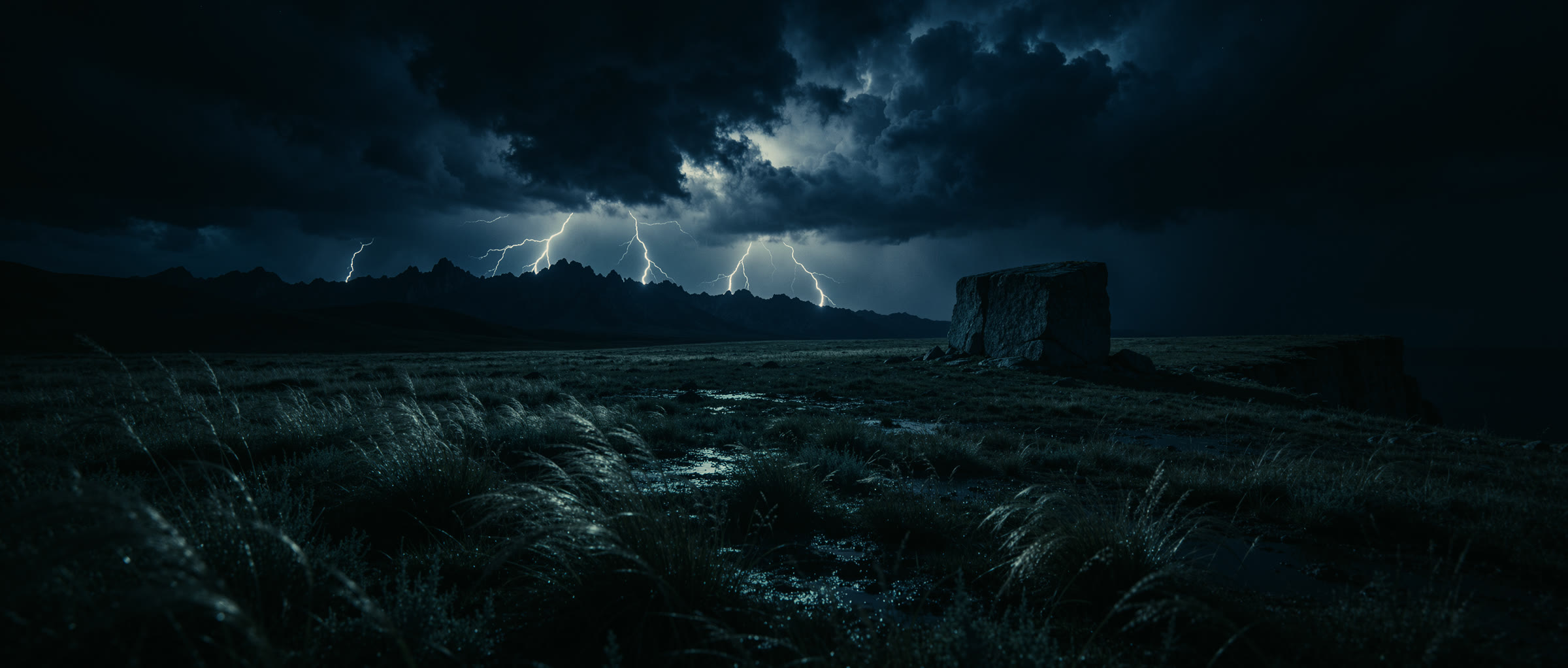
Генерация видео
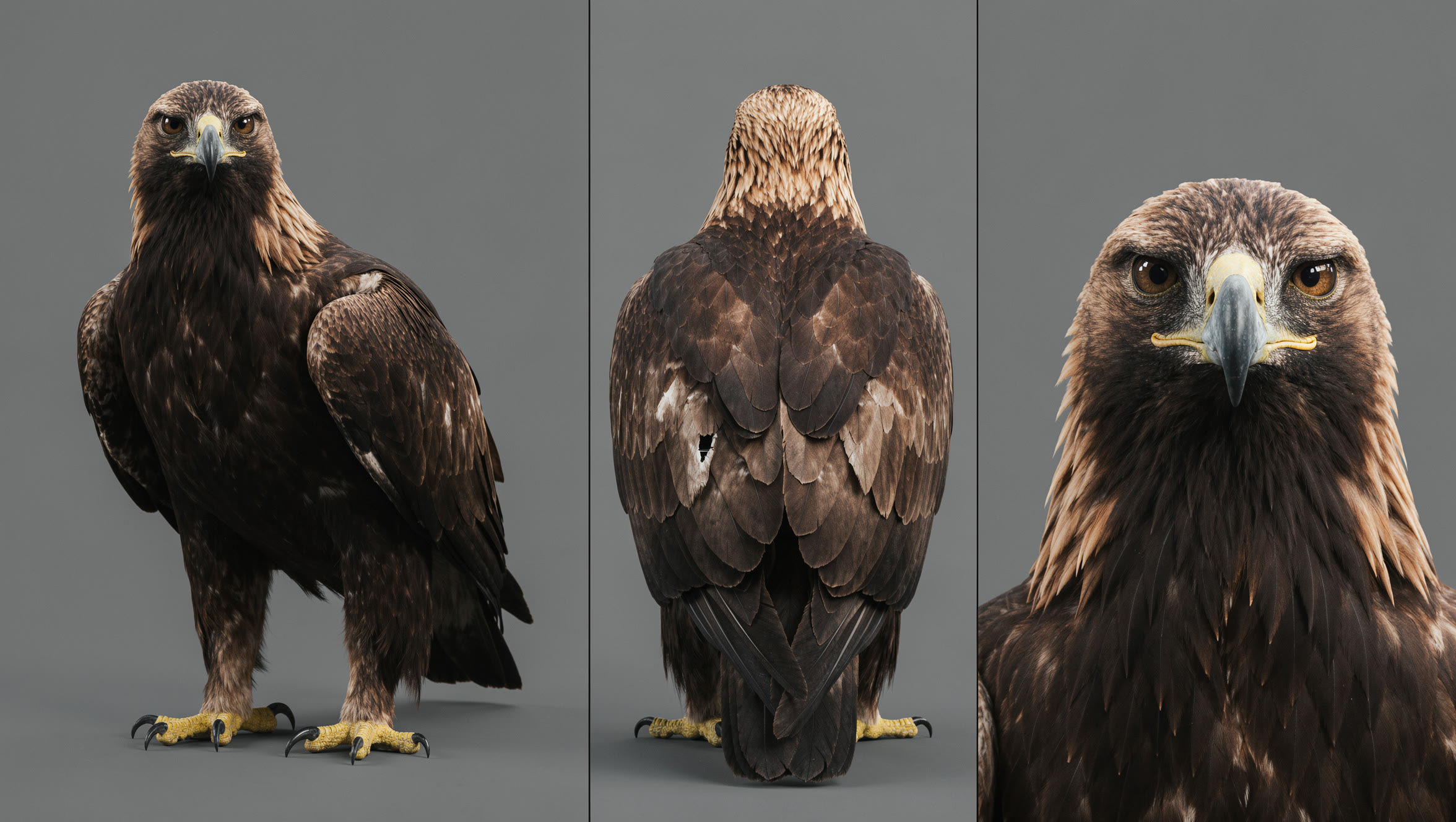
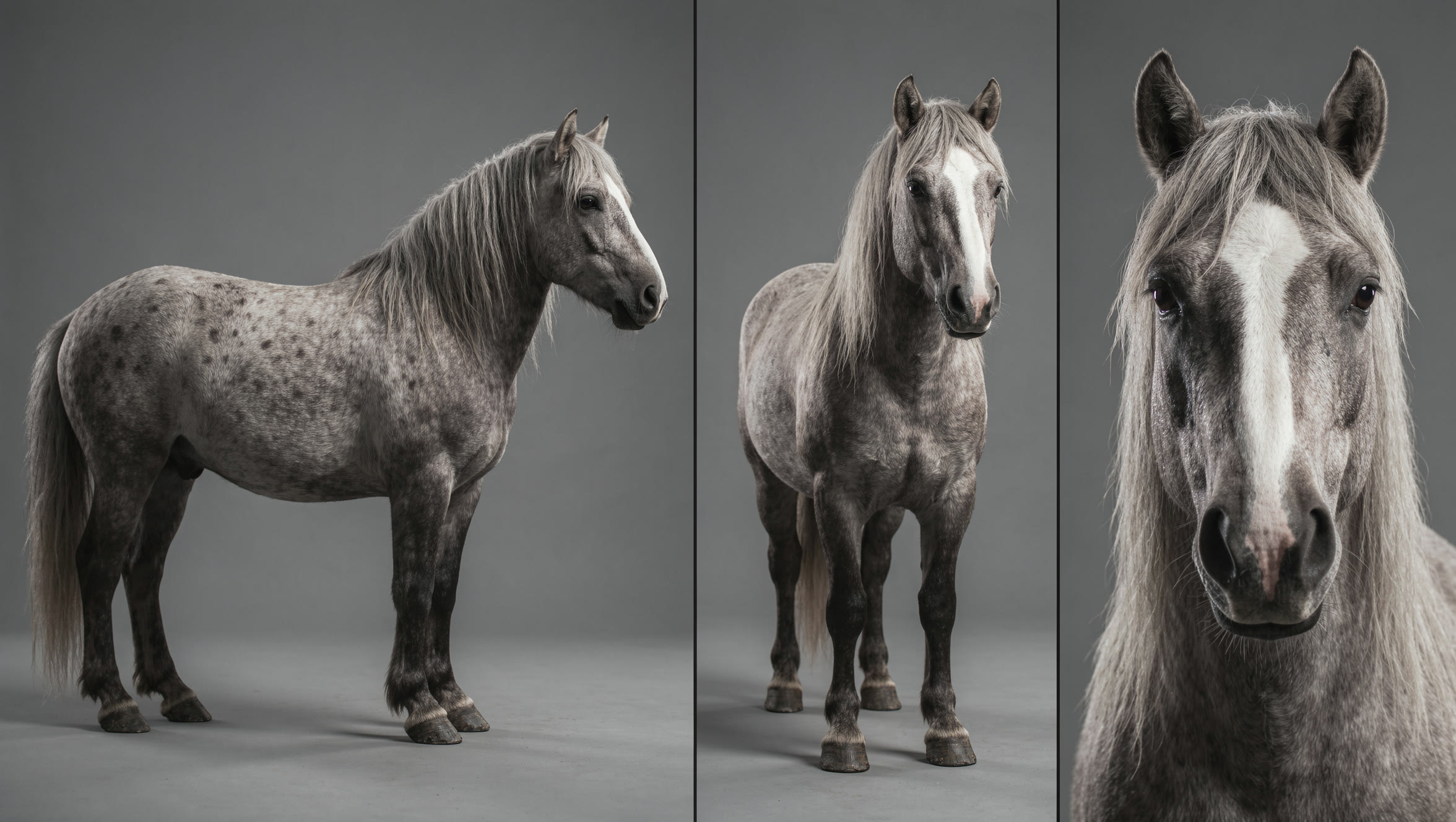
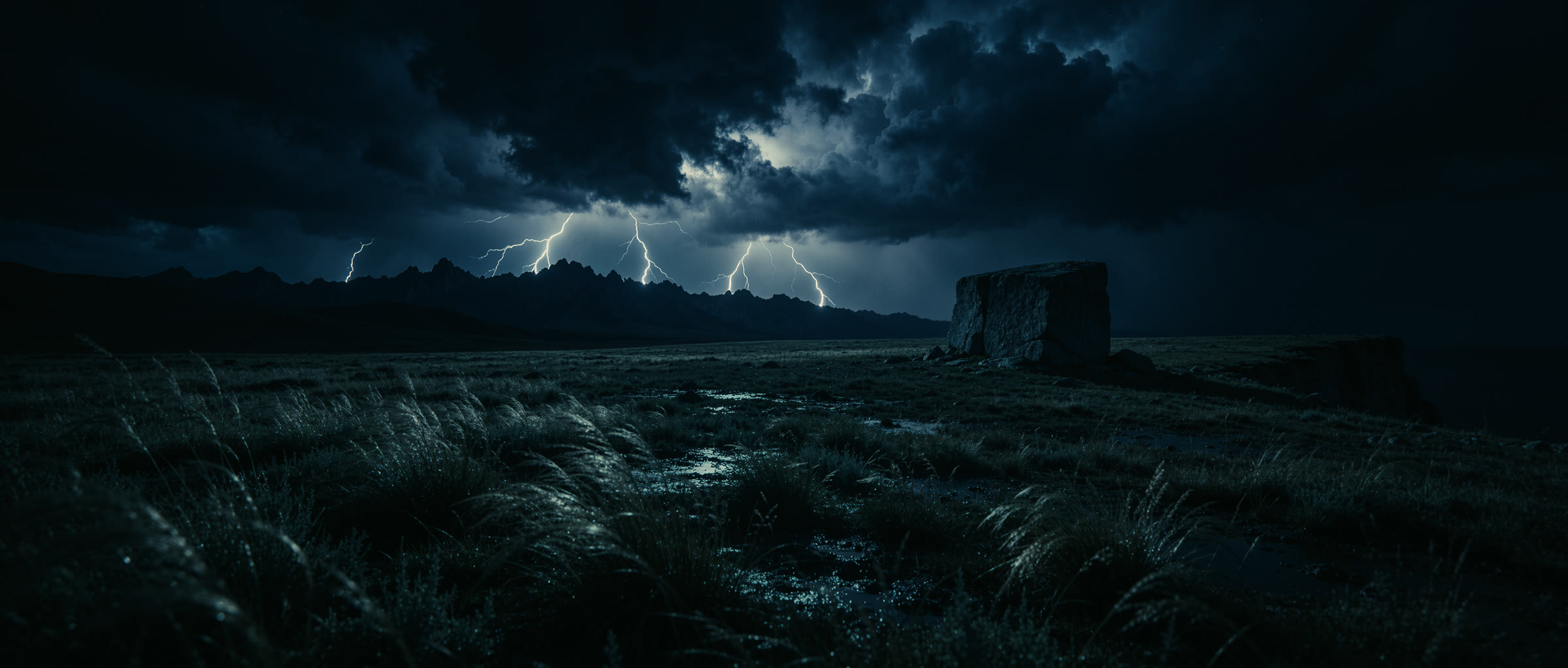
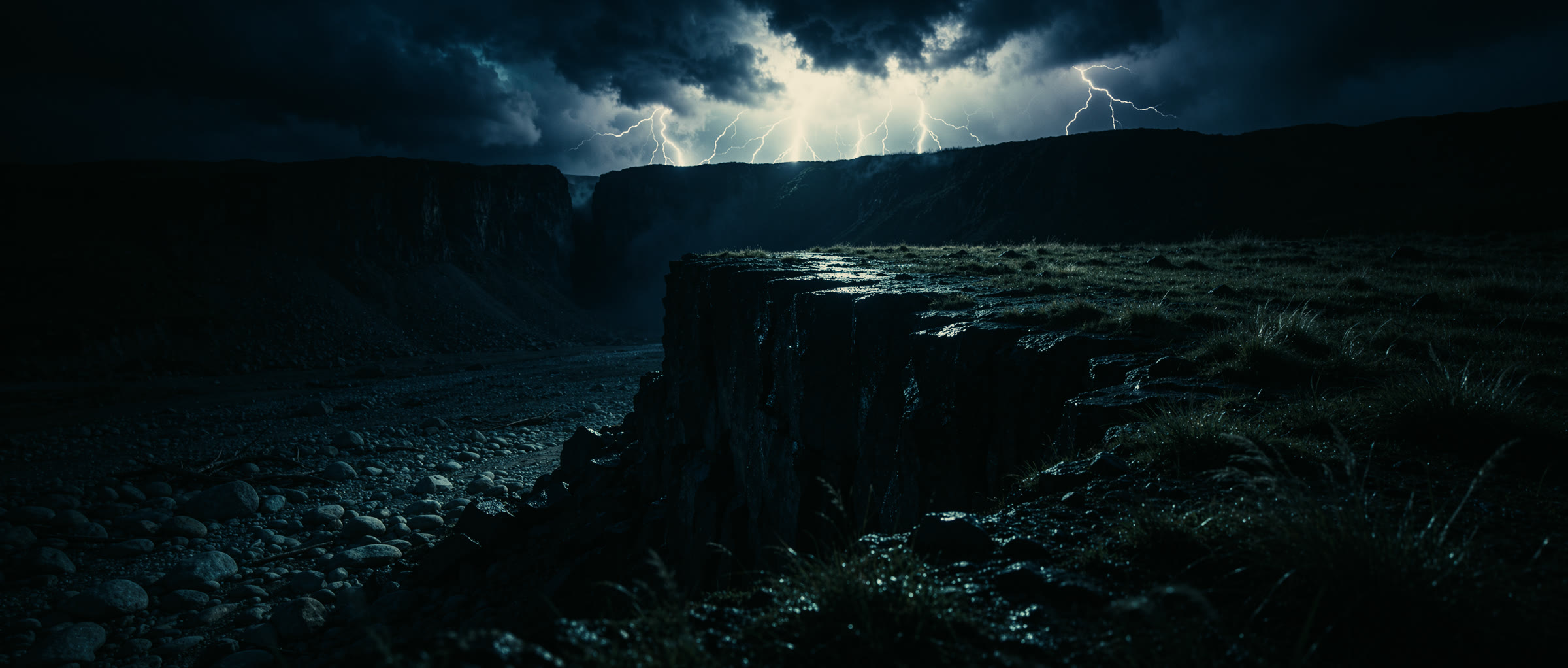
A golden eagle and a stampede of two hundred wild horses are frozen in a single instant of a night thunderstorm over a Tian Shan highland plateau while only the lightning and the camera move, high-budget epic feature-film commercial, the camera flies through the frozen storm from inside the clouds down into the herd and over the cliff edge where the herd leaps.

Format: 9 shots with hard cuts at 4s, 7s, 10s, 13s, 15s, 20s, 24s and 27s. Time is completely frozen in every shot: all shots show the same single frozen instant from different camera positions.

Subject: The golden eagle — @Image 1: take its plumage, colours, beak, eyes, feet and talons, the pale shoulder patches and the gap in the wing feathers; it applies in shots 1–3, high in the sky above the herd; do not take the studio background, the standing pose or the studio light. The dapple-grey stallion — @Image 2: take his coat pattern, charcoal lower legs, long light-grey mane and tail, white blaze, face, eyes and build; he applies in shots 3–5, in the middle of the herd on the plateau; do not take the studio background, the standing pose or the studio light. The herd: about two hundred wild steppe horses, stocky, 135–145 cm at the withers, bay and dun coats, the duns with a dark dorsal stripe, long dark manes and tails, unshod dark hooves, no halters or tack of any kind; the grey stallion from @Image 2 is the only grey horse in the whole herd, every other horse is bay or dun. The plateau — @Image 3: take the terrain, the wet steppe grass and puddles, the granite outcrop, the cliff edge on the right side of the plateau and the jagged mountain ridge across the horizon; it applies in shots 1–6; do not take the purple colour of its lightning or the shape of its lightning bolts. The cliff — @Image 4: take the shape and texture of the dark basalt ledge, the dry riverbed of rounded boulders below it and the dark canyon cleft beyond the riverbed; it applies in shots 7–9; do not take the purple colour of its lightning or the shape of its lightning bolts; the jagged ridge from @Image 3 rises behind the canyon. No people, no vehicles, no other animals are present. lock identity, age, body proportions, coat and plumage pattern, lighting, and spatial relationship to the reference images throughout the scene.

Action: In one frozen instant of a thunderstorm, the golden eagle hangs motionless in a vertical stoop high above a stampede of two hundred wild horses racing across the plateau toward the mountain ridge; the front of the herd is frozen in mid-air leaping off an 8 m basalt ledge, the horses behind it frozen at the very edge, the grey stallion frozen mid-gallop in the middle of the herd. Nothing living moves. The camera travels through this frozen instant from inside the storm cloud, past the eagle, down into the herd, to the cliff, and up into the sky, where all the lightning in the sky draws together into one colossal bolt that strikes the floor of the canyon at the foot of the ridge.

Environment: Night, violent thunderstorm over a high Tian Shan plateau. Layout as in @Image 3 and @Image 4. Geography: the herd races west toward the jagged mountain ridge; between the herd and the ridge the plateau ends in a vertical basalt ledge 8 m high; below the ledge lies a wide dry riverbed of rounded boulders; beyond the riverbed, at the foot of the ridge, a deep dark canyon cleft. The storm core sits above the ridge, ahead of the herd, so the animals are backlit by the lightning. In the side views the camera is on the south side of the herd and the herd moves from frame-right to frame-left. Frozen state of the whole scene: every animal is a motionless statue caught mid-action — no breathing, no blinking, no muscle twitch, no movement of mane, tail or feather; raindrops hang motionless in the air like beads of glass; mud clods, pebbles, stones, dust and water spray hang suspended exactly where they were thrown; the grass does not move. Only two things move in the entire film: the camera, travelling through the frozen scene with real parallax, and the lightning.

Lightning: real atmospheric lightning as photographed in a real storm — a thin, jagged, ragged channel with a blinding pure-white core and a faint cold blue halo around it; stepped leaders that fork again and again into thinner and thinner capillary branches; each branch pulses and flickers in brightness; the bolts crawl and branch slowly through the frozen world while everything else stands still. Each flash throws a hard, instantaneous white-blue light onto the hanging rain, the mist, the grass, the rock and the animals, casting sharp shadows that jump with every flicker. Electricity on the animals: hair-thin crawling filaments of the same white-blue electricity creep slowly across wet fur and feathers like frost spreading across glass, lighting individual wet hairs and feather edges from within, tiny bright sparks jumping off the tips of hairs; the light of each filament falls on the coat around it. The lightning has the colour and behaviour of real electricity only: white core, cold blue edge, sharp and thin.

Camera: Cinematic feature-film camera travelling through a frozen world on smooth, heavy, physically weighted paths — flying, diving, gliding and orbiting like a high-end aerial and motion-control rig; every shot has its own position, shot size and lens, given in the Timing below; the camera stays sharp on the subject of each shot while foreground objects pass close to the lens out of focus.

Look: Shot on ARRI Alexa 35 with Cooke Anamorphic/i lenses. Anamorphic character visible in frame: shallow depth of field with soft oval bokeh, horizontal blue-tinged flare streaks only from practical light sources never from the sun, gentle barrel distortion and slight edge softness, wide 2x squeeze feel with compressed vertical perspective. Kodak Vision / 2383 film print emulation: soft contrast, highlights roll off gently and keep detail, natural fine film grain, no digital sharpness.

White balance: cool night balance, steel-blue base, the lightning cores read as clean neutral white, colours muted and natural, room left for grading.

Exposure: highlights never clip — the lightning cores, the lit rain and the wet highlights keep detail; shadows stay deep but keep texture in fur, feathers, grass and rock.

Lighting: the only light is the lightning; key light is hard, cold white-blue backlight from the storm over the ridge ahead of the herd; it builds in three layers: the bolt itself; its light caught in the hanging rain, mist and haze as visible beams and glowing veils of droplets; and a cold steel-blue ambient base in which the animals stand as near-silhouettes with crisp bright rim light along backs, manes, ears and feather edges while their faces sit in deep shadow. The camera moves, light sources stay in place.

Color: steel blue, desaturated teal and charcoal black; the only bright accent is the white-blue of the lightning and the electricity on the animals.

Style: Low-key night thunderstorm lit only by lightning: hard cold blue-white backlight from the storm behind the subjects, subjects mostly silhouettes with crisp bright rim light along backs, manes and feather edges, faces in deep shadow; near-black shadows that keep texture; heavy atmosphere of rain, mist and haze catching the light in visible beams; palette of steel blue, desaturated teal and charcoal black, the only bright accent the white-blue lightning; out-of-focus foreground bodies, debris and water drops framing a sharp subject in depth; water droplets on the lens front element and subtle chromatic fringing on the brightest lightning edges; weighty, majestic, primal mood of a nature epic shot as a feature film.

Texture: realistic wet animal coats with individual hair strands, translucent backlit edges and beads of rain on the fur; real feathers with visible barbs and rain beads; real wet basalt, mud and grass.

Timing:

00–04s: Camera: inside a dense storm cloud high above the plateau, extreme wide, 24 mm; a slow, smooth glide forward and downward; it starts in near-total darkness; a lightning branch crawls slowly through the cloud mass and lights up a wall of raindrops hanging motionless in the air; the camera glides straight through this wall of hanging drops — they pass the lens at arm's length, each drop flashing with reflected white-blue light, the nearest ones sliding past as soft out-of-focus beads; the camera exits through the ragged underside of the cloud; it finishes on an extreme wide view: far below, the dark wet plateau, and across the horizon the jagged ridge with lightning standing over it. Sound: <low sub-bass rumble>, <dry electric crackle of the discharge>, <fine glassy ticking of hanging drops>.

Hard cut at 4s to:

04–07s: Camera: diving vertically beside the golden eagle from @Image 1, keeping pace with it, wide shot, 35 mm; it starts level with the bird, the eagle in the right half of the frame, its head pointing straight down toward the plateau and the ridge; the eagle is frozen in a vertical stoop — wings half-folded tight against the body, talons thrust forward, head stretched forward, eye open; a hair-thin white-blue filament crawls along the leading edge of its left wing, lighting each feather edge from within, tiny sparks jumping off the feather tips; the camera accelerates past the bird, drops below it and tilts down; it finishes on an extreme wide view looking down past the eagle's talons: far below, the frozen stampede — about two hundred horses pouring across the plateau toward the ridge, a long plume of mud and spray hanging in the air behind them. Sound: <rushing whistle of air>, <crackle along the wing>.

Hard cut at 7s to:

07–10s: Camera: strictly top-down, directly above the middle of the herd, extreme wide, 24 mm; a slow descent while rotating 90° clockwise; it starts high: the herd fills the frame as one solid river of backs and manes, every horse frozen mid-gallop and pointed toward the top of the frame, toward the ridge; the grey stallion from @Image 2 is the single pale shape in the middle of the dark bay-and-dun mass; behind the herd hangs a plume of mud clods and water spray; branching lightning crawls across the sky above them and its flickering light sweeps across the backs like veins of white light running over the herd; it finishes lower, the backs, manes and the grey stallion's back in sharp detail. Sound: <deep rumble>, <distant rolling thunder>.

Hard cut at 10s to:

10–13s: Camera: at ground level among the hooves inside the herd, low angle looking up, 24 mm; a slow push-in forward with a rising tilt; it starts at a medium shot: frozen flanks and legs of neighbouring horses fill the left and right foreground out of focus and slide past by parallax, mud clods and pebbles hang in the air, raindrops sit beaded on the lens front glass and catch the light; in the centre of the frame the grey stallion from @Image 2 stands frozen mid-gallop with his head thrown back and up, mouth half open, nostrils flared, mane flung upward in a fan, the white blaze catching the light, rain beaded on his wet dapple-grey coat; directly behind his head a vertical lightning bolt strikes the plateau and outlines his silhouette with a hard white rim; it finishes at a medium close-up low under his chin, looking up at his head against the bolt. Sound: <sharp crackle>, <crunch of hanging grit>, <low rumble>.

Hard cut at 13s to:

13–15s: Camera: extreme close-up, 100 mm; a slow slide along the stallion's muzzle to his eye; it starts on the wet grey hair of the muzzle; the dark wet eye of the grey stallion with its lashes; a single raindrop hangs motionless in front of the eye with a tiny lightning bolt reflected inside it; a hair-thin white-blue filament creeps along the eyelashes, lighting each lash one by one; it finishes on the eye and the hanging drop filling the frame. Sound: <near silence>, <faint fine crackle along the lashes>.

Hard cut at 15s to:

15–20s: Camera: low at hoof height among the rear part of the herd, behind the galloping horses, 24 mm; a fast forward flight between the frozen legs toward the ridge, then a smooth rise; it starts at a medium-wide shot: hind legs, hooves and tails frame a narrow path, mud clods hang across it; ahead, through the gaps between the bodies, vertical white-blue lightning bolts stand on the plateau; the camera flies forward between the legs, then rises above the croups and tails and keeps flying forward over the backs of the frozen herd; ahead the jagged ridge, horizontal lightning blooming across the sky above it; it finishes at a wide shot over the backs: ahead the edge of the cliff, the first horses already frozen in mid-air beyond the edge, the ridge and the lightning behind them. Sound: <rumble growing>, <rolling thunder>.

Hard cut at 20s to:

20–24s: Camera: on the south side of the herd, level with the top of the ledge, wide shot, 35 mm; an orbit to the right; it starts at a strict side profile with the herd moving from frame-right to frame-left: the cascade — the lead horses frozen in mid-air over the 8 m basalt ledge from @Image 4, above the dry boulder riverbed, the horses behind them frozen at the very edge with forelegs stretched out over the drop; hair-thin white-blue electricity crawls along their bodies from heads to tails, lighting the wet hair and sparking off the manes; stones and dust hang under the hooves just off the edge; the camera orbits to the right around the cascade; it finishes at a three-quarter front view: the faces of the leaping horses toward the camera, the ledge behind them, the storm and the ridge beyond. Sound: <crackle across the bodies>, <deep rumble>.

Hard cut at 24s to:

24–27s: Camera: from the floor of the dry riverbed among the boulders, low angle looking up, medium shot, 32 mm; a slow crane up; it starts on the wet boulders with the leading horse high above; the first horse is frozen at the apex of its leap above the drop — legs tucked under the body, mane and tail fanned out; behind it a giant vertical lightning bolt splits the sky from top to bottom; the horse is a black silhouette with a razor-thin rim of white light; it finishes as the camera rises to the horse's level, its silhouette centred against the bolt. Sound: <massive thunderclap, stretched and slow>.

Hard cut at 27s to:

27–30s: Camera: rising above the frozen cascade and tilting toward the ridge, extreme wide, 24 mm; it starts above the leaping horses and keeps rising; all the lightning branches across the whole sky slowly bend toward one point and draw together, braiding into one colossal bolt; the colossal bolt drops down into the canyon cleft at the foot of the ridge beyond the riverbed and touches the canyon floor; it finishes at the moment of contact: a blinding white point deep in the canyon, the frozen cascade of horses small in the foreground. Sound: <deep stretched impact>, the sound tail rings on into the next scene.

Audio: No background music. The frozen world is silent except for the sounds of the lightning and the camera's passage: <low sub-bass rumble> under the whole film, <dry electric crackle> wherever electricity crawls, <glassy ticking of hanging raindrops>, <rolling thunder>, <massive stretched thunderclap> on the giant bolt, <deep stretched impact> at the end. Preserve the frozen positions of every animal, the grey stallion as the only grey horse, the backlight from the storm over the ridge, the white-blue colour of all lightning and the direction of the herd toward the ridge across every shot. No subtitles appear on screen.

Negative: No subtitles, captions or on-screen text. No background music. No logos or readable text. No purple, pink or neon lightning, no glowing tubes, no fantasy or cartoon glow; no extra animals, no people, no duplicated or floating limbs.
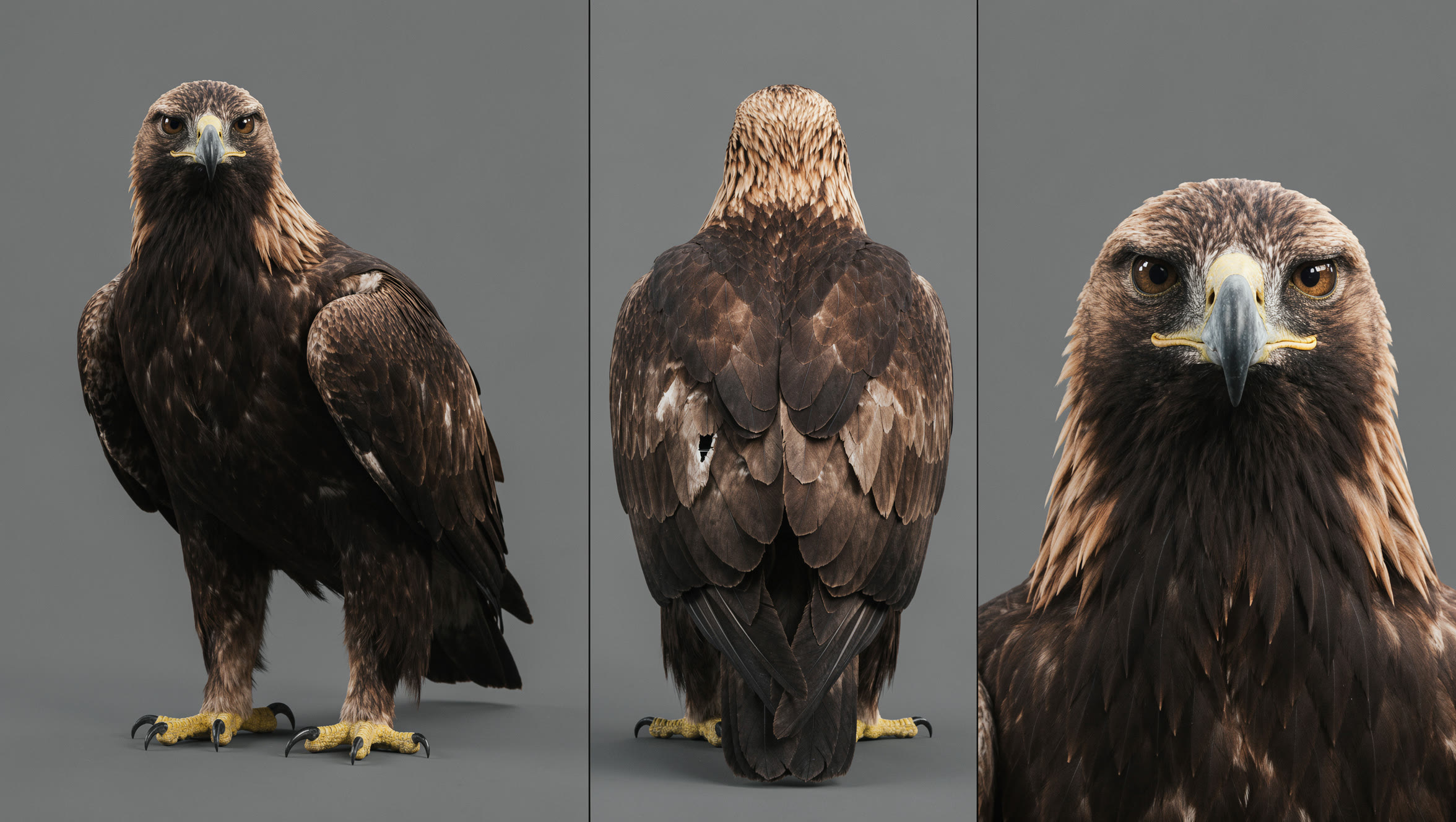
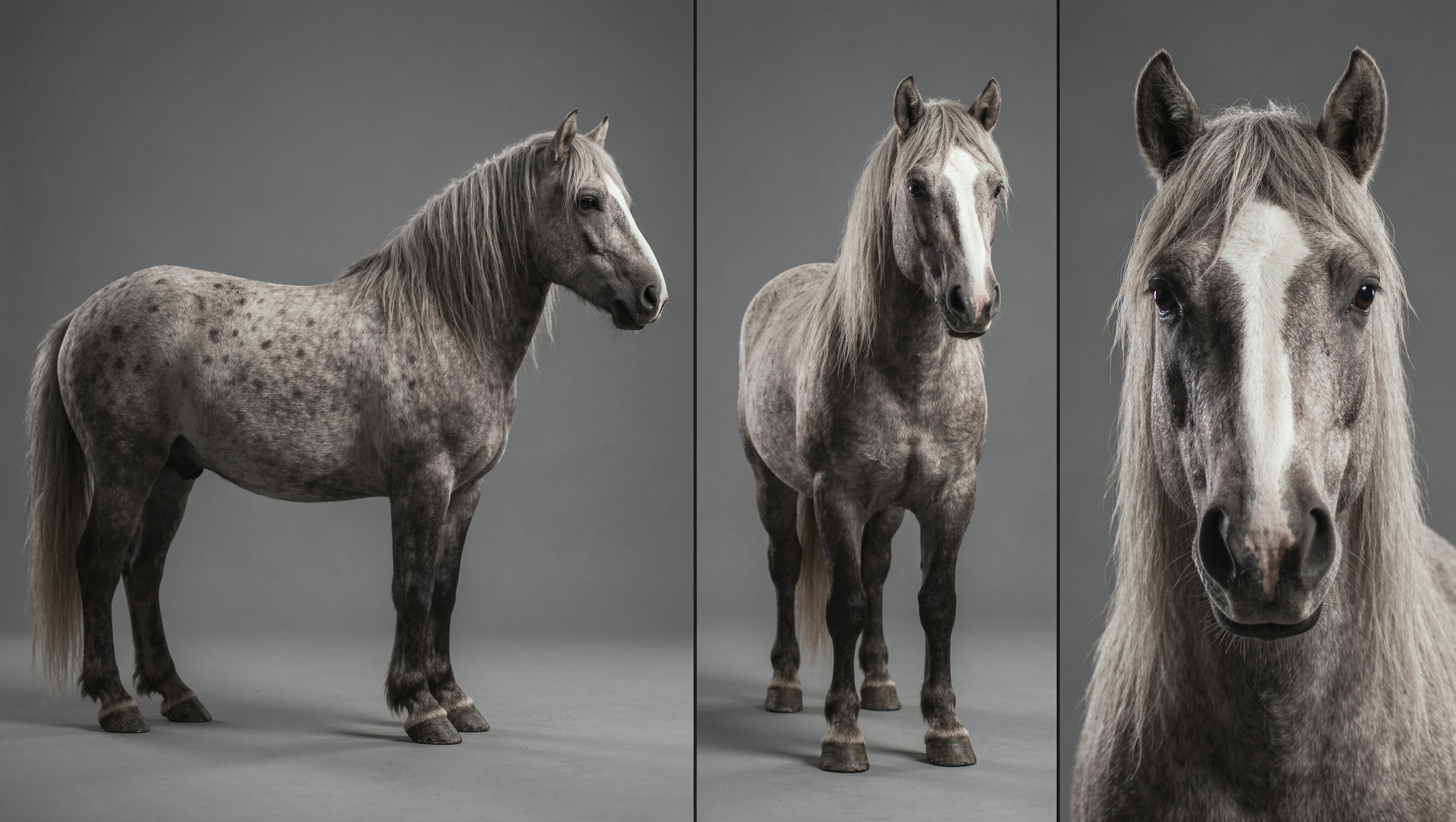
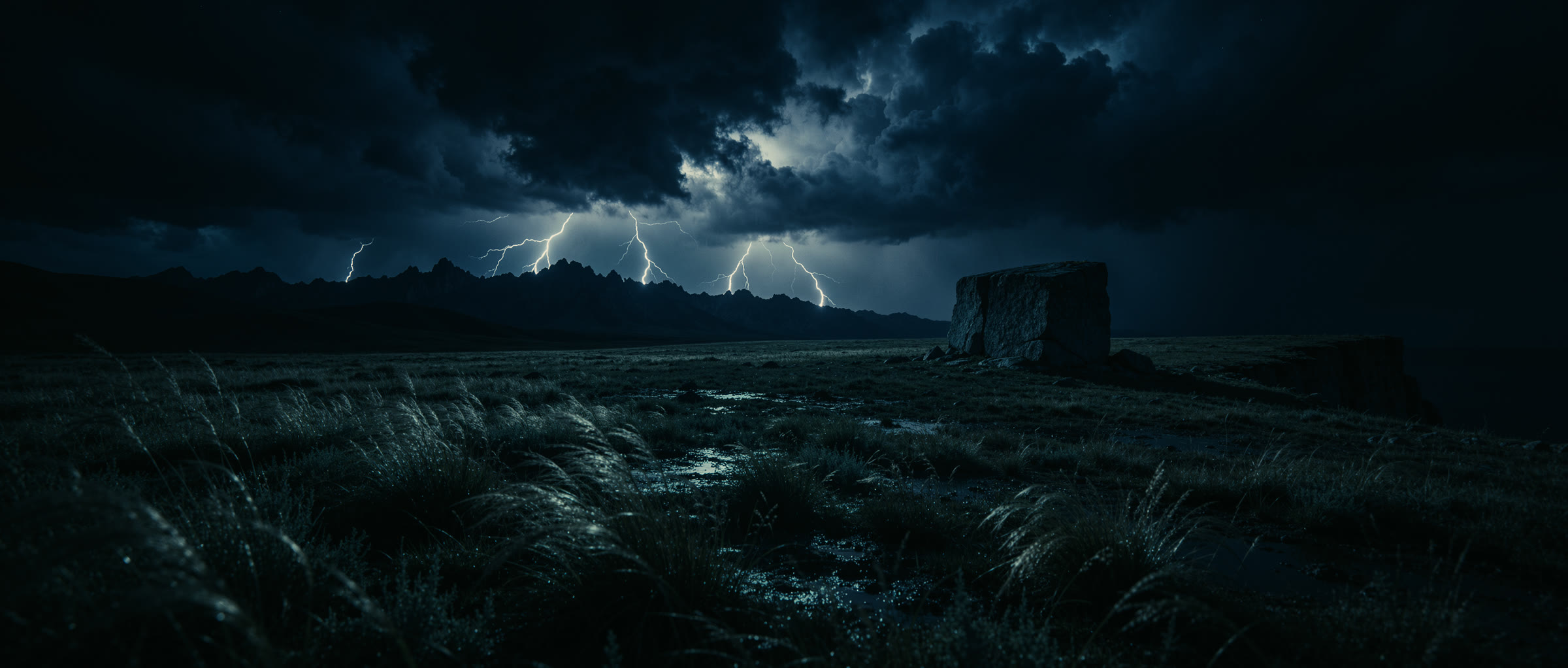
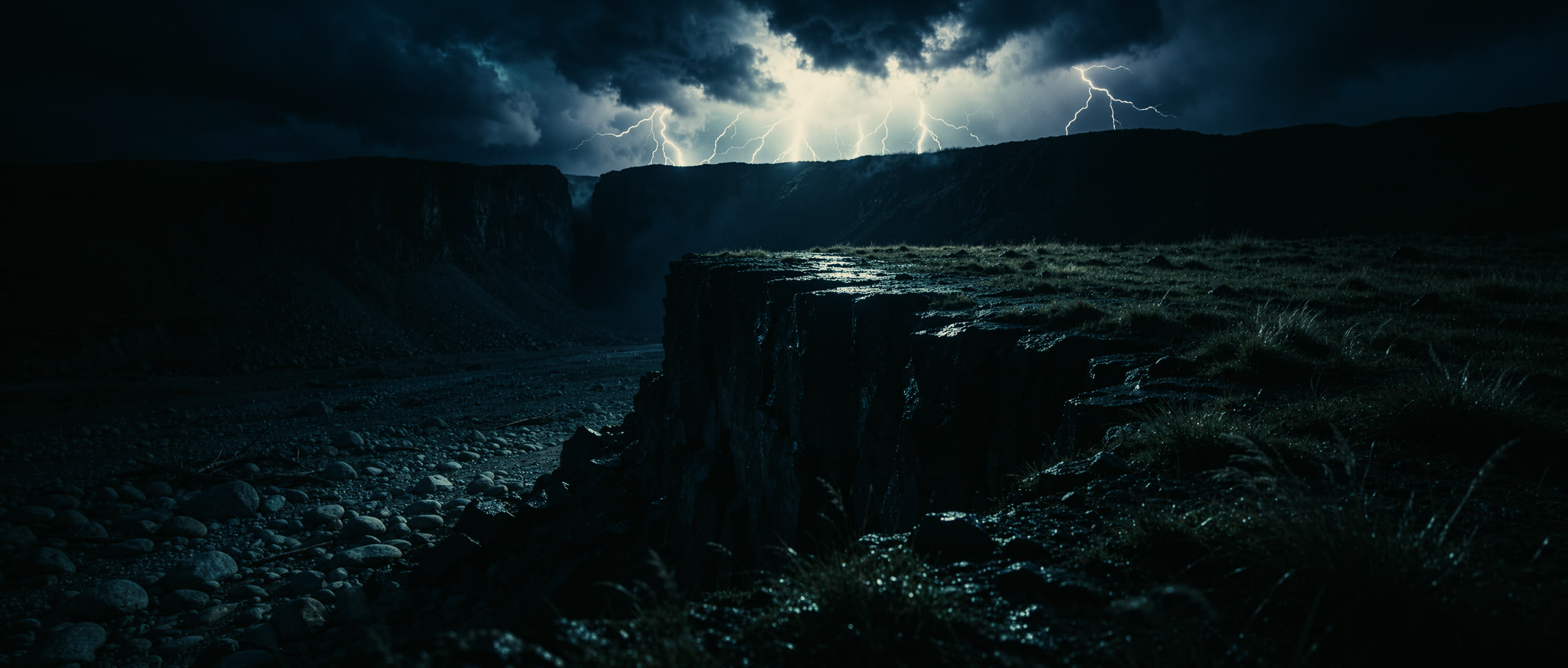
A golden eagle and a stampede of two hundred wild horses are frozen in a single instant of a night thunderstorm over a Tian Shan highland plateau while only the lightning and the camera move, high-budget epic feature-film commercial, the camera flies through the frozen storm from inside the clouds down into the herd and over the cliff edge where the herd leaps.

Format: 9 shots with hard cuts at 4s, 7s, 10s, 13s, 15s, 20s, 24s and 27s. Time is completely frozen in every shot: all shots show the same single frozen instant from different camera positions.

Subject: The golden eagle — @Image 1: take its plumage, colours, beak, eyes, feet and talons, the pale shoulder patches and the gap in the wing feathers; it applies in shots 1–3, high in the sky above the herd; do not take the studio background, the standing pose or the studio light. The dapple-grey stallion — @Image 2: take his coat pattern, charcoal lower legs, long light-grey mane and tail, white blaze, face, eyes and build; he applies in shots 3–5, in the middle of the herd on the plateau; do not take the studio background, the standing pose or the studio light. The herd: about two hundred wild steppe horses, stocky, 135–145 cm at the withers, bay and dun coats, the duns with a dark dorsal stripe, long dark manes and tails, unshod dark hooves, no halters or tack of any kind; the grey stallion from @Image 2 is the only grey horse in the whole herd, every other horse is bay or dun. The plateau — @Image 3: take the terrain, the wet steppe grass and puddles, the granite outcrop, the cliff edge on the right side of the plateau and the jagged mountain ridge across the horizon; it applies in shots 1–6; do not take the purple colour of its lightning or the shape of its lightning bolts. The cliff — @Image 4: take the shape and texture of the dark basalt ledge, the dry riverbed of rounded boulders below it and the dark canyon cleft beyond the riverbed; it applies in shots 7–9; do not take the purple colour of its lightning or the shape of its lightning bolts; the jagged ridge from @Image 3 rises behind the canyon. No people, no vehicles, no other animals are present. lock identity, age, body proportions, coat and plumage pattern, lighting, and spatial relationship to the reference images throughout the scene.

Action: In one frozen instant of a thunderstorm, the golden eagle hangs motionless in a vertical stoop high above a stampede of two hundred wild horses racing across the plateau toward the mountain ridge; the front of the herd is frozen in mid-air leaping off an 8 m basalt ledge, the horses behind it frozen at the very edge, the grey stallion frozen mid-gallop in the middle of the herd. Nothing living moves. The camera travels through this frozen instant from inside the storm cloud, past the eagle, down into the herd, to the cliff, and up into the sky, where all the lightning in the sky draws together into one colossal bolt that strikes the floor of the canyon at the foot of the ridge.

Environment: Night, violent thunderstorm over a high Tian Shan plateau. Layout as in @Image 3 and @Image 4. Geography: the herd races west toward the jagged mountain ridge; between the herd and the ridge the plateau ends in a vertical basalt ledge 8 m high; below the ledge lies a wide dry riverbed of rounded boulders; beyond the riverbed, at the foot of the ridge, a deep dark canyon cleft. The storm core sits above the ridge, ahead of the herd, so the animals are backlit by the lightning. In the side views the camera is on the south side of the herd and the herd moves from frame-right to frame-left. Frozen state of the whole scene: every animal is a motionless statue caught mid-action — no breathing, no blinking, no muscle twitch, no movement of mane, tail or feather; raindrops hang motionless in the air like beads of glass; mud clods, pebbles, stones, dust and water spray hang suspended exactly where they were thrown; the grass does not move. Only two things move in the entire film: the camera, travelling through the frozen scene with real parallax, and the lightning.

Lightning: real atmospheric lightning as photographed in a real storm — a thin, jagged, ragged channel with a blinding pure-white core and a faint cold blue halo around it; stepped leaders that fork again and again into thinner and thinner capillary branches; each branch pulses and flickers in brightness; the bolts crawl and branch slowly through the frozen world while everything else stands still. Each flash throws a hard, instantaneous white-blue light onto the hanging rain, the mist, the grass, the rock and the animals, casting sharp shadows that jump with every flicker. Electricity on the animals: hair-thin crawling filaments of the same white-blue electricity creep slowly across wet fur and feathers like frost spreading across glass, lighting individual wet hairs and feather edges from within, tiny bright sparks jumping off the tips of hairs; the light of each filament falls on the coat around it. The lightning has the colour and behaviour of real electricity only: white core, cold blue edge, sharp and thin.

Camera: Cinematic feature-film camera travelling through a frozen world on smooth, heavy, physically weighted paths — flying, diving, gliding and orbiting like a high-end aerial and motion-control rig; every shot has its own position, shot size and lens, given in the Timing below; the camera stays sharp on the subject of each shot while foreground objects pass close to the lens out of focus.

Look: Shot on ARRI Alexa 35 with Cooke Anamorphic/i lenses. Anamorphic character visible in frame: shallow depth of field with soft oval bokeh, horizontal blue-tinged flare streaks only from practical light sources never from the sun, gentle barrel distortion and slight edge softness, wide 2x squeeze feel with compressed vertical perspective. Kodak Vision / 2383 film print emulation: soft contrast, highlights roll off gently and keep detail, natural fine film grain, no digital sharpness.

White balance: cool night balance, steel-blue base, the lightning cores read as clean neutral white, colours muted and natural, room left for grading.

Exposure: highlights never clip — the lightning cores, the lit rain and the wet highlights keep detail; shadows stay deep but keep texture in fur, feathers, grass and rock.

Lighting: the only light is the lightning; key light is hard, cold white-blue backlight from the storm over the ridge ahead of the herd; it builds in three layers: the bolt itself; its light caught in the hanging rain, mist and haze as visible beams and glowing veils of droplets; and a cold steel-blue ambient base in which the animals stand as near-silhouettes with crisp bright rim light along backs, manes, ears and feather edges while their faces sit in deep shadow. The camera moves, light sources stay in place.

Color: steel blue, desaturated teal and charcoal black; the only bright accent is the white-blue of the lightning and the electricity on the animals.

Style: Low-key night thunderstorm lit only by lightning: hard cold blue-white backlight from the storm behind the subjects, subjects mostly silhouettes with crisp bright rim light along backs, manes and feather edges, faces in deep shadow; near-black shadows that keep texture; heavy atmosphere of rain, mist and haze catching the light in visible beams; palette of steel blue, desaturated teal and charcoal black, the only bright accent the white-blue lightning; out-of-focus foreground bodies, debris and water drops framing a sharp subject in depth; water droplets on the lens front element and subtle chromatic fringing on the brightest lightning edges; weighty, majestic, primal mood of a nature epic shot as a feature film.

Texture: realistic wet animal coats with individual hair strands, translucent backlit edges and beads of rain on the fur; real feathers with visible barbs and rain beads; real wet basalt, mud and grass.

Timing:

00–04s: Camera: inside a dense storm cloud high above the plateau, extreme wide, 24 mm; a slow, smooth glide forward and downward; it starts in near-total darkness; a lightning branch crawls slowly through the cloud mass and lights up a wall of raindrops hanging motionless in the air; the camera glides straight through this wall of hanging drops — they pass the lens at arm's length, each drop flashing with reflected white-blue light, the nearest ones sliding past as soft out-of-focus beads; the camera exits through the ragged underside of the cloud; it finishes on an extreme wide view: far below, the dark wet plateau, and across the horizon the jagged ridge with lightning standing over it. Sound: <low sub-bass rumble>, <dry electric crackle of the discharge>, <fine glassy ticking of hanging drops>.

Hard cut at 4s to:

04–07s: Camera: diving vertically beside the golden eagle from @Image 1, keeping pace with it, wide shot, 35 mm; it starts level with the bird, the eagle in the right half of the frame, its head pointing straight down toward the plateau and the ridge; the eagle is frozen in a vertical stoop — wings half-folded tight against the body, talons thrust forward, head stretched forward, eye open; a hair-thin white-blue filament crawls along the leading edge of its left wing, lighting each feather edge from within, tiny sparks jumping off the feather tips; the camera accelerates past the bird, drops below it and tilts down; it finishes on an extreme wide view looking down past the eagle's talons: far below, the frozen stampede — about two hundred horses pouring across the plateau toward the ridge, a long plume of mud and spray hanging in the air behind them. Sound: <rushing whistle of air>, <crackle along the wing>.

Hard cut at 7s to:

07–10s: Camera: strictly top-down, directly above the middle of the herd, extreme wide, 24 mm; a slow descent while rotating 90° clockwise; it starts high: the herd fills the frame as one solid river of backs and manes, every horse frozen mid-gallop and pointed toward the top of the frame, toward the ridge; the grey stallion from @Image 2 is the single pale shape in the middle of the dark bay-and-dun mass; behind the herd hangs a plume of mud clods and water spray; branching lightning crawls across the sky above them and its flickering light sweeps across the backs like veins of white light running over the herd; it finishes lower, the backs, manes and the grey stallion's back in sharp detail. Sound: <deep rumble>, <distant rolling thunder>.

Hard cut at 10s to:

10–13s: Camera: at ground level among the hooves inside the herd, low angle looking up, 24 mm; a slow push-in forward with a rising tilt; it starts at a medium shot: frozen flanks and legs of neighbouring horses fill the left and right foreground out of focus and slide past by parallax, mud clods and pebbles hang in the air, raindrops sit beaded on the lens front glass and catch the light; in the centre of the frame the grey stallion from @Image 2 stands frozen mid-gallop with his head thrown back and up, mouth half open, nostrils flared, mane flung upward in a fan, the white blaze catching the light, rain beaded on his wet dapple-grey coat; directly behind his head a vertical lightning bolt strikes the plateau and outlines his silhouette with a hard white rim; it finishes at a medium close-up low under his chin, looking up at his head against the bolt. Sound: <sharp crackle>, <crunch of hanging grit>, <low rumble>.

Hard cut at 13s to:

13–15s: Camera: extreme close-up, 100 mm; a slow slide along the stallion's muzzle to his eye; it starts on the wet grey hair of the muzzle; the dark wet eye of the grey stallion with its lashes; a single raindrop hangs motionless in front of the eye with a tiny lightning bolt reflected inside it; a hair-thin white-blue filament creeps along the eyelashes, lighting each lash one by one; it finishes on the eye and the hanging drop filling the frame. Sound: <near silence>, <faint fine crackle along the lashes>.

Hard cut at 15s to:

15–20s: Camera: low at hoof height among the rear part of the herd, behind the galloping horses, 24 mm; a fast forward flight between the frozen legs toward the ridge, then a smooth rise; it starts at a medium-wide shot: hind legs, hooves and tails frame a narrow path, mud clods hang across it; ahead, through the gaps between the bodies, vertical white-blue lightning bolts stand on the plateau; the camera flies forward between the legs, then rises above the croups and tails and keeps flying forward over the backs of the frozen herd; ahead the jagged ridge, horizontal lightning blooming across the sky above it; it finishes at a wide shot over the backs: ahead the edge of the cliff, the first horses already frozen in mid-air beyond the edge, the ridge and the lightning behind them. Sound: <rumble growing>, <rolling thunder>.

Hard cut at 20s to:

20–24s: Camera: on the south side of the herd, level with the top of the ledge, wide shot, 35 mm; an orbit to the right; it starts at a strict side profile with the herd moving from frame-right to frame-left: the cascade — the lead horses frozen in mid-air over the 8 m basalt ledge from @Image 4, above the dry boulder riverbed, the horses behind them frozen at the very edge with forelegs stretched out over the drop; hair-thin white-blue electricity crawls along their bodies from heads to tails, lighting the wet hair and sparking off the manes; stones and dust hang under the hooves just off the edge; the camera orbits to the right around the cascade; it finishes at a three-quarter front view: the faces of the leaping horses toward the camera, the ledge behind them, the storm and the ridge beyond. Sound: <crackle across the bodies>, <deep rumble>.

Hard cut at 24s to:

24–27s: Camera: from the floor of the dry riverbed among the boulders, low angle looking up, medium shot, 32 mm; a slow crane up; it starts on the wet boulders with the leading horse high above; the first horse is frozen at the apex of its leap above the drop — legs tucked under the body, mane and tail fanned out; behind it a giant vertical lightning bolt splits the sky from top to bottom; the horse is a black silhouette with a razor-thin rim of white light; it finishes as the camera rises to the horse's level, its silhouette centred against the bolt. Sound: <massive thunderclap, stretched and slow>.

Hard cut at 27s to:

27–30s: Camera: rising above the frozen cascade and tilting toward the ridge, extreme wide, 24 mm; it starts above the leaping horses and keeps rising; all the lightning branches across the whole sky slowly bend toward one point and draw together, braiding into one colossal bolt; the colossal bolt drops down into the canyon cleft at the foot of the ridge beyond the riverbed and touches the canyon floor; it finishes at the moment of contact: a blinding white point deep in the canyon, the frozen cascade of horses small in the foreground. Sound: <deep stretched impact>, the sound tail rings on into the next scene.

Audio: No background music. The frozen world is silent except for the sounds of the lightning and the camera's passage: <low sub-bass rumble> under the whole film, <dry electric crackle> wherever electricity crawls, <glassy ticking of hanging raindrops>, <rolling thunder>, <massive stretched thunderclap> on the giant bolt, <deep stretched impact> at the end. Preserve the frozen positions of every animal, the grey stallion as the only grey horse, the backlight from the storm over the ridge, the white-blue colour of all lightning and the direction of the herd toward the ridge across every shot. No subtitles appear on screen.

Negative: No subtitles, captions or on-screen text. No background music. No logos or readable text. No purple, pink or neon lightning, no glowing tubes, no fantasy or cartoon glow; no extra animals, no people, no duplicated or floating limbs.
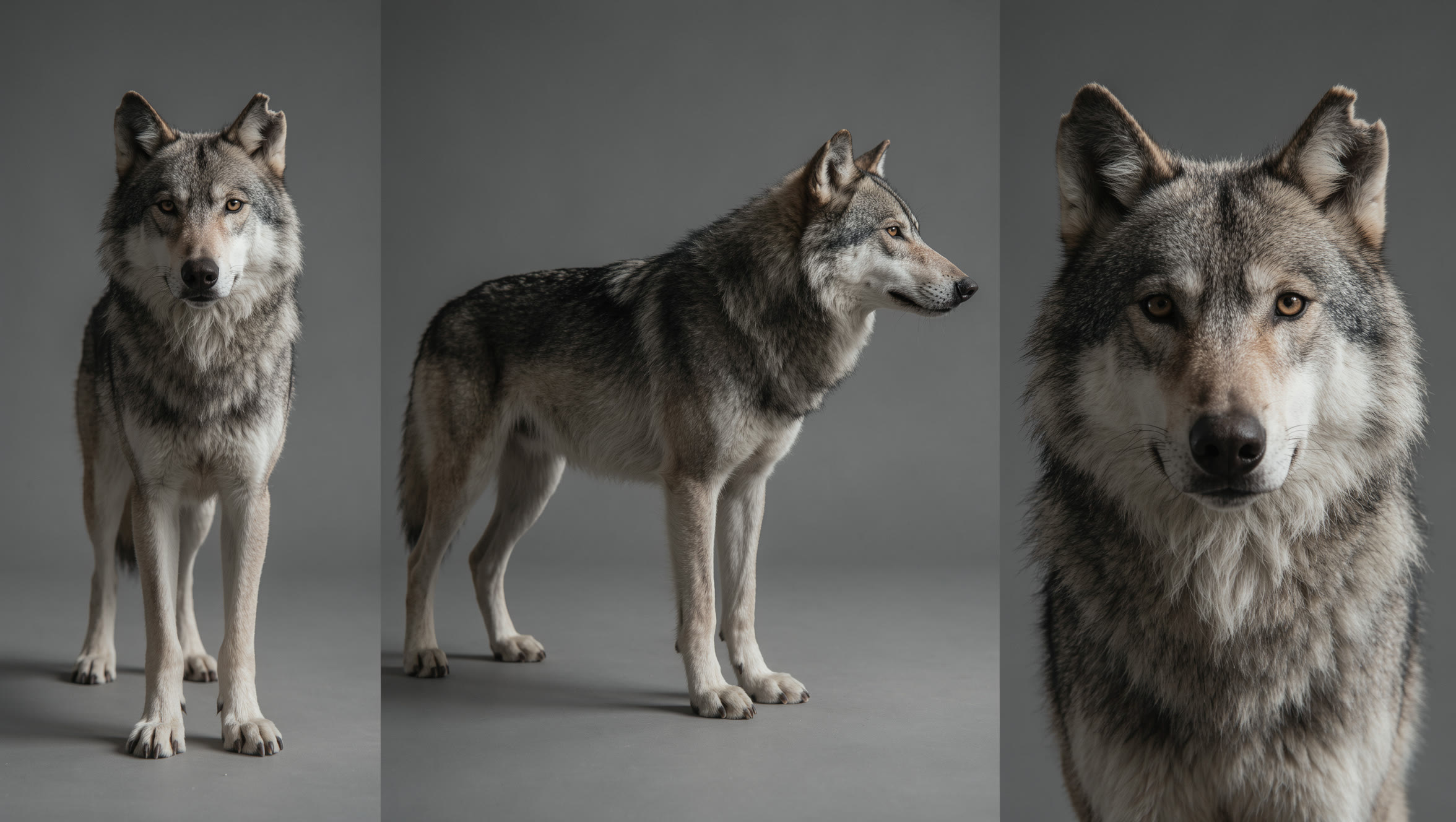
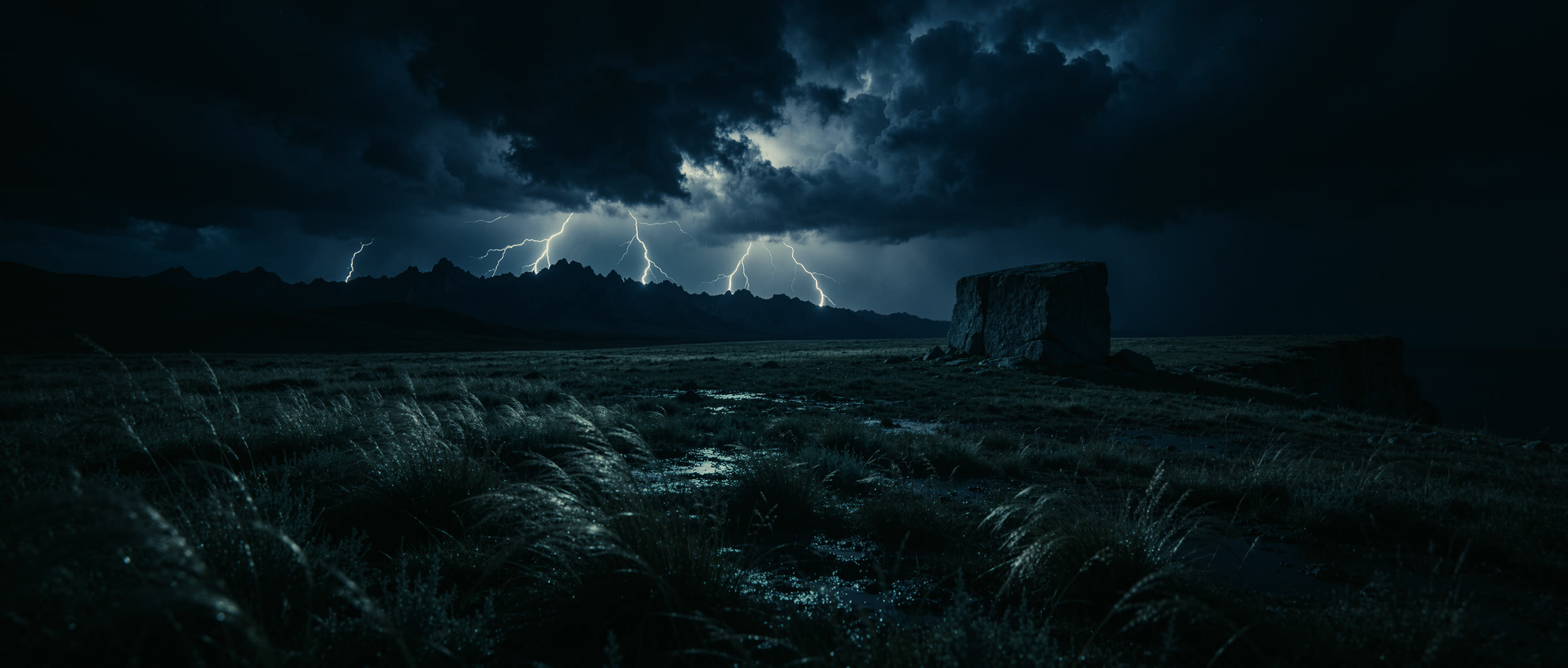
A wolf pack and a snow leopard are frozen in mid-attack on the rear of a stampede of wild horses in a single instant of a night thunderstorm over a Tian Shan highland plateau while only the lightning and the camera move, high-budget epic feature-film commercial, the camera travels back along the frozen herd to the wolves and then orbits around a snow leopard frozen in mid-pounce.

Format: 4 shots with hard cuts at 4s, 7s and 9s. Time is completely frozen in every shot: all shots show the same single frozen instant from different camera positions.

Subject: The lead wolf — @Image 1: take his grey coat with the darker saddle, pale throat and cheeks, amber eyes, the notched tip of the left ear, long legs, pale paws and build; he applies in shots 1–3, at the rear of the herd; do not take the studio background, the standing pose or the studio light. The other three wolves: adult Eurasian wolves, 75–80 cm at the shoulder, tawny-grey coats lighter than the lead wolf and without a dark saddle, tawny-grey paws with dark claws, no collars; they appear in shot 1 beside and slightly behind the lead wolf. The snow leopard — @Image 2: take its smoky-white coat, black ring rosettes and solid spots, pale grey-green eyes, small rounded ears, very thick bushy tail with the black tip, wide furry paws and build; it applies in shot 4, on the north flank of the herd; do not take the studio background, the standing pose or the studio light. The herd: wild steppe horses, stocky, 135–145 cm at the withers, bay and dun coats, the duns with a dark dorsal stripe, long dark manes and tails, unshod dark hooves, no halters or tack of any kind; every horse in these shots is bay or dun. The horse under the snow leopard is a bay horse with a long dark mane. The plateau — @Image 3: take the terrain, the wet steppe grass and puddles, the flat-topped granite outcrop and the jagged mountain ridge across the horizon; it applies to all shots; do not take the purple colour of its lightning or the shape of its lightning bolts. No people, no vehicles, no other animals are present. lock identity, age, body proportions, coat pattern, lighting, and spatial relationship to the reference images throughout the scene.

Action: In one frozen instant of a thunderstorm, a pack of four wolves hangs motionless in mid-leap at the last horses of a stampeding herd, the lead wolf's open jaws a few centimetres from the hind leg of a bay horse; on the north flank of the herd a snow leopard hangs motionless in mid-pounce from a granite outcrop onto the back of a bay horse, its claws ten centimetres from the horse's mane. Nothing living moves. The camera travels back along the frozen herd to the wolves, closes in on the gap between fangs and leg where a thin arc of lightning jumps across, then orbits around the frozen snow leopard and drops to the ground among the horses' legs, turning toward the ridge.

Environment: Night, violent thunderstorm over a high Tian Shan plateau. Layout as in @Image 3. Geography: the herd races west toward the jagged mountain ridge; the storm core sits above the ridge, ahead of the herd, so the animals are backlit by the lightning. In the side views the camera is on the south side of the herd, the herd moves from frame-right to frame-left, and the rear of the herd is toward frame-right. The wolves are at the very rear of the herd, chasing it toward the ridge. The flat-topped granite outcrop, 3 m high, stands on the north flank of the herd's path; the snow leopard has launched itself from its top toward the herd. Frozen state of the whole scene: every animal is a motionless statue caught mid-action — no breathing, no blinking, no muscle twitch, no movement of mane, tail or fur; raindrops hang motionless in the air like beads of glass; mud clods, pebbles, dust and water spray hang suspended exactly where they were thrown; the grass does not move. Only two things move in the entire film: the camera, travelling through the frozen scene with real parallax, and the lightning.

Lightning: real atmospheric lightning as photographed in a real storm — a thin, jagged, ragged channel with a blinding pure-white core and a faint cold blue halo around it; stepped leaders that fork again and again into thinner and thinner capillary branches; each branch pulses and flickers in brightness; the bolts crawl and branch slowly through the frozen world while everything else stands still. Each flash throws a hard, instantaneous white-blue light onto the hanging rain, the mist, the grass, the rock and the animals, casting sharp shadows that jump with every flicker. Electricity on the animals: hair-thin crawling filaments of the same white-blue electricity creep slowly across wet fur like frost spreading across glass, lighting individual wet hairs from within, tiny bright sparks jumping off the tips of hairs; the light of each filament falls on the coat around it. Arcs between bodies: where predator and prey almost touch, the gap is bridged by a real electric arc — a thin, jagged, flickering white-blue thread splitting into two or three finer threads, its light flashing on the hanging drops around it. The lightning has the colour and behaviour of real electricity only: white core, cold blue edge, sharp and thin.

Camera: Cinematic feature-film camera travelling through a frozen world on smooth, heavy, physically weighted paths — gliding, tracking and orbiting like a high-end motion-control rig; every shot has its own position, shot size and lens, given in the Timing below; the camera stays sharp on the subject of each shot while foreground objects pass close to the lens out of focus.

Look: Shot on ARRI Alexa 35 with Cooke Anamorphic/i lenses. Anamorphic character visible in frame: shallow depth of field with soft oval bokeh, horizontal blue-tinged flare streaks only from practical light sources never from the sun, gentle barrel distortion and slight edge softness, wide 2x squeeze feel with compressed vertical perspective. Kodak Vision / 2383 film print emulation: soft contrast, highlights roll off gently and keep detail, natural fine film grain, no digital sharpness.

White balance: cool night balance, steel-blue base, the lightning cores read as clean neutral white, colours muted and natural, room left for grading.

Exposure: highlights never clip — the lightning cores, the lit rain and the wet highlights keep detail; shadows stay deep but keep texture in fur, feathers, grass and rock.

Lighting: the only light is the lightning; key light is hard, cold white-blue backlight from the storm over the ridge ahead of the herd; it builds in three layers: the bolt itself; its light caught in the hanging rain, mist and haze as visible beams and glowing veils of droplets; and a cold steel-blue ambient base in which the animals stand as near-silhouettes with crisp bright rim light along backs, manes, ears and feather edges while their faces sit in deep shadow. The camera moves, light sources stay in place.

Color: steel blue, desaturated teal and charcoal black; the only bright accent is the white-blue of the lightning and the electricity on the animals.

Style: Low-key night thunderstorm lit only by lightning: hard cold blue-white backlight from the storm behind the subjects, subjects mostly silhouettes with crisp bright rim light along backs, manes and feather edges, faces in deep shadow; near-black shadows that keep texture; heavy atmosphere of rain, mist and haze catching the light in visible beams; palette of steel blue, desaturated teal and charcoal black, the only bright accent the white-blue lightning; out-of-focus foreground bodies, debris and water drops framing a sharp subject in depth; water droplets on the lens front element and subtle chromatic fringing on the brightest lightning edges; weighty, majestic, primal mood of a nature epic shot as a feature film.

Texture: realistic wet animal coats with individual hair strands, translucent backlit edges and beads of rain on the fur; real wet granite, mud and grass.

Timing:

00–04s: Camera: low, at hip height of the horses, on the south side of the herd, wide shot, 24 mm; a smooth tracking move backward along the flank of the herd toward its rear, travelling toward frame-right; it starts beside the frozen flanks of galloping bay and dun horses filling the frame, their bodies sliding past the lens out of focus in the foreground; the camera travels past the last horses of the herd — their hind legs frozen in a powerful push-off, hooves high, clods of mud hanging in the air behind them; it finishes on the darkness and rain behind the herd, out of which a pack of four wolves is revealed frozen in mid-leap at the last horses: the lead wolf from @Image 1 in front, three tawny-grey wolves beside and behind him, all stretched forward toward frame-left, raindrops hanging around them, a lightning branch over the ridge rimming their backs. Sound: <low sub-bass rumble>, <dry electric crackle>, <deep growling rumble of thunder>.

Hard cut at 4s to:

04–07s: Camera: low, beside the lead wolf on the south side, medium close-up, 50 mm; a slow tracking move along his body from the tail to the muzzle, travelling toward frame-left; it starts on his outstretched tail and hind legs, frozen after the push-off; the lead wolf is frozen in mid-leap, his whole body stretched out like a drawn string, forelegs reaching forward, ears pinned back, jaws wide open, fangs bared a few centimetres from the hind leg of a bay horse at the edge of the frame; a hair-thin white-blue filament crawls slowly along his fur from the nape of the neck to the muzzle, lighting each wet hair, tiny sparks jumping off the tips; it finishes on his open jaws and amber eye, the bay horse's hind leg just ahead of the fangs. Sound: <crackle running through wet fur>.

Hard cut at 7s to:

07–09s: Camera: extreme close-up, 100 mm, locked off, a profile view of the gap; in the frame the open fangs of the lead wolf on one side and the hock of the bay horse's hind leg on the other, a few centimetres of empty air between them; a thin jagged arc of white-blue electricity jumps across the gap, splits into two or three finer threads and flickers; the hanging raindrops around the gap flash white with each flicker; it finishes with the arc burning steady between fang and leg. Sound: <sharp dry snap of the discharge>.

Hard cut at 9s to:

09–15s: Camera: on the north flank of the herd, wide shot, 32 mm; a 180-degree orbit around the frozen moment like a bullet-time move, then a crane down to the ground and a turn toward the ridge; it starts on the south side of the pair, looking north from inside the edge of the herd: the snow leopard from @Image 2 frozen in mid-pounce, launched from the top of the 3 m granite outcrop behind it onto the back of a bay horse — forelegs flung wide apart, claws out, hind legs stretched back from the push-off, the thick tail straight out behind as a counterweight, its pale eyes on the horse's neck; ten centimetres of air remain between its claws and the horse's mane, and that gap is filled with a net of fine white-blue lightning threads jumping between claws and mane; the bay horse frozen mid-gallop beneath it, mane flying, eye wide open; the camera orbits 180 degrees around the pair to the north side, the outcrop sliding past behind them, revealing the leopard's face and the horse's eye toward the camera with the frozen herd beyond; then the camera cranes down to the ground between the legs of the frozen herd and turns to face the ridge; it finishes low among the frozen legs and hooves of the rear of the herd, looking west toward the jagged ridge with lightning over it. Sound: <growing rumble>, <crackle of the lightning net>, <rolling thunder>.

Audio: No background music. The frozen world is silent except for the sounds of the lightning and the camera's passage: <low sub-bass rumble> under the whole film, <dry electric crackle> wherever electricity crawls, <glassy ticking of hanging raindrops>, <rolling thunder>, <sharp dry snap> of the arc between fang and leg. Preserve the frozen positions of every animal, the backlight from the storm over the ridge, the white-blue colour of all lightning and the direction of the herd toward the ridge across every shot. No subtitles appear on screen.

Negative: No subtitles, captions or on-screen text. No background music. No logos or readable text. No purple, pink or neon lightning, no glowing tubes, no fantasy or cartoon glow; no grey horses, no extra animals, no people, no duplicated or floating limbs.
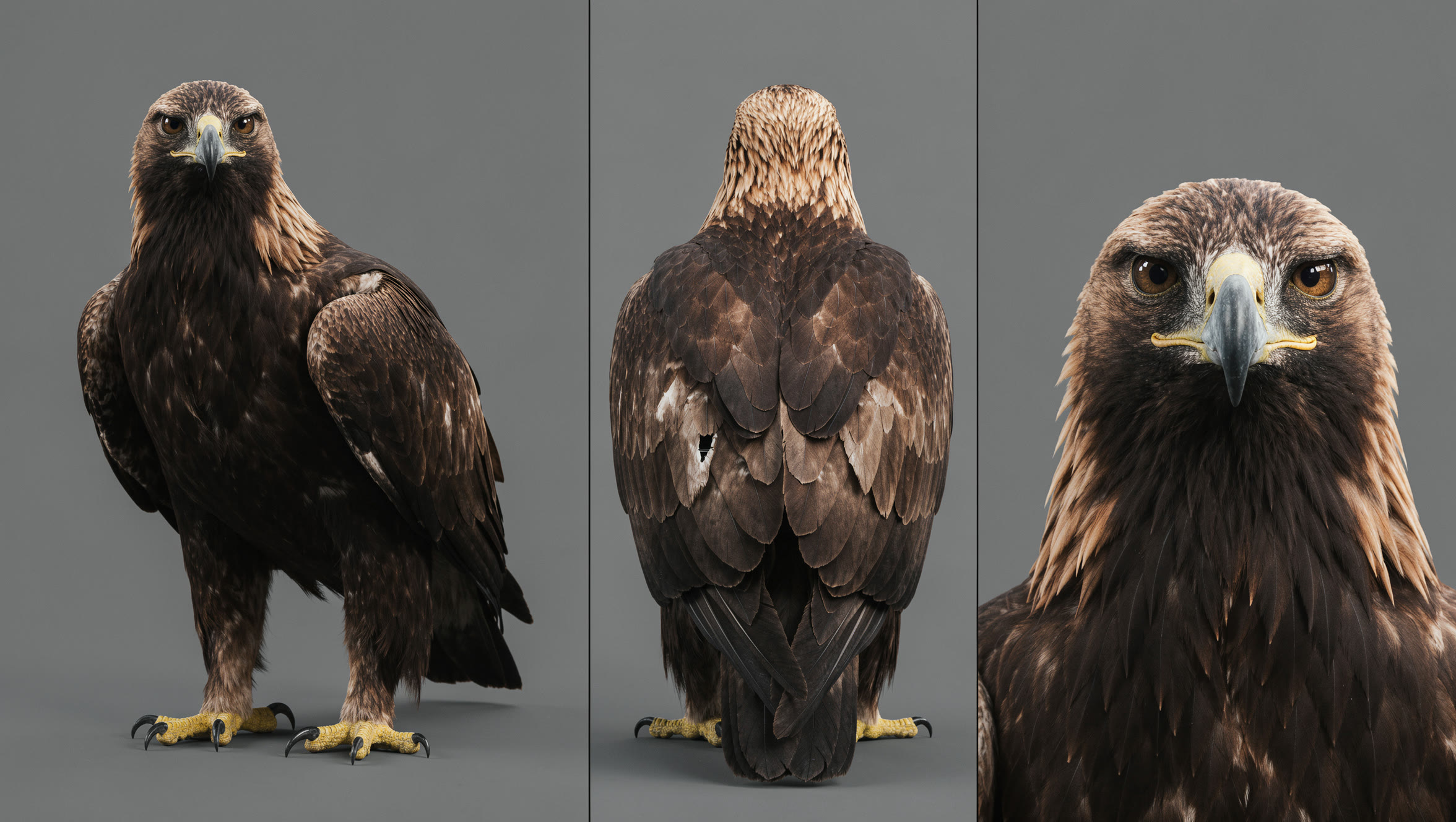
One golden eagle from @Image 1 hangs completely frozen in mid-flight, motionless like a statue suspended inside a black night thunderstorm cloud, seen from the side at its own altitude as a pure backlit silhouette, while a lightning bolt slowly crawls down through the cloud behind it and the camera slowly drifts past it, high-budget epic feature-film commercial.

Format: one continuous shot, no cuts, 5 seconds.

Subject: The golden eagle — @Image 1: take its body shape and proportions, head and hooked beak profile, wing shape with fingered primary feathers, fanned tail and dark plumage; it is seen almost entirely as a black silhouette, so only its outline, feather edges and a thin rim light read; do not take the studio background, the standing pose or the studio light. There is exactly one eagle in the whole shot. No other birds, no animals, no people, no ground, no horizon, no sun, no moon.

Action: Time is stopped. The eagle hangs frozen in the air in one fixed pose for the entire shot and never changes it: body horizontal, head and hooked beak stretched straight forward toward frame-right, both wings raised high above the back at the top of an upstroke like a "V", primary feathers spread apart like fingers, tail fanned, legs and talons tucked under the body. Not one feather moves. The only things that move are the camera and the lightning: a bolt slowly crawls down through the cloud behind the eagle, the glow inside the cloud pulses, and the camera drifts slowly past the frozen bird.

Environment: Night, inside a violent thunderstorm cloud high in the sky — the camera is inside the cloud at the eagle's altitude, looking sideways, never upward. No ground, no horizon; only cloud. The cloud is built of heavy layered volumes of dark vapour with soft billowing edges and deep black voids between them; some volumes are in front of the eagle, some behind it, so the camera move produces parallax between cloud layers. Behind the eagle, in the centre and right of the frame, a large soft glow burns inside the cloud — the lightning lighting the vapour from within like a lamp behind thick fog; everything in front of the eagle and on the left is near-black. Fine rain specks and tiny water particles hang motionless in the air, catching the light as small pale dots. Frozen time: the eagle, the rain particles and the cloud volumes are still; only the camera moves through them and only the lightning changes.

Lightning: real atmospheric lightning as in a real photograph of a storm. One thin, jagged channel with a blinding pure-white core and a faint cold blue halo crawls slowly downward from the top centre of the frame behind the eagle in sharp zigzag steps, growing a short side branch, flickering in brightness as it grows; at the far right edge a second, smaller branch flickers in and out. The glow inside the cloud pulses with each flicker. No glowing tubes, no neon, no thick bright bands, no sun-like point of light.

Camera: at exactly the same altitude as the eagle, inside the cloud, side view, wide shot, 35 mm; a slow lateral drift toward frame-right combined with a very slow push-in toward the eagle; it starts with the eagle centre-left of the frame, its silhouette against the glowing cloud; trajectory: smooth, heavy and steady like a camera on a gimbal, dark cloud wisps in the foreground slide past the lens with parallax while the far glowing cloud shifts slowly behind the bird; it finishes slightly closer, the eagle still centre-left with raised wings, the crawling bolt behind it in the upper centre, the glow and the second branch at the right. Focus stays on the eagle; foreground vapour soft.

Look: Shot on ARRI Alexa 35 with Cooke Anamorphic/i lenses. Anamorphic character visible in frame: shallow depth of field with soft oval bokeh, horizontal blue-tinged flare streaks only from practical light sources never from the sun, gentle barrel distortion and slight edge softness, wide 2x squeeze feel with compressed vertical perspective. Kodak Vision / 2383 film print emulation: soft contrast, highlights roll off gently and keep detail, natural fine film grain, no digital sharpness.

White balance: cool night balance, steel-blue base, the lightning core reads as clean neutral white, colours muted and natural, room left for grading.

Exposure: very low-key; most of the frame is near-black with texture; highlights never clip — the lightning core and the brightest glowing cloud keep detail.

Lighting: only the lightning; hard, cold white-blue backlight from inside and behind the cloud, behind and to the right of the eagle; it builds in three layers: the bolt and the inner flashes; their light diffused through the vapour as glowing cloud volumes and catching the hanging particles; and a black, faintly steel-blue ambient in which the eagle is a pure silhouette with a thin bright rim only where the light grazes the top of the head, the back of the neck, the leading edges of the raised wings and the tips of the primary feathers. No front light on the bird. The camera moves, light sources stay in place.

Color: near-black, deep navy and steel blue; the glowing cloud cold blue-white with a faint teal-green tinge in its upper right; the lightning white with a cold blue edge.

Style: Low-key night thunderstorm lit only by lightning: hard cold blue-white backlight from the storm behind the subject, the subject a silhouette with crisp bright rim light along feather edges, face in deep shadow; near-black shadows that keep texture; heavy atmosphere of mist and vapour catching the light; palette of steel blue, desaturated teal and charcoal black, the only bright accent the white-blue lightning; out-of-focus foreground vapour and hanging particles framing a sharp subject in depth; subtle chromatic fringing on the brightest lightning edges; weighty, majestic, primal mood of a nature epic shot as a feature film.

Texture: real feathers with individual primaries spread like fingers and backlit translucent edges; real volumetric storm vapour; photographic realism, not CG.

Timing:

00–01s: Camera: beginning the slow drift right. The eagle hangs frozen centre-left in profile, wings raised in a V, a black silhouette against a dim glow deep in the cloud behind it; the glow is faint, the frame very dark; dark foreground vapour slides past the lens. The eagle does not move. Sound: <deep low rumble inside the cloud>, <wind hiss>.

01–02s: Camera: drifting right, the push-in beginning. The glow behind the eagle swells and lights the cloud volumes from within; the thin rim light appears along the eagle's head, neck and the leading edges of its raised wings, its spread primary feathers backlit at the tips. The eagle does not move. Sound: <rumble rising>, <faint electric crackle>.

02–04s: Camera: continuing. A thin jagged bolt begins at the top centre of the frame behind the eagle and crawls slowly downward in zigzag steps, white core, cold blue halo, growing a short side branch; each flicker throws a hard pulse of light through the vapour and sharpens the rim on the frozen eagle; the hanging rain particles around the bird flash as pale dots. The eagle does not move. Sound: <slow stretched electric crack>, <rolling thunder>.

04–05s: Camera: the drift and push-in settle. At the far right edge a second small branch flickers; the glow behind the eagle holds; the frame ends with the frozen eagle centre-left, wings raised, the crawling bolt above and behind it, the glowing cloud and the second branch at the right. The eagle has not moved a single feather. Sound: <second crack>, <thunder rolling away>.

Audio: No background music. Only <deep cloud rumble>, <wind>, <stretched electric cracks>, <rolling thunder>. No wingbeat sounds: the bird is frozen. Preserve the single fixed pose of the eagle, the side view at its altitude, the backlight from behind-right and the white-blue lightning throughout. No subtitles appear on screen.

Negative: No subtitles, captions or on-screen text. No background music. No logos or readable text. No wing flapping, no gliding, no change of pose, no second bird, no cranes or long-necked birds, no view from below, no bright daytime sky, no sun or moon or point light source, no front light on the eagle, no glowing outlines, no neon or purple lightning.One golden eagle from @Image 1 hangs completely frozen in mid-flight, motionless like a statue suspended inside a black night thunderstorm cloud, seen from the side at its own altitude as a pure backlit silhouette, while a lightning bolt slowly crawls down through the cloud behind it and the camera slowly drifts past it, high-budget epic feature-film commercial.

Format: one continuous shot, no cuts, 5 seconds.

Subject: The golden eagle — @Image 1: take its body shape and proportions, head and hooked beak profile, wing shape with fingered primary feathers, fanned tail and dark plumage; it is seen almost entirely as a black silhouette, so only its outline, feather edges and a thin rim light read; do not take the studio background, the standing pose or the studio light. There is exactly one eagle in the whole shot. No other birds, no animals, no people, no ground, no horizon, no sun, no moon.

Action: Time is stopped. The eagle hangs frozen in the air in one fixed pose for the entire shot and never changes it: body horizontal, head and hooked beak stretched straight forward toward frame-right, both wings raised high above the back at the top of an upstroke like a "V", primary feathers spread apart like fingers, tail fanned, legs and talons tucked under the body. Not one feather moves. The only things that move are the camera and the lightning: a bolt slowly crawls down through the cloud behind the eagle, the glow inside the cloud pulses, and the camera drifts slowly past the frozen bird.

Environment: Night, inside a violent thunderstorm cloud high in the sky — the camera is inside the cloud at the eagle's altitude, looking sideways, never upward. No ground, no horizon; only cloud. The cloud is built of heavy layered volumes of dark vapour with soft billowing edges and deep black voids between them; some volumes are in front of the eagle, some behind it, so the camera move produces parallax between cloud layers. Behind the eagle, in the centre and right of the frame, a large soft glow burns inside the cloud — the lightning lighting the vapour from within like a lamp behind thick fog; everything in front of the eagle and on the left is near-black. Fine rain specks and tiny water particles hang motionless in the air, catching the light as small pale dots. Frozen time: the eagle, the rain particles and the cloud volumes are still; only the camera moves through them and only the lightning changes.

Lightning: real atmospheric lightning as in a real photograph of a storm. One thin, jagged channel with a blinding pure-white core and a faint cold blue halo crawls slowly downward from the top centre of the frame behind the eagle in sharp zigzag steps, growing a short side branch, flickering in brightness as it grows; at the far right edge a second, smaller branch flickers in and out. The glow inside the cloud pulses with each flicker. No glowing tubes, no neon, no thick bright bands, no sun-like point of light.

Camera: at exactly the same altitude as the eagle, inside the cloud, side view, wide shot, 35 mm; a slow lateral drift toward frame-right combined with a very slow push-in toward the eagle; it starts with the eagle centre-left of the frame, its silhouette against the glowing cloud; trajectory: smooth, heavy and steady like a camera on a gimbal, dark cloud wisps in the foreground slide past the lens with parallax while the far glowing cloud shifts slowly behind the bird; it finishes slightly closer, the eagle still centre-left with raised wings, the crawling bolt behind it in the upper centre, the glow and the second branch at the right. Focus stays on the eagle; foreground vapour soft.

Look: Shot on ARRI Alexa 35 with Cooke Anamorphic/i lenses. Anamorphic character visible in frame: shallow depth of field with soft oval bokeh, horizontal blue-tinged flare streaks only from practical light sources never from the sun, gentle barrel distortion and slight edge softness, wide 2x squeeze feel with compressed vertical perspective. Kodak Vision / 2383 film print emulation: soft contrast, highlights roll off gently and keep detail, natural fine film grain, no digital sharpness.

White balance: cool night balance, steel-blue base, the lightning core reads as clean neutral white, colours muted and natural, room left for grading.

Exposure: very low-key; most of the frame is near-black with texture; highlights never clip — the lightning core and the brightest glowing cloud keep detail.

Lighting: only the lightning; hard, cold white-blue backlight from inside and behind the cloud, behind and to the right of the eagle; it builds in three layers: the bolt and the inner flashes; their light diffused through the vapour as glowing cloud volumes and catching the hanging particles; and a black, faintly steel-blue ambient in which the eagle is a pure silhouette with a thin bright rim only where the light grazes the top of the head, the back of the neck, the leading edges of the raised wings and the tips of the primary feathers. No front light on the bird. The camera moves, light sources stay in place.

Color: near-black, deep navy and steel blue; the glowing cloud cold blue-white with a faint teal-green tinge in its upper right; the lightning white with a cold blue edge.

Style: Low-key night thunderstorm lit only by lightning: hard cold blue-white backlight from the storm behind the subject, the subject a silhouette with crisp bright rim light along feather edges, face in deep shadow; near-black shadows that keep texture; heavy atmosphere of mist and vapour catching the light; palette of steel blue, desaturated teal and charcoal black, the only bright accent the white-blue lightning; out-of-focus foreground vapour and hanging particles framing a sharp subject in depth; subtle chromatic fringing on the brightest lightning edges; weighty, majestic, primal mood of a nature epic shot as a feature film.

Texture: real feathers with individual primaries spread like fingers and backlit translucent edges; real volumetric storm vapour; photographic realism, not CG.

Timing:

00–01s: Camera: beginning the slow drift right. The eagle hangs frozen centre-left in profile, wings raised in a V, a black silhouette against a dim glow deep in the cloud behind it; the glow is faint, the frame very dark; dark foreground vapour slides past the lens. The eagle does not move. Sound: <deep low rumble inside the cloud>, <wind hiss>.

01–02s: Camera: drifting right, the push-in beginning. The glow behind the eagle swells and lights the cloud volumes from within; the thin rim light appears along the eagle's head, neck and the leading edges of its raised wings, its spread primary feathers backlit at the tips. The eagle does not move. Sound: <rumble rising>, <faint electric crackle>.

02–04s: Camera: continuing. A thin jagged bolt begins at the top centre of the frame behind the eagle and crawls slowly downward in zigzag steps, white core, cold blue halo, growing a short side branch; each flicker throws a hard pulse of light through the vapour and sharpens the rim on the frozen eagle; the hanging rain particles around the bird flash as pale dots. The eagle does not move. Sound: <slow stretched electric crack>, <rolling thunder>.

04–05s: Camera: the drift and push-in settle. At the far right edge a second small branch flickers; the glow behind the eagle holds; the frame ends with the frozen eagle centre-left, wings raised, the crawling bolt above and behind it, the glowing cloud and the second branch at the right. The eagle has not moved a single feather. Sound: <second crack>, <thunder rolling away>.

Audio: No background music. Only <deep cloud rumble>, <wind>, <stretched electric cracks>, <rolling thunder>. No wingbeat sounds: the bird is frozen. Preserve the single fixed pose of the eagle, the side view at its altitude, the backlight from behind-right and the white-blue lightning throughout. No subtitles appear on screen.

Negative: No subtitles, captions or on-screen text. No background music. No logos or readable text. No wing flapping, no gliding, no change of pose, no second bird, no cranes or long-necked birds, no view from below, no bright daytime sky, no sun or moon or point light source, no front light on the eagle, no glowing outlines, no neon or purple lightning.
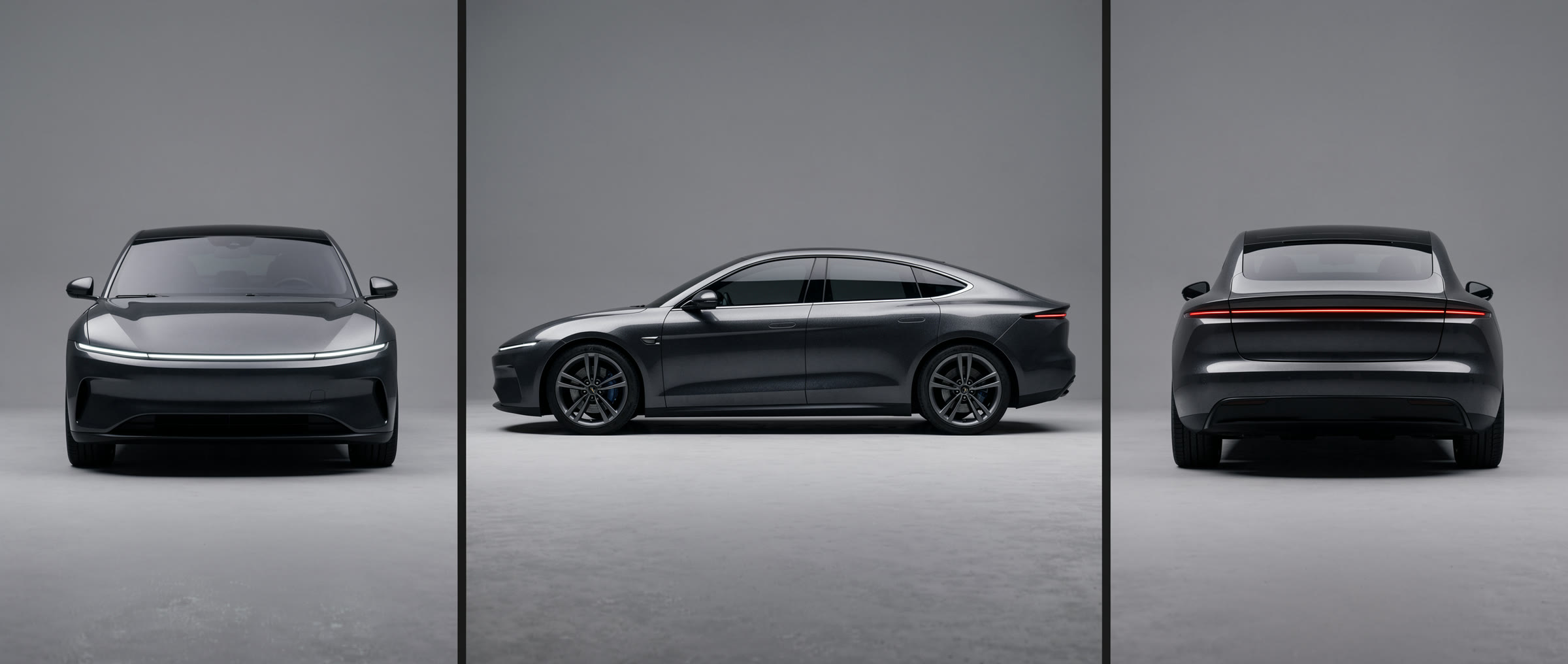
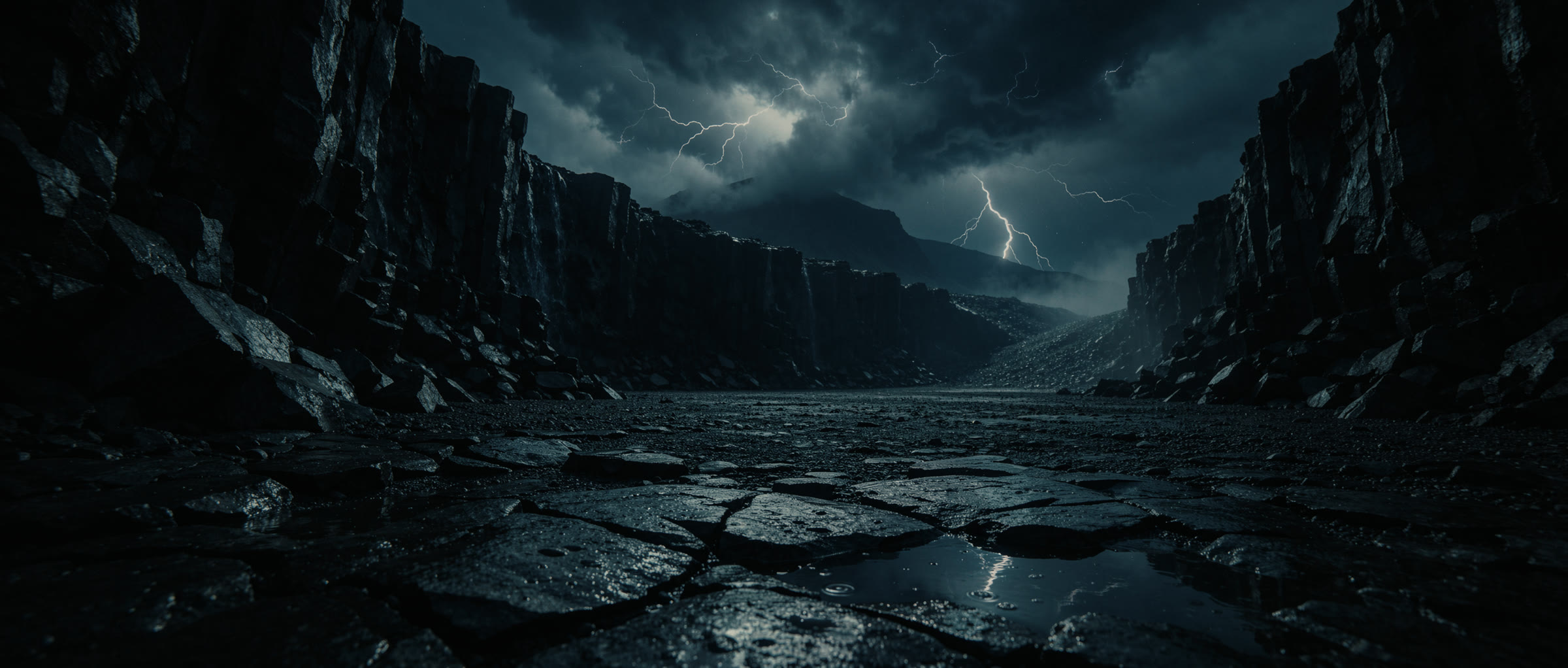
A cinematic automotive VFX sequence in the storm-filled basalt canyon from @Image 2: lightning progressively reveals electrical fragments of the vehicle from @Image 1, advancing from abstract macro details to a complete translucent car, with a continuously moving camera in every shot.

Format: Fifteen distinct shots in the stated order. Hard cuts precisely at 2, 4, 6, 8, 10, 12, 14, 16, 18, 20, 22, 24, and 26 seconds. At 28 seconds, cut on continuing camera movement to the final shot. Each shot contains one uninterrupted camera move and one principal visual development. Carry camera momentum through each outgoing frame. End at exactly 30 seconds.

Subject: @Image 1: Vehicle identity and the exact exterior geometry shown in the front, side and rear views: proportions, roofline, glazing, wheelbase, wheel design, body contours and light-strip placement. Applies: Throughout all vehicle-related shots; the exterior becomes fully readable only during 26–30s. Exclude from this reference: Studio background, studio lighting, triptych layout, panel dividers and presentation of three separate vehicles. @Image 2: Basalt canyon architecture, wet fractured ground, puddles, distant ridge, storm clouds, atmospheric depth and cold environmental palette. Applies: The entire sequence. Opening composition as in @Image 2; subsequent views occupy this same location while the camera moves. Exclude from this reference: A permanently fixed viewpoint or a flat background that follows the camera. Represent one vehicle. Preserve the proportions and exterior geometry of @Image 1 at every reveal stage. Electrical illumination reveals a stable underlying shape. The vehicle occupies one fixed ground position, its longitudinal axis aligned with the canyon and its nose pointing toward the distant ridge. Once wheels become visible, all four remain seated on the same ground plane. Doors and windows remain closed. 00–06s: landscape and ground discharges. 06–16s: isolated abstract electrical and mechanical fragments. 16–18s: a bodyless chassis-like arrangement. 18–24s: isolated interior and wheel details. 24–26s: a cropped rear fragment. 26–30s: the complete vehicle, still translucent and made legible by electrical filaments. The vehicle sheet defines exterior identity only. Interior and mechanical close-ups follow the abstract, partially obscured forms visible in the video references; treat them as stylized VFX fragments rather than a mechanically accurate cutaway of an undocumented vehicle.

Action: A descending storm discharge reaches the canyon floor. Branching surface currents lead into close views of dark reflective forms threaded with cyan-white and pink-violet electricity. Successive cuts reveal increasingly organized mechanical volumes, a four-wheel chassis arrangement, a seat-like interior form, fine surface filaments, one wheel and a rear fragment. Only the final two shots connect these details into the complete exterior from @Image 1. The car remains a translucent electrical volume through the ending, with its surrounding environment visible between the filaments.

Environment: Spatial layout and opening composition as in @Image 2. Maintain the same basalt walls, distant ridge, wet ground and storm atmosphere throughout. In macro views, blue-black defocused ground or canyon texture maintains continuity with the location. Reflections attach to the wet surfaces beneath the luminous elements; localized haze scatters their light. The canyon and ground remain fixed in world space as the viewpoint changes.

Camera: Every shot has visible camera translation or an orbital move from its first frame through its last frame. Show parallax between foreground, subject and background. Each timeline entry specifies a technique, subject, starting composition, trajectory and ending composition. Maintain controlled inertia and readable motion during each two-second move. Wide shots retain readable environmental depth. Macro shots use a narrow focus plane on the principal filament or surface edge, with soft defocused layers in front and behind. Track the stated subject as the camera travels. Use forward travel for the approach, lateral travel for the macro exploration, and a continuous rear-to-front progression along the same visible flank for the ending. In the exterior reveal, the vehicle nose stays screen-right. Continue the final orbit across the cut at 28 seconds.

Look: Match the supplied Electricity references: deep blue-black surroundings, cyan-white branching discharge cores, pink-magenta and violet secondary filaments, translucent reflective volumes, dense fine luminous particles and layered depth. Large lightning channels have irregular branching paths; smaller currents cling to the visible contours of the forms. Separate bright electrical cores, softer local halos and the much darker surrounding space. Use the storm illumination and cold environment of @Image 2. Electrical discharges provide the changing local highlights and reflected color. Preserve dark intervals between pulses. Keep source locations attached to the storm, surface contacts and electrical structure while the camera moves; light intensity changes with discharge activity. Follow the video references' shallow macro depth of field, soft bokeh, restrained horizontal colored flare streaks, bloom around intense discharge cores, slight chromatic separation at bright edges and motion blur during faster travel. Retain material texture outside the brightest cores. Brief motivated flare occlusion may punctuate a cut while leaving the spatial progression understandable. The electrical vehicle combines dark reflective fragments, semitransparent surfaces and fine contour-following threads. Dense clusters describe volume without filling every surface uniformly. The exterior silhouette and wheel geometry resolve toward @Image 1 as visibility increases. Large-scale drama comes from the canyon, near-camera lightning and the progression from microscopic detail to full vehicle.

Timing:

00–02s: Camera: Forward dolly toward the storm opening. Start in a low wide view with composition as in @Image 2. Travel steadily above the wet central ground; nearby stones shift against the distant ridge. Finish farther into the canyon with the cloud opening still visible above the center. A faint branched discharge brightens inside the clouds, briefly outlining the basalt walls and reflecting in the foreground puddle. The frame contains the landscape alone. Hard cut at 2s on the growing cloud illumination.

02–04s: Camera: Descending forward tracking move following the leading lightning channel. Start with a wide view between the canyon walls beneath the cloud opening. Travel diagonally forward and downward toward the ground contact; the side rocks slide outward through parallax. Finish near the bright strike point on the wet floor. One dominant white-cyan channel extends downward, branches and contacts the ground. Its contact flare expands across the final frames, retaining a few dark ground edges around it. Hard cut at 4s within the contact flare to the closer ground view.

04–06s: Camera: Low lateral tracking move across the discharge contacts. Start close to a white-cyan contact point on the wet ground. Travel smoothly toward screen-right, keeping the branching surface current in focus as foreground stone edges pass through frame. Finish on a finer branch entering a dark reflective patch. Several vertical branches pulse at separate surface contacts. Thin pink and cyan threads spread outward over the irregular wet texture, with small reflected halos beneath each contact. Hard cut at 6s matching a fine luminous branch to the next close-up.

06–08s: Camera: Close lateral tracking move across an irregular dark form. Start with one cyan filament at the lower edge of an extreme close-up. Travel toward screen-right along the relief, allowing nearer protrusions to occlude portions of the background. Finish on a brighter fork crossing a curved edge. Cyan and violet currents reveal only local ridges, cavities and reflective edges. The illuminated area grows across the fragment while its overall identity remains abstract. Hard cut at 8s matching the curved luminous edge to a smoother reflective form.

08–10s: Camera: Short macro arc around a rounded reflective fragment. Start in extreme close-up with a dark curved surface centered between defocused magenta threads. Move smoothly around the near edge; foreground threads slide faster than the surface behind. Finish with the curved edge farther to frame-left and a concentrated luminous cluster near the center. Pink-white branches trace the curved surface and appear as layered reflections inside adjacent translucent forms. Illumination spreads over the fragment while the surrounding vehicle remains outside the crop. Hard cut at 10s on the concentrated luminous cluster.

10–12s: Camera: Diagonal tracking move past a near-camera electrical flare. Start close to the bright cluster with most of the adjacent form in darkness. Travel diagonally past it, using the flare as brief foreground occlusion. Finish on layered circular contours and small connecting reflective fragments behind the flare. A white-violet pulse briefly washes across the image and recedes, exposing a denser network of short pink and cyan currents attached to the previously hidden contours. Hard cut at 12s from one circular contour to the ring-shaped detail in the next shot.

12–14s: Camera: Macro arc around the reference's ring-and-shaft-like form. Start obliquely beside the projecting central element with the luminous ring behind it. Travel around the ring at a steady pace, creating clear parallax between the central element and the outer filaments. Finish with more of the ring face visible while the surrounding assembly stays cropped. Pink electrical threads become denser around the ring, and a concentrated cyan-white pulse brightens the central element. The geometry stays stable beneath the fluctuating light. Hard cut at 14s on the central pulse to a wider view through a foreground discharge.

14–16s: Camera: Pull-back from a foreground lightning branch into a low wider view. Start with the bright branch partially covering the luminous fragment. Retreat smoothly so the foreground branch slides across the frame and several separated electrical volumes become visible near ground level. Finish with these fragments distributed across the same wet canyon floor. The foreground pulse subsides enough to expose scattered translucent forms and their ground reflections. Larger branches continue connecting the area to the storm; the body silhouette remains unresolved. Hard cut at 16s to an elevated view of the same developing arrangement.

16–18s: Camera: Descending oblique overhead dolly toward the chassis arrangement. Start high enough to contain four luminous wheel volumes and the connecting central structure. Move closer along a shallow diagonal, maintaining the same longitudinal orientation. Finish tighter on the central framework while keeping the four-wheel arrangement understandable. Fine cyan lines connect the four wheel positions into a stable bodyless chassis-like volume. Pink-white particle concentrations pulse around the wheels. The wheelbase and track correspond to @Image 1, while the upper exterior remains visually unresolved. Hard cut at 18s from the central framework to an isolated interior volume.

18–20s: Camera: Upward tracking move along the seat-like electrical form. Start close to its lower side supports, with layered luminous structure in the foreground. Rise along the backrest at a controlled speed. Finish on the upper backrest and headrest-like contour in a tight crop. Dense cyan-white filaments outline the lower volume, followed by pink branching threads across the upper form. Keep the interior abstract and semitransparent as in the reference; only this local volume becomes readable. Hard cut at 20s matching a narrow group of surface filaments to an extreme close-up.

20–22s: Camera: Extreme macro lateral tracking move across rows of electrical threads. Start with a curved dark surface occupying most of the frame and a narrow band of cyan and magenta threads in focus. Travel along the surface toward screen-right; nearby luminous tips pass as soft elongated bokeh. Finish with the threads filling the image around the focused central band. Small bright pulses travel along the irregular threads. Their density increases across the visible surface, retaining dark gaps between rows and the reference's shallow depth of field. Hard cut at 22s matching a curved cyan thread to a cropped wheel arc.

22–24s: Camera: Low close arc around one wheel. Start on a tightly cropped lower rim segment beside the wet ground. Move around the outer face, preserving the wheel's circular geometry and its ground contact. Finish with more of the spokes visible while the wheel arch and body continue beyond the frame boundaries. Cyan-white arcs and small pink highlights progressively delineate the wheel design from @Image 1. The tire and rim remain fixed while their electrical visibility increases; their reflection occupies the wet surface directly beneath them. Hard cut at 24s to a cropped rear corner on the same visible flank.

24–26s: Camera: Close lateral dolly along the rear corner. Start tightly on a partial rear light-strip contour and adjacent translucent body edge. Travel toward the visible flank while keeping the roof, nose and opposite rear corner outside the frame. Finish with the local rear quarter and part of the rear wheel readable together. Fine electrical strands trace the rear panel and light-strip placement from @Image 1. A larger discharge pulses behind the cropped fragment, separating it from the basalt background. The complete vehicle remains outside the crop. Hard cut at 26s to the first complete exterior view from a compatible rear three-quarter angle.

26–28s: Camera: Low orbital tracking move from rear three-quarter toward the side. Start wide enough to reveal the entire electrical vehicle for the first time, nose pointing screen-right. Travel smoothly along the visible flank, with near-camera lightning passing across the body and the canyon wall shifting behind it. Finish near a full side view, still moving toward the front. The fragments read together as the exact exterior from @Image 1. Roof, closed doors, glazing and wheels remain semitransparent and threaded with cyan, pink and violet light. Branching strikes reach the ground in front of and behind the car, producing corresponding reflections. At 28s, cut on the continuing orbit to a slightly closer side view with matching vehicle orientation and reveal state.

28–30s: Camera: Continue the low orbit from side view toward front three-quarter along the same visible flank. Start with the full car filling more of the frame, nose screen-right. Travel toward the front at the established pace; a thick foreground discharge crosses the composition with strong parallax. Finish at a readable front three-quarter view while the camera is still moving. A final white-violet pulse briefly veils part of the front wheel and body, then recedes enough to reveal the vehicle's exact front proportions and light-strip placement from @Image 1. Hold the complete translucent electrical form through the final frame, with the canyon visible between the filaments and reflections beneath the wheels. End at exactly 30s on the readable electrical vehicle during the continuing orbit.

Audio: Preserve the supplied clips' silent presentation.

Negative: No static camera shots, freeze frames, extra cuts, dissolves that merge adjacent shots, or changes to the fifteen two-second intervals. No complete vehicle silhouette before 26 seconds, early opaque beauty shot, final transformation into a solid showroom car, Porsche identity transfer, altered vehicle proportions, duplicate vehicles, floating wheels, rotating display platform or invented detailed engineering. No extra people, buildings, futuristic interface graphics, holographic grids, text, subtitles, logos, watermarks, split-screen layout or reference-sheet borders. No added music, dialogue or sound effects.
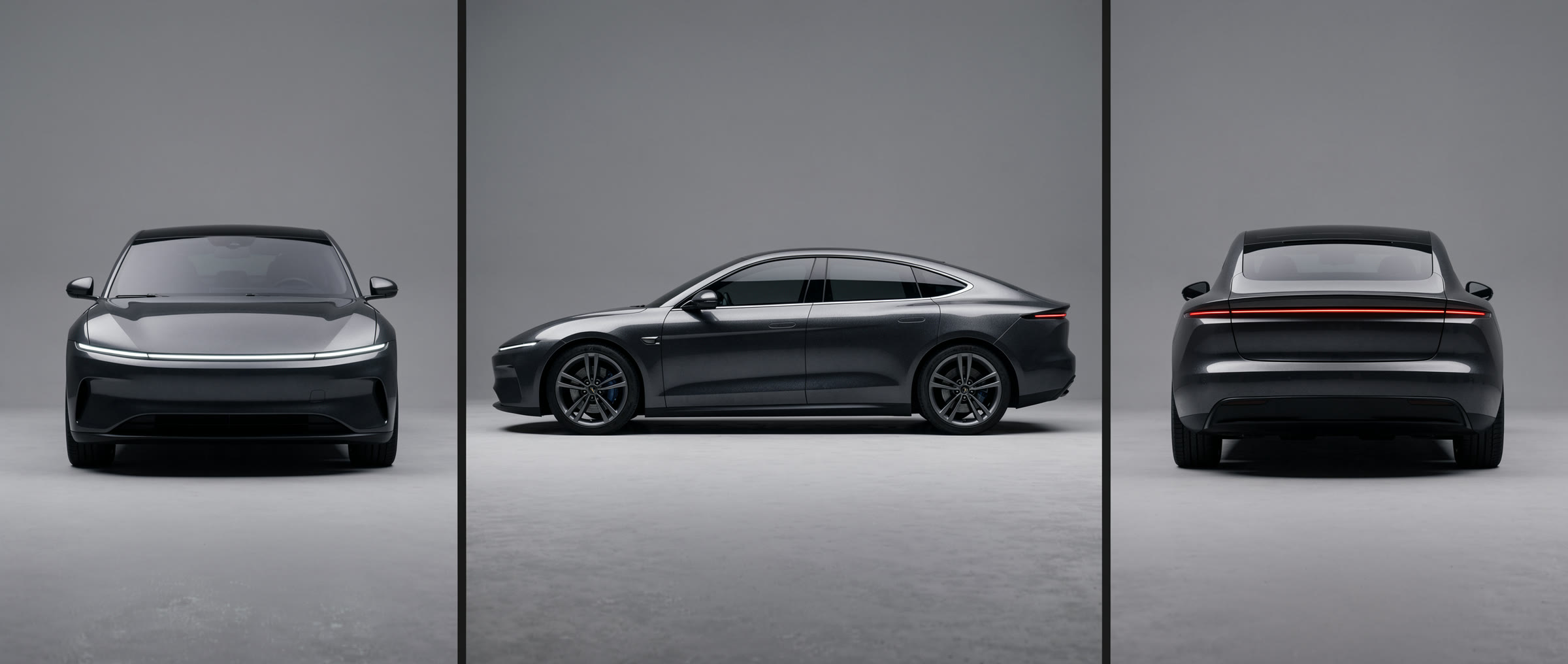
Use @Image 1 as the first frame. The real graphite ORAGE electric grand tourer from @Image 1 and @Image 2 stands on the wet floor of a dark basalt canyon at night as the thunderstorm dies down, then drives out of the canyon onto a wet winding road across the plateau, in five separate shots that copy a premium car commercial exactly — the car pulling away from its resting place, a drone rising over the canyon rim to reveal the tiny car on the winding road far below, a tight side tracking shot along its flank with lightning flashes sliding across the paint, a slow-motion slide to a stop in a fan of spray, and a locked top-down drone view as it drives away into the dark — high-budget feature-film commercial, night, cold teal and steel-blue palette.

Format: exactly 5 separate shots with 4 hard cuts, at exactly 3s, 6s, 9s and 12s; total length 15 seconds. Each shot lasts exactly the seconds given in Timing; at every cut the camera position, shot size and angle change completely; no shot runs longer than its seconds.

Subject: The car — @Image 1 is the first frame and sets the car's exact look, the canyon floor, the light and the colour grade for the whole film; @Image 2 is the car's model sheet: take its exact shape and proportions from every angle — the low four-door fastback silhouette, the long sloping roofline, the wide rear haunches, the sharp shoulder line, the smooth closed nose with the thin full-width white front light bar, the thin full-width red rear light bar, the graphite metallic paint, the dark tinted glass and the 21-inch dark five-twin-spoke wheels; do not take the studio background or the studio light from @Image 2. The front light bar is lit in every shot; the red rear light bar is lit whenever the tail is visible. The paint is wet with rain beads; the lower body and wheel arches carry road spray. No driver visible through the tinted glass, no people, no animals, no other vehicles, no badges, no text.

Action: The car stands still on the wet canyon floor exactly as in @Image 1, its front light bar lit; it pulls away and drives out of the canyon. From the canyon rim a drone reveals it far below on the wet winding road across the dark plateau. A side camera travels with it along its right flank while lightning flashes slide across the paint. In slow motion it slides sideways to a stop on the wet gravel shoulder in a fan of spray. From straight above it drives away diagonally into the dark.

Environment: Night, the tail end of a violent thunderstorm. The canyon floor as in @Image 1: wet cracked black basalt, puddles, scattered rock, a dark faceted basalt wall behind; beyond the canyon mouth a wet two-lane asphalt road winds in long S-curves across a dark steppe plateau of wet grass and dark basalt outcrops toward a jagged mountain ridge; no road signs, no markings except a faint worn centre line, no buildings, no poles. Rain has stopped; low mist lies over the ground and in the folds of the land; the air is full of fine haze. Light: the sky is a dark storm sky with lightning still flickering inside the clouds, far and near, each flash lighting the wet ground and the car's paint with a hard cold white-blue pulse; between flashes a cold steel-blue ambient; the car's own front light bar is a strong practical source that lights the wet ground ahead of it and the haze; everything reflects in the wet surfaces. The colour grade of @Image 1 — dark teal and steel blue, deep blacks, no warm colour anywhere — holds for the whole film.

Lightning: real atmospheric lightning as in @Image 1's world — thin jagged white-blue channels with blinding cores far away over the ridge and inside the clouds, each flash a hard instantaneous white-blue pulse on every wet surface, followed by darkness; never a steady glow, never purple or pink.

Camera: Five setups, one per shot, given in Timing. Real camera physics: a locked-off camera on the canyon floor; a heavy aerial drone with smooth steady motion; a camera car tracking rig; a high-speed camera for slow motion; a locked-off drone looking straight down.

Look: Shot on ARRI Alexa 35 with Cooke Anamorphic/i lenses. Anamorphic character visible in frame: shallow depth of field with soft oval bokeh, horizontal blue-tinged flare streaks only from practical light sources never from the sun, gentle barrel distortion and slight edge softness, wide 2x squeeze feel with compressed vertical perspective. Kodak Vision / 2383 film print emulation: soft contrast, highlights roll off gently and keep detail, natural fine film grain, no digital sharpness.

White balance: cool night balance exactly as in @Image 1, steel-blue base, the light bar and the lightning read as clean cold white, colours muted and natural, room left for grading.

Exposure: very low-key as in @Image 1; highlights never clip — the light bar, the lightning cores and the wet reflections keep detail; shadows deep but with texture in the rock, the asphalt and the grass.

Lighting: the car's front light bar as the main practical source, cold white, lighting the wet ground ahead and the haze; lightning as hard intermittent white-blue pulses from the storm; a cold steel-blue ambient between flashes; the dark basalt and the plateau as near-black masses with wet highlights. The camera moves, light sources stay in place.

Color: dark teal, steel blue and deep black as in @Image 1; the graphite car with cold reflections; the white light bar; the red rear light bar as the only warm accent in the whole film.

Style: Low-key night car commercial at the end of a thunderstorm: cold teal-blue grade, the car lit by its own light bar and by intermittent lightning, long cold reflections on wet paint, wet ground mirroring every light, low mist and haze giving depth, near-black shadows with texture, dark basalt and dark plateau; out-of-focus foreground rock, grass and spray framing a sharp car; subtle chromatic fringing on the brightest lightning edges; weighty, majestic, quiet mood of a feature film.

Texture: real wet basalt with cracks and puddles, real wet asphalt with grit, real wet gravel, real wet steppe grass, real metallic paint with flake and rain beads, real water spray; photographic realism, not CG.

Timing:

00–03s — SHOT 1 of 5, 3 seconds — the car pulls away (first frame @Image 1): Camera: locked off on the canyon floor, low, at headlight height, three-quarter front view exactly as in @Image 1, wide, 35 mm. 00–01s: the frame is @Image 1 — the car standing still on the wet basalt, its front light bar lit, the dark wall behind; a lightning flash far above pulses across the wet ground and the paint, then darkness returns. 01–03s: the car pulls away smoothly toward frame-left, its wheels turning, fine spray lifting off the wet stone, the light bar sweeping its cold light across the puddles and the rock as the car turns; it passes out of the left edge of the frame; the frame ends on the empty wet canyon floor, the red glow of its rear light bar fading on the wet stone. Sound: <soft electric motor hum rising>, <tyres on wet stone>, <distant thunder rumble>. CUT at exactly 3s.

03–06s — SHOT 2 of 5, 3 seconds — drone reveal over the canyon rim: Camera: aerial drone, extreme wide, 24 mm, starting low behind the dark rocky rim of the canyon, rising and pushing forward over it. 03–04s: the frame is filled with the wet dark rock and wind-blown grass of the rim close to the lens, soft and out of focus, blurring past as the drone rises; above it the dark storm sky, lightning flickering inside the clouds over the distant ridge. 04–06s: the drone clears the rim and the dark plateau opens below: the wet road winding in long S-curves across the black land, its wet surface catching each lightning flash as a pale ribbon; on the road, far below and small, the car from @Image 2 drives away from the camera toward the distant ridge, its light bar a small cold point lighting the road ahead of it, its red rear bar a tiny warm point, a faint trail of spray behind it; the drone keeps rising and gliding forward slowly. Sound: <wind over the rim>, <distant thunder>, <far tyre hiss on wet road>. CUT at exactly 6s.

06–09s — SHOT 3 of 5, 3 seconds — side tracking along the flank: Camera: on a camera car travelling exactly alongside the car's right side at the same speed, close, medium close-up, 50 mm, at the height of the door handle, looking straight at the flank at a slight three-quarter rear angle. 06–07s: the frame is filled with the right front wheel arch and the front door of the car from @Image 2 — the dark five-twin-spoke wheel turning, the wet graphite paint with rain beads, the sharp shoulder line running across the door, the right mirror at the top of the frame; behind the car, out of focus, the dark wet road and the black plateau slide past with motion blur. 07–08s: a lightning flash from behind the ridge pulses across the paint as a hard cold white glint that slides along the shoulder line, the dark sky reflected as a long soft band on the paint; fine spray lifts off the tyre; the camera holds the same distance and height, perfectly steady. 08–09s: a second, fainter flash, the glint sliding back along the door; the wheel and door stay sharp, the background streaks black. Sound: <close tyre hiss on wet asphalt>, <fine spray>, <wind rush>, <soft motor hum>, <thunder>. CUT at exactly 9s.

09–12s — SHOT 4 of 5, 3 seconds — slow-motion slide to a stop: Camera: locked off on the wet gravel shoulder, low, at headlight height, wide, 35 mm, three-quarter front view of the car, the dark plateau and the storm sky with lightning behind. High-speed slow motion throughout. 09–10s: the car from @Image 2 enters from frame-right already sliding sideways toward the camera in slow motion, nose turned toward frame-left, the front light bar lit and sweeping its cold light across the camera, all four wheels turned into the slide, a wide fan of wet gravel and water spray lifting off the rear wheels and hanging in the air, each drop catching the light bar as a cold spark. 10–11s: the slide continues in slow motion, the body leaning on its outer wheels, the spray fan rising past the roof and drifting toward the camera; a lightning flash behind the car pulses through the spray and rims the whole silhouette white for an instant. 11–12s: the car settles to a stop in the centre of the frame, slightly rocking on its suspension, the spray drifting down and settling, the light bar burning steady toward the camera. Sound: <gravel and water spray in slow motion, deep and stretched>, <tyres scrubbing on wet gravel>, <motor hum dropping to idle>, <thunder>. CUT at exactly 12s.

12–15s — SHOT 5 of 5, 3 seconds — top-down drive away: Camera: drone locked off directly above the road, looking straight down at 90 degrees, 30 m up, extreme wide, 24 mm, no camera movement. 12–13s: the frame is the wet road and the dark wet grass seen from above, the road running diagonally from the lower left to the upper right, its wet surface reflecting the dark sky; the car from @Image 2 enters from the lower left, seen from directly above, its roof and hood graphite with cold reflections, its light bar throwing a cold pool of light on the road ahead of it, its red rear light bar at the tail. 13–15s: the car drives steadily along the road diagonally toward the upper right, a trail of fine spray behind it; a lightning flash lights the whole plateau from above for an instant and goes dark; the car grows smaller and exits the frame at the upper right; the frame ends on the empty wet road and dark grass from above. Sound: <tyre hiss receding>, <wind>, <distant thunder>, <motor hum fading>.

Audio: No background music. Only <soft electric motor hum>, <tyre hiss on wet asphalt and stone>, <water and gravel spray>, <wind>, <distant thunder>. Preserve the car's exact look from @Image 1 and @Image 2, the lit front light bar, the night storm light with cold lightning pulses and the dark teal-blue grade of @Image 1 across every shot. No subtitles appear on screen.

Negative: No subtitles, captions or on-screen text. No background music. No logos, badges, license plates or readable text. No daylight, no dawn, no sun, no warm orange or golden light, no rain falling, no other cars, no people, no driver visible, no road signs or buildings, no crystal or glowing car body, no purple or pink lightning, no CG look.
Дубли и ошибки
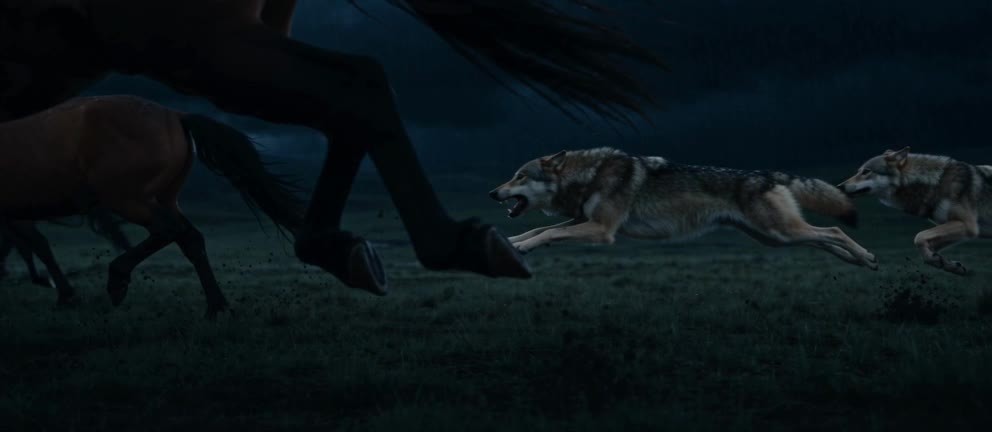 Ошибка
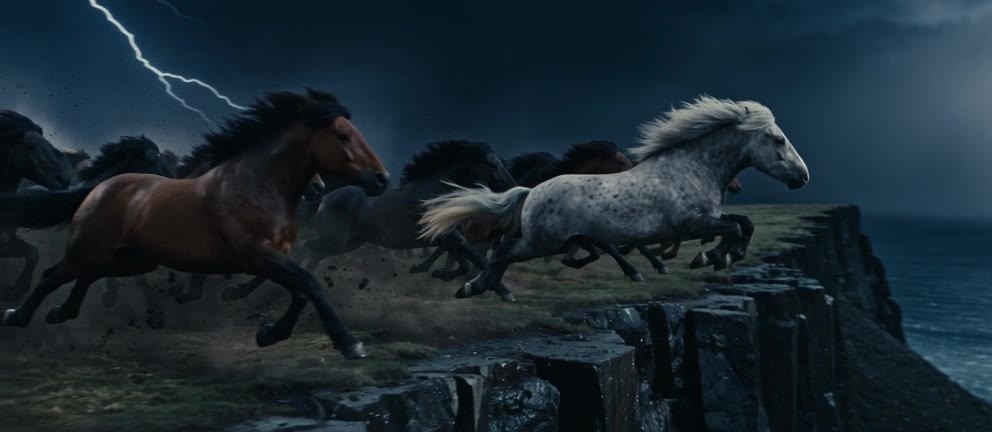 Ошибка
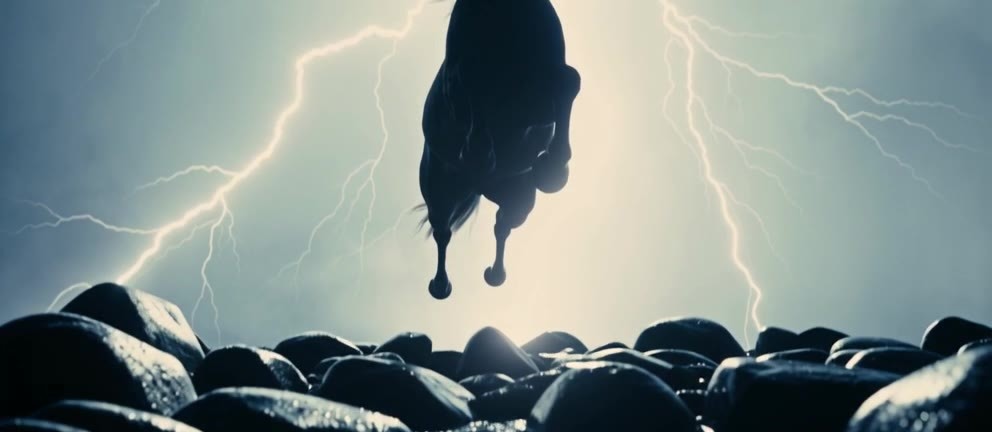 Ошибка
 Ошибка
Что я изменил в промпте
- Неподвижная сценаУбрал из промпта глаголы, провоцирующие движение животных. Вместо «табун несётся» описал статичную композицию: «лошади застыли в позе галопа, словно фотография, преобразованная в 3D».
- Контроль склеекЗадал для каждого шота чёткую структуру: «SHOT N of 9, N seconds» в начале и «CUT at exactly Ns» в конце. В первой версии из восьми склеек корректно сработали только четыре.
- Реалистичные молнииЗафиксировал визуальные характеристики молнии: бело-голубой цвет, тонкий разветвлённый канал, яркое белое ядро и холодное свечение по краям. Розовые и фиолетовые оттенки, неоновые эффекты и радужные цвета исключил через negative prompt.
- Один шот — одна генерацияОтказался от попытки получить все девять шотов в одной 30-секундной генерации. Вместо этого перешёл к генерации каждого шота отдельно, с коротким промптом и подробным описанием визуальных деталей референса.
Готовые материалы апскейлил в Topaz AI, после чего выполнил цветокоррекцию в DaVinci Resolve.
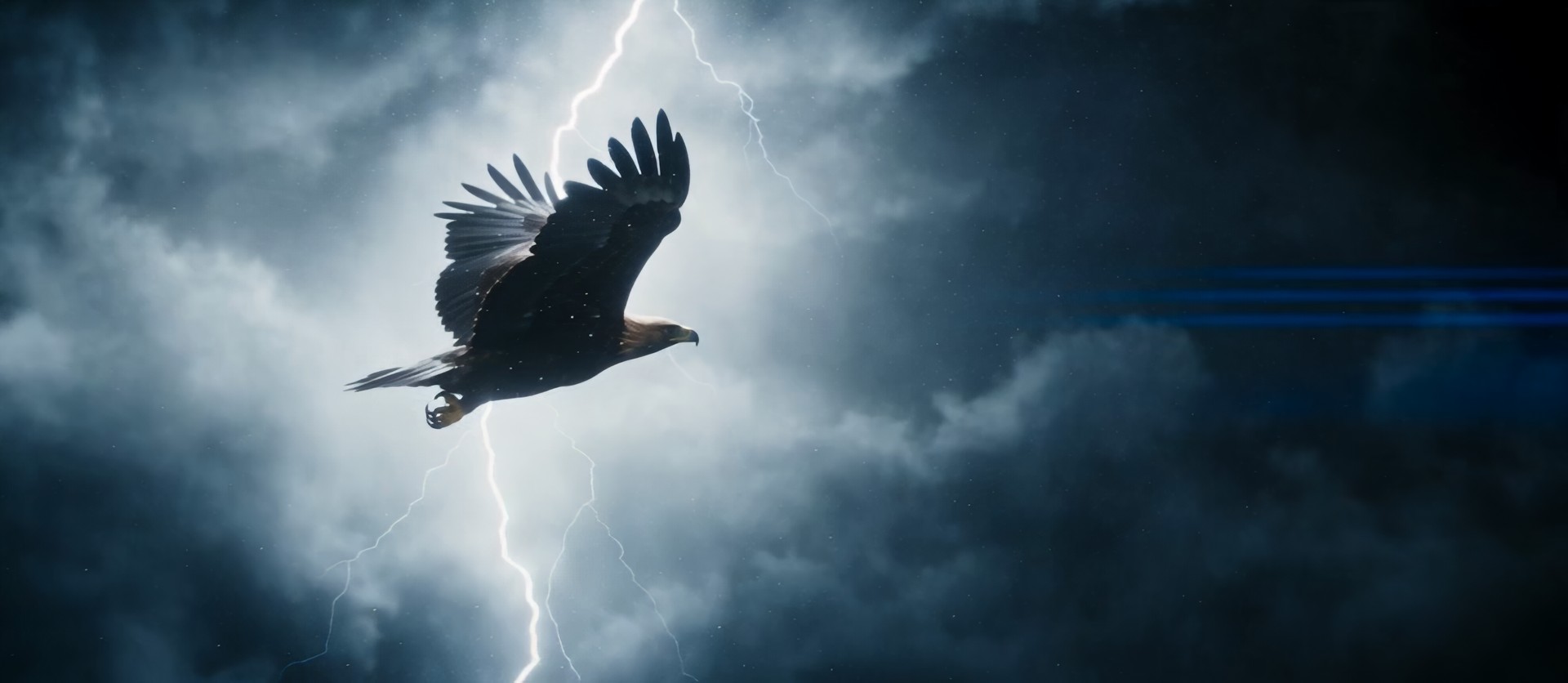
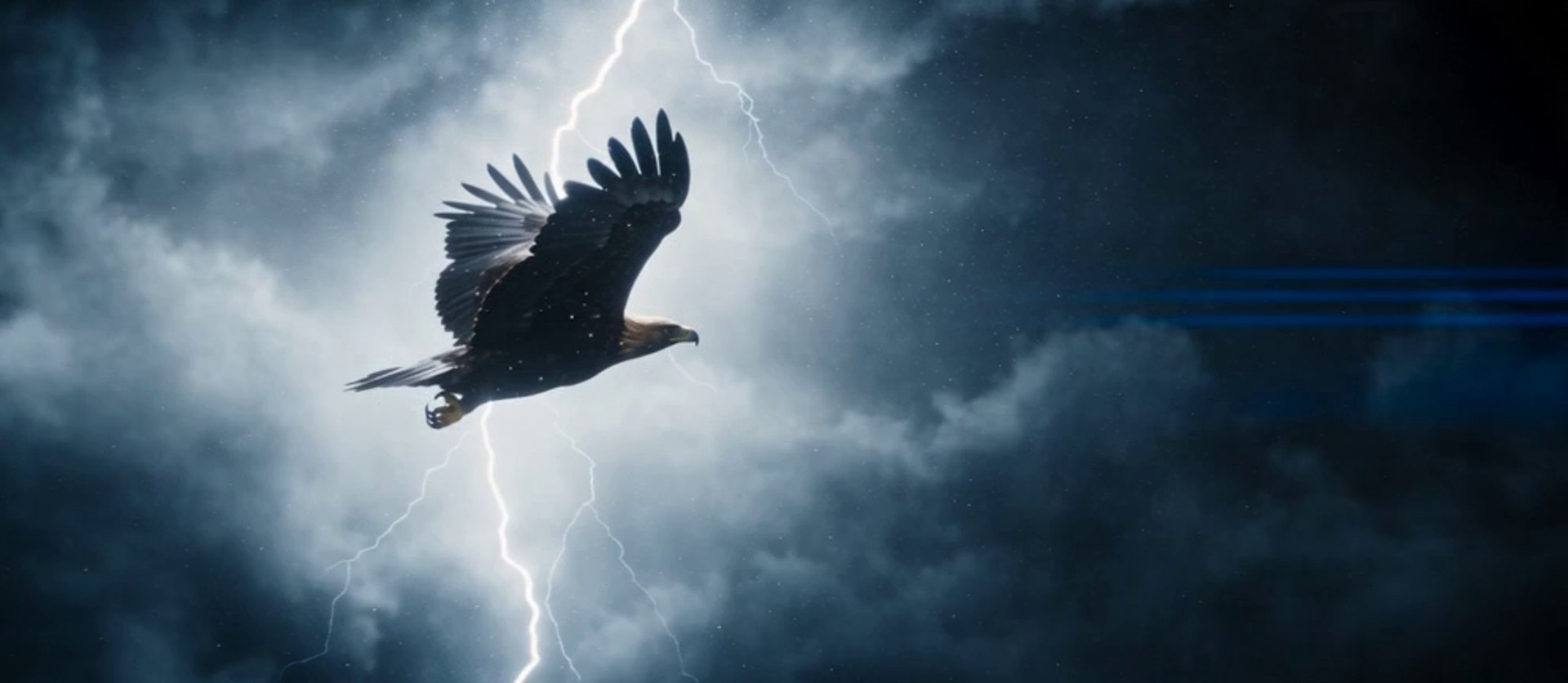
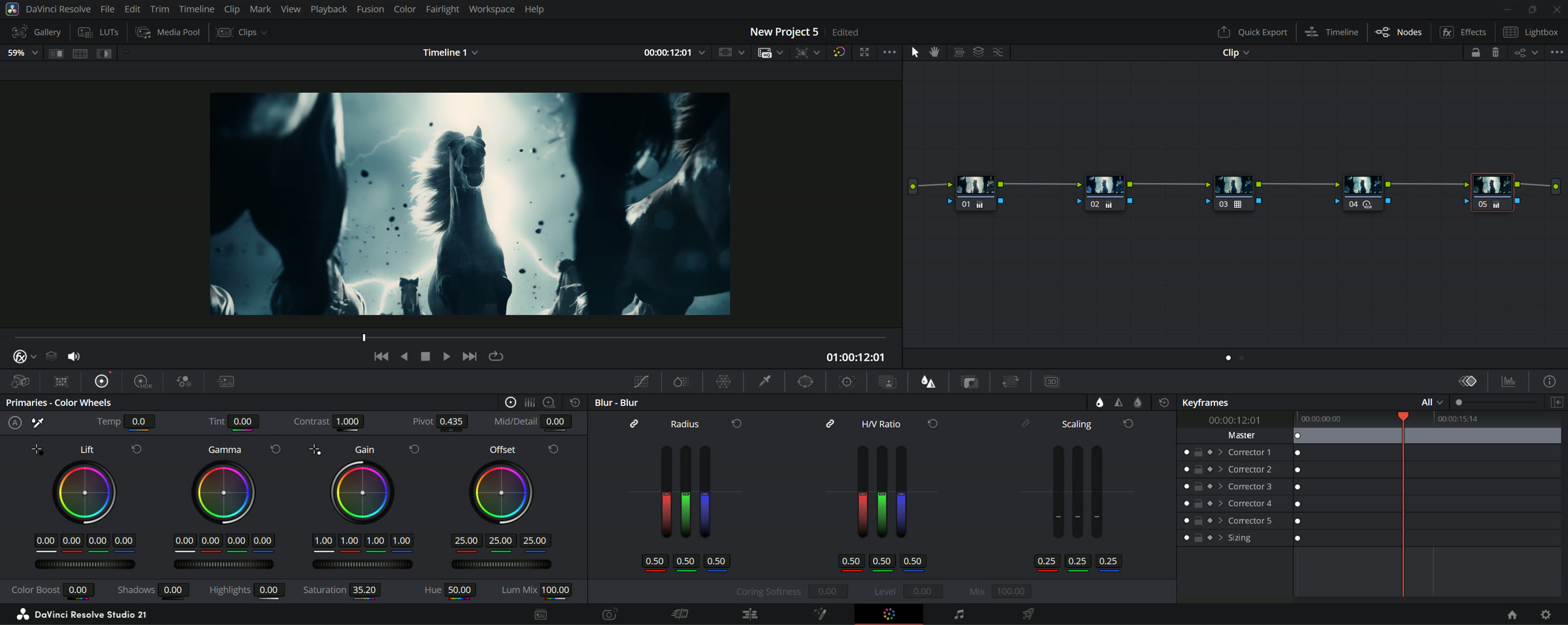
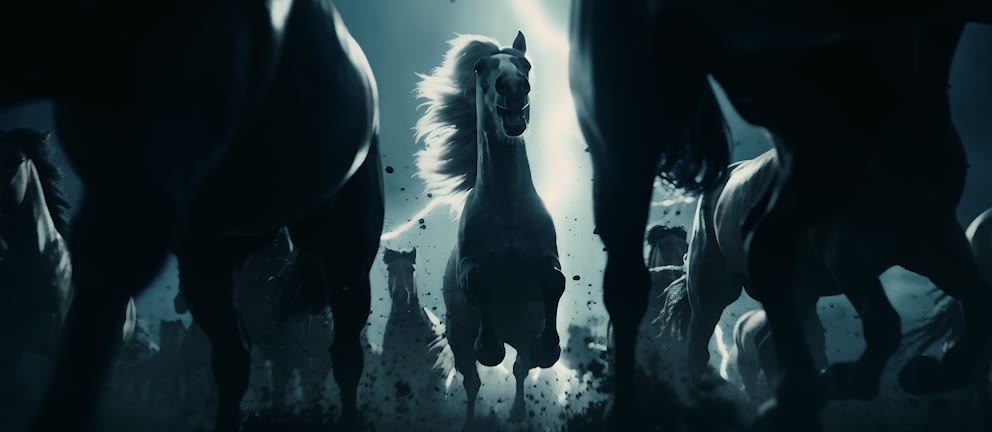
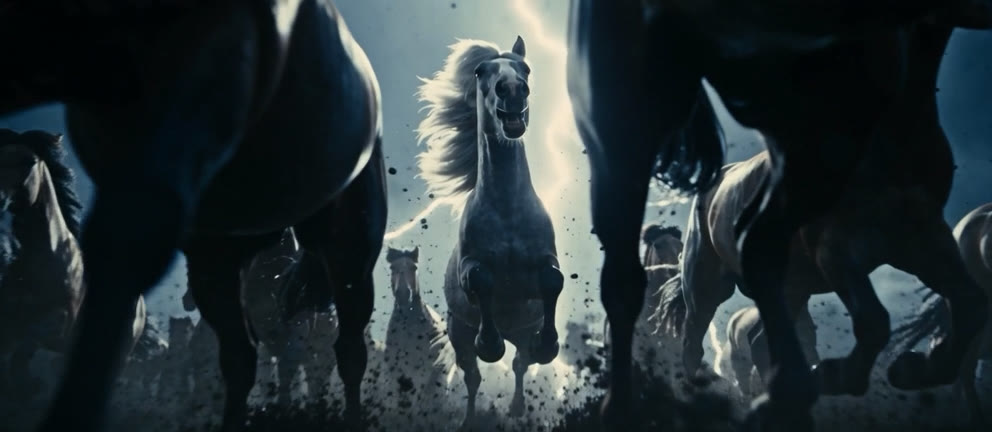
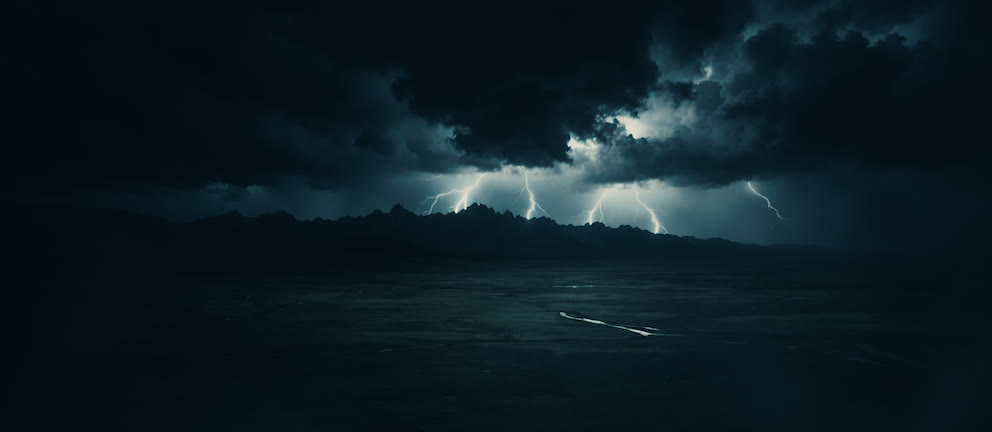
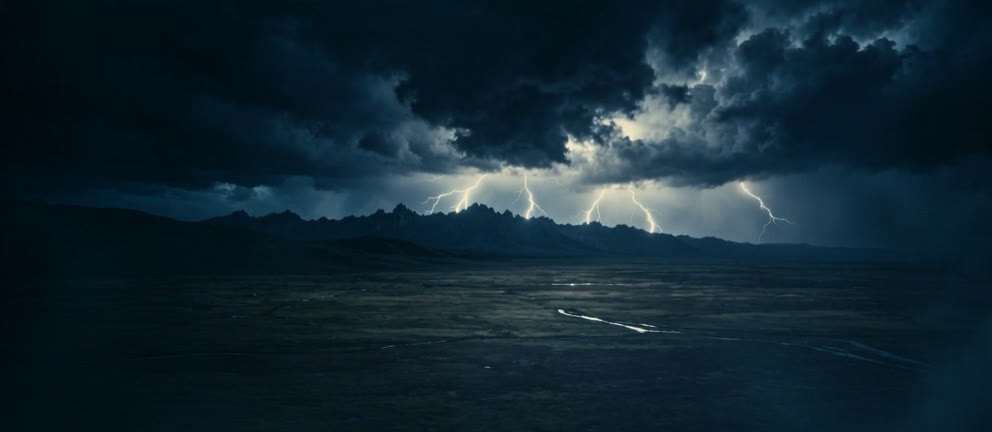
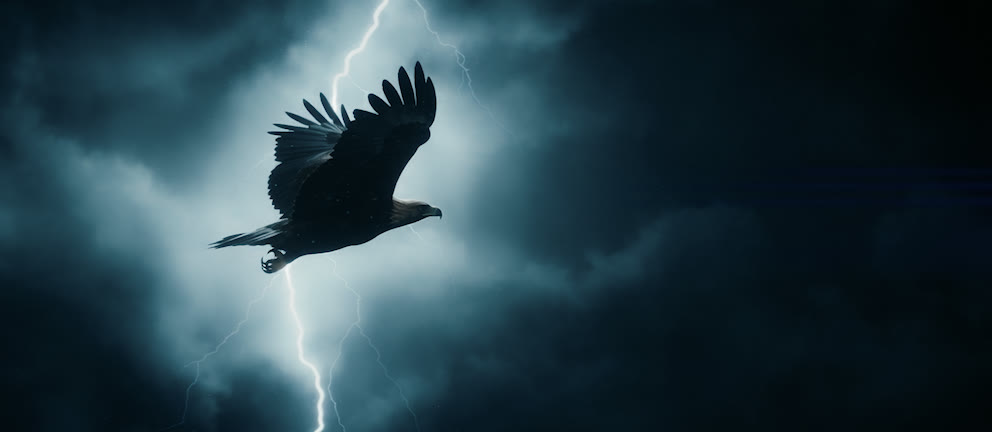
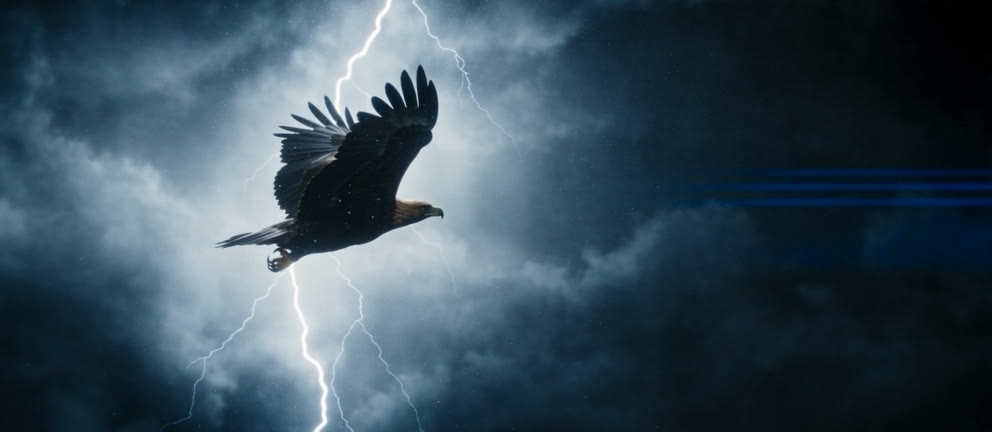
Затем я смонтировал материал в Adobe Premiere Pro, отобрав наиболее удачные шоты.
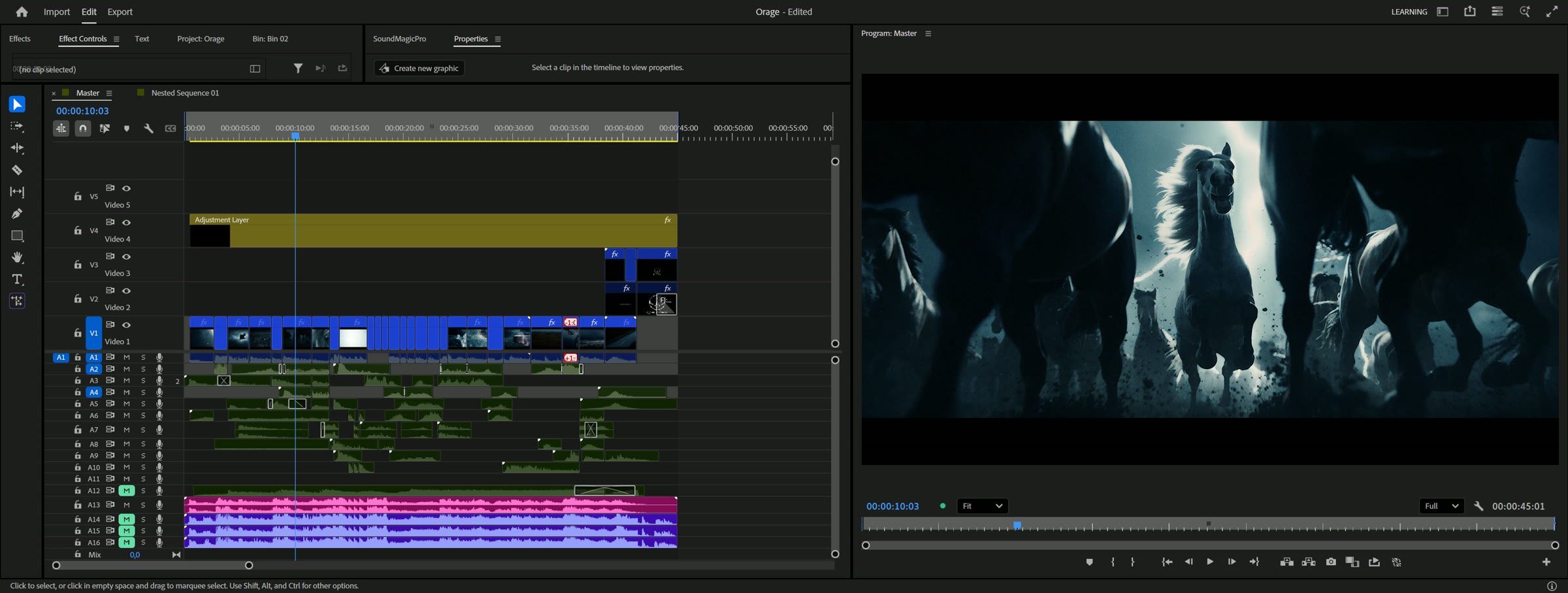
В следующем этапе добавил лёгкую анимацию слогана и вымышленного логотипа, созданного с помощью ChatGPT. Оба элемента подготовил с альфа-каналом для наложения на видео с прозрачным фоном.
После я сгенерировал закадровый голос в ElevenLabs v4.
Текст с тегами
[calm] [quietly] There is a moment… [long pause] [whispers] …when everything stops. [pause] [low voice] [slowly] The hunt. [short pause] The fear. [long pause] [calm] [confident] Born from the lightning. [calm] [confident] Orage. [short pause] [quietly] The world stops for it.
Когда я поделился роликом с другом Мехрубоном Назаровым, он предложил послушать свою новую песню. Во время прослушивания я решил наложить её на видео и понял, что она не просто дополняет ролик, а делает его выразительнее. Я попросил Мехрубона разрешить использовать трек в проекте, и он без колебаний согласился.
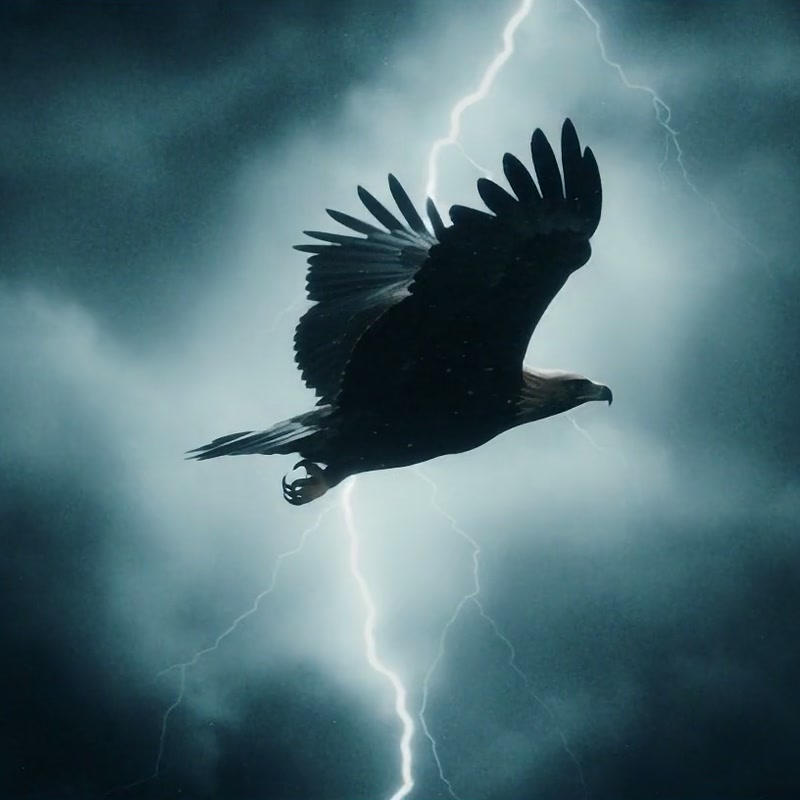
После этого удалил оригинальный звук, сгенерированный вместе с видео, и создал собственный саунд-дизайн. Затем экспортировал аудиоматериал в Avid Pro Tools, где выполнил дальнейшую обработку: эквализацию, компрессию и другие этапы сведения.